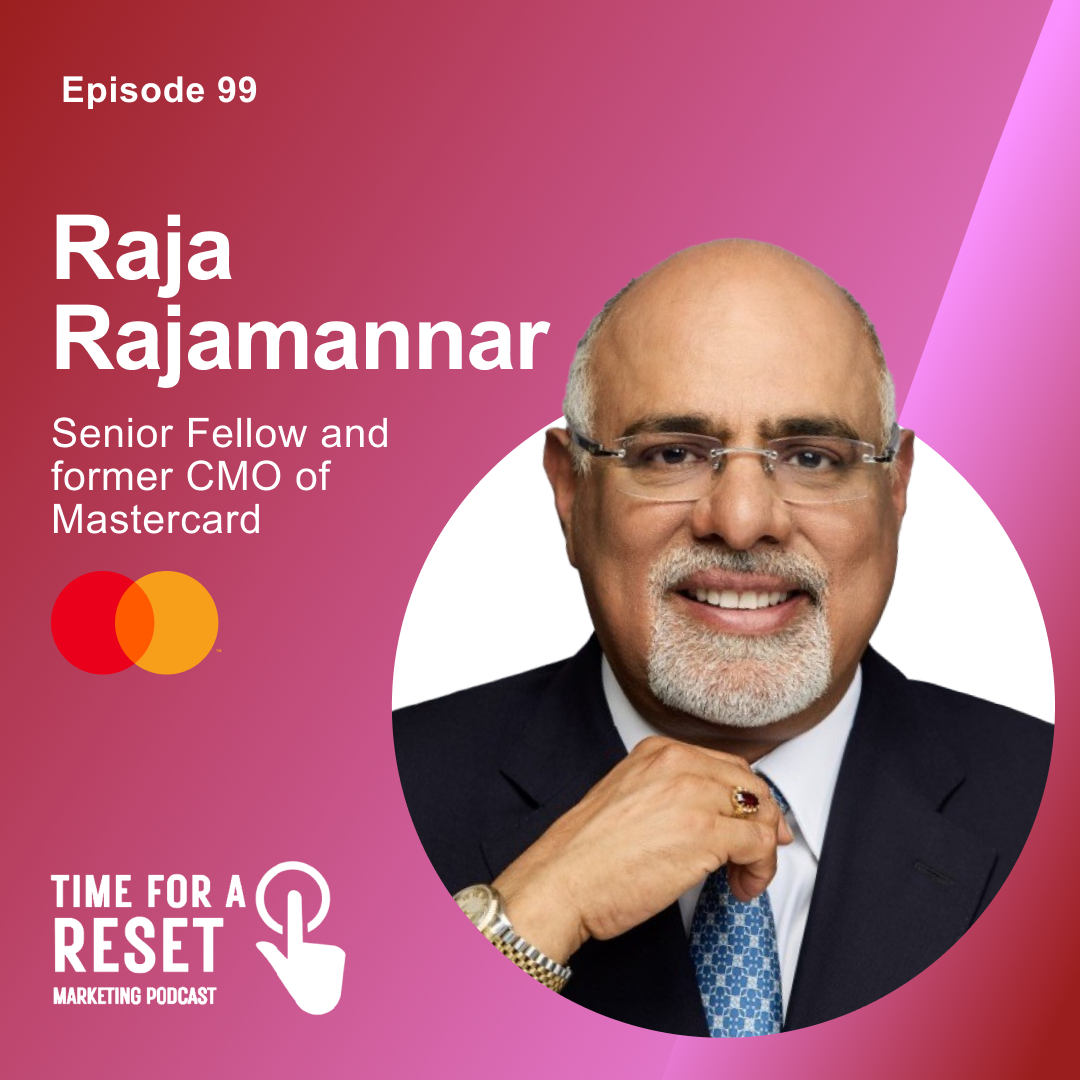
Raja Rajamannar – 00:00:01: The single biggest reason why marketers have lost their level of influence is because, number one, they did not understand the business dynamics. They did not put any effort to learn the business completely in a way that the CFO and CEO understand and to connect the dots between marketing investments and business outcomes in a credible fashion. And CEOs have lost patience. In fact, there was a study which was done about seven years back. The study said that an overwhelming 80% plus majority of CEOs say that they have zero confidence, zero confidence in their CMOs and in their marketing teams to drive sustained profitable growth.
Nick King – 00:00:39: Welcome to Time for Reset, the marketing podcast that gets behind the thinking of the industry’s sharpest leaders shaping the world’s most iconic brands. We ask the big questions. What does it take to drive real change? How do you stay ahead when the rules keep evolving? From shifting consumer expectations to marketing’s seat in the boardroom, every episode dives into what’s working, what’s not, and what’s next. Expect smart conversations, real-world insights, and a bold perspective on modern marketing leadership. Let’s hit reset and turn strategy into action. Now into the conversation.
Fiona Davis – 00:01:13: We have the wonderful Raja here from Mastercard. He is a senior fellow at Mastercard and very recently was the CMO at Mastercard for twelve years. He has an incredible background. He is an award-winning author. He’s an award winner across our industry—WFA, ANA, Forbes CMO list. You name it, he’s had the awards. He’s had a very varied career across healthcare; he’s worked at Unilever; he’s worked at Citibank. So a very wide range of backgrounds and different sort of roles in different stages of his career. So welcome, Raja. We’re very excited to have you on the podcast today.
Raja Rajamannar – 00:01:49: Thank you for having me. Really appreciate it, Fiona.
Fiona Davis – 00:01:52: So, Raja, we always start our podcast asking everybody and you in particular. This would be fascinating for me because you’ve worked in the industry for such a long time and had such a varied career that asking the question to you of what would you hit the reset button on in the marketing industry, I’m very interested to hear what you will say.
Raja Rajamannar – 00:02:08: I think it starts about resetting the button on any aspect of marketing within the industry, but my reset will be to the entire field and function of marketing. Marketing as we have been practicing, the theories and concepts, the basis of which we are practicing today, they are more than six decades old. They were formulated by the likes of Dr. Philip Kotler. And at the time, there was no Internet. There was no digital. There was no mobile. There was no social media. There was no artificial intelligence. So one of the things I started seriously asking is, are those theories and frameworks which were suggested six, seven decades back, are they still valid today? Are they like the laws of physics, which don’t change with time and are sort of timeless? But I quickly came to the conclusion, no. They’re not timeless. They actually change quite a lot. They have to be changed. And I started coming up with various hypotheses and putting them into practice at Mastercard to see if my hypothesis is correct or I’m hallucinating. And I came to the conclusion eventually that everything all the way from insights, which is the first step of marketing, all the way to customer retention, customer upsell cross-sell, and everything in between, the entire marketing value chain has to be reset. And the new way of reimagining marketing, what I call quantum marketing, is a subject in the title of my book that I wrote almost four and a half, five years back.
Fiona Davis – 00:03:37: And I was gonna ask you, and you’ve touched on a few of the major themes that are happening in our industry right now, like, not just the introduction of Agentic AI, but the whole way people are consuming content, the use of large language models in how you’re even accessing those customers is changing so much. You’ve stepped into this new role at Mastercard away from your original CMO role there. First of all, what led to that change for you, and how has that changed your focus within Mastercard?
Raja Rajamannar – 00:04:04: So the average lifespan of a CMO in that entire industry is actually less than three years. I have already spent twelve years. And I can keep sitting and occupying that seat forever, but I wanted to do other things as well. And so I had a detailed conversation, discussion with the Mastercard CEO. And, eventually, what I have decided is to leave the role behind as of 01/01/2026 and still be associated with Mastercard as a senior fellow for the next couple of years. But to pursue a whole bunch of things that I always wanted to do. And if I don’t do them today, I’ll be too old to do them tomorrow. So I joined Harvard Business School as an executive fellow. I also simultaneously joined Yale School of Management also as an executive fellow. And the idea is that I’ll be interacting with the professors predominantly to try and reimagine marketing. And based on that, come up with the curriculum with which students are taught in MBA. And I’ll also be doing guest lectures at the executive development programs at both Harvard as well as Yale, and very excited about that part of it. I also have joined a private equity company as a senior adviser, which gives me exposure to a completely different world. And I joined the McLaren team as an advisory board member, and Formula One is a more recent passion for me, and I’m very excited about it. So I joined that. So I’m doing a ton of things that I always wanted to do and feel enriched and fulfilled.
Fiona Davis – 00:05:38: Such a great time to be working with universities on resetting the curriculum, isn’t it, Raja? Because it’s changed so dramatically from when you might have studied marketing back in the day. And, certainly, some of the recent studies that I had done, it’s like half of it’s just not even relevant anymore.
Raja Rajamannar – 00:05:54: So true. I know. I went to my MBA school forty-one years back. So nothing that I started there is really relevant today. Almost all of it is not relevant. So I think the time is ripe for us to really restart. And to your point, we just need to reset how marketing is taught, and I’m very excited about that.
Fiona Davis – 00:06:13: And you have talked a lot about this, and I’ve seen you talk about this in some of the panels of, like, how marketing had lost its influence over time. And, certainly, when you talk about tenure of CMOs of that very short turnaround, you’ve got a very short window to be successful and prove the value of marketing as a growth engine in a business. Right? What do you think the single biggest mistake marketers have made to put themselves into that situation?
Raja Rajamannar – 00:06:35: So I think you’re being very kind when you say that marketers have lost a lot of their influence. I think in many cases, marketing has totally lost its stature, its gravitas, and also its position at the seat of the table of the CEO. Many CMO roles have been eliminated. Many CMOs have been pushed a level lower and no longer reporting to the CEO. And in many other cases, companies are bringing new C-suite executives like chief growth officer, chief revenue officer, chief customer officer. And if you take a step back and say, if I’m a CMO and I don’t look at revenue, I don’t look at customers, I don’t look at growth, then what am I looking at? It’s very stunning how marketing has lost its relevance and significance, unfortunately. And the single biggest reason for that for me is I think marketers classically have come from the creative side of the house, from the right side brain. So about psychology, sociology, design, anthropology, and the art of storytelling, and things like that. They were excellent. Like, in seventies, eighties, that was really riding the wave. But with the advent of Internet, where data has come about in a significant way and technology started playing a real significant role, the classical marketers were caught a little bit like deer caught in headlights. They froze. They didn’t know what to do, and a new breed of marketers started coming called the performance marketers. You do this today. What’s the result tomorrow? It’s such a short-term transactional marketing activity that’s being done, and CFOs and CEOs found that transactional thing very good because they feel that they are exactly able to measure what they’re getting for their marketing investment, and they can turn the dial up or down depending on how the results are. Now I have been on both sides of the house, which is I have been managing P&Ls, and I’ve managed a company like Diners Club, where I had marketers reporting to me. When they would ask my head of marketing, “what exactly did we get for the money we have put?” They give me some fluffy answers like our brand awareness has gone up, our predisposition has gone up, and our preference has gone up, net promoter scores have gone up. The point is these are such a long-tail later-in-time metrics that a CEO or CFO, when their tail is on fire, they want solutions for here and now. So the single biggest reason why marketers have lost their level of influence is because, number one, they did not understand the business dynamics. They did not put any effort to learn the business completely in a way that the CFO and CEO understand and to connect the dots between marketing investments and business outcomes in a credible fashion. And CEOs have lost patience. In fact, there was a study which was done about seven years back, so it’s not that old, and it’s still relevant even today. I believe it is McKinsey, but I can’t correct it if it is not. But the study said that an overwhelming 80% plus majority of CEOs say that they have zero confidence, zero confidence in their CMOs and their marketing teams to drive sustained profitable growth.
Fiona Davis – 00:09:43: Wow. That’s a pretty damning indictment, isn’t it?
Raja Rajamannar – 00:09:47: It is disastrous.
Fiona Davis – 00:09:49: I think it’s really interesting you say that too. In a world where especially when you’re moving more towards particularly GenTech shopping, those types of things that actually having a good brand marketing storyteller is even more important now. But I think the most successful CMOs I’ve seen are the ones who are both fantastic brand storytellers and can speak in terms of data and outcomes. And when you combine those, incredibly powerful. But when you’re only talking about one side of marketing, you’ve got one arm tied behind your back effectively. So it’s so interesting because more and more, what we’re starting to see now is more of that creative storytelling brand marketing starts to come back in the fold again because in a world of AI and mass-produced content creative, where’s the differentiation gonna come in again? It’s gonna be with the creative storytelling. Right? So it’s a fast and very big cycle we’ve got.
Raja Rajamannar – 00:10:40: Cycle that comes back. Exactly.
Fiona Davis – 00:10:43: So that being said then, what are the capabilities that separate a really good strategic marketer from a tactical one? Because you talked a lot about performance marketing there, which works for a time. And there’s a lot of people that have invested heavily in performance marketing that don’t really understand that long-term brand implications until it’s too late. So, yeah, what would you say are the ones that stand out for you as capabilities for a real strategic marketer?
Raja Rajamannar – 00:11:09: So firstly, the best marketers that I have seen, they are general managers. They’re not marketing specialists. They are general managers who understand how their business works. They’re business managers, first and foremost, with their deep expertise of marketing, but they are not just marketing experts, number one. Number two, they have incredible conviction and communication skills. Conviction that some abstract ideas, though, may not be quantifiable at that moment in time, if their intuition, gut feel, experience, and the appreciation tells them that this is going to work, they need to be convinced about it and not be easily moved around. They cannot be backing off. If they think it is something really good, they should have the spine to stand up and say, “this is going to work, and I’ve gotta stick my neck out,” and to communicate that effectively in a language that the CFO and the CEO understand. The CMO today is the ultimate connector. So if you look at marketing, it is at the confluence of so many functions. The marketing has become very tech-driven. So if you don’t understand technology, you are a bad marketer, and you should be able to speak the language of your CTO or CIO and be able to effectively partner with them. They will just be dismissive of you if you don’t know about technology. They don’t have time and patience for you. They can easily spin some mumbo jumbo and you are lost and then they just move on and then you are left behind. So you need to know technology. Marketing has been data intense and data driven. Now it is even more data intense than ever before. With everything around us getting connected, we are gathering so much of information and so much of data. How do you make sense out of it, and how do you put it to good use in a responsible way? So you need to have a quantitative mindset. So if you don’t understand data, you’re gone. Number three, you need to understand finance because your CFO can be your biggest pain or your biggest ally. And I found that my CFO has always been my best buddy because we speak the same language, and she understands my situation, and I understand theirs situation, and we are empathetic, and then we work together as a team. Like, for example, three, four years back, I remember I took my CFO, and we did a joint session on the center stage at Cannes Lions. And I wanted to demonstrate that CFO, CMO partnership and how critical it is. So I worked on my best buddy in the company is my CFO, Sachin. You need to be a real leader, which means when you are in a meeting, when you are at the CEO’s table, don’t just be a functional specialist who talks about your function, but talk about the business. Participate, ask questions, be a full-fledged person, holistic person, business person, and also be an advocate of talent and a developer of talent. Because you can’t do everything yourself. In my days, forty-one years back when I graduated from my MBA, marketing was a top function. The best students, the toppers, as we used to call the valedictorians as they call it in the US, they would all go to marketing because that seemed to be creative. It’s very pragmatic and lot of very glamorous. You travel a lot. You meet interesting people. It’s an exciting field. Right? Today, marketing is one of the lowest desired functions in MBA schools or in colleges. It is ranking only above two functions: accounting and nursing.
Fiona Davis – 00:14:23: Wow. That’s a big indictment as well, isn’t it?
Raja Rajamannar – 00:14:26: That’s how low we have stooped down to as a function. That’s unfortunate. We have really slipped. So the key thing is, today, if you want to get the best marketing talent, we want people who think with right brain, left brain, general managers, top talent. Those people don’t want to come into marketing. They want to go and start a company in Silicon Valley or somewhere, or they want to join an investment bank and mint boatloads of money, or they want to be in consulting because of the variety and the scope that they have got. Nobody wants to come into marketing. Therefore, how do you actually attract the right talent? And because they are not coming fully prepared, because what is being taught in colleges is so obsolete, how do you really train them, develop them, and help them grow and realize their career dreams and aspirations? And during my days, again, I would say, if you got promoted in three years, you considered yourself to be a fast raiser. Today, eighteen months and people say, “how come I’m not yet promoted?”
Fiona Davis – 00:15:20: Yeah. I was gonna say the expectation is a lot shorter than that now.
Raja Rajamannar – 00:15:23: Exactly. I want things to happen in a hurry. What we used to actually say at one point at Citibank when I was there, they said year one is learning. Year two, you’re actually beginning to make the changes that are needed. Year three, you’re performing extremely well. Year four is when you see whether it was a flash in the pan or it is a consistent thing. So, typically, four years is where you stay in a given stint. So the new generation of folks, four years is like a lifetime. I’m not gonna stay that long.
Fiona Davis – 00:15:51: Six months of attempting to be onboarded and performing.
Raja Rajamannar – 00:15:55: So how do you keep such folks engaged, inspired, motivated, and continuing to grow? So you need to be a real people leader in that sense. So the combination of all this is what is Leonardo da Vinci.
Fiona Davis – 00:16:07: I was gonna say as well, one that we see a lot more now is you gotta be an operations specialist as well because so much of the actual marketing operations spans the layers of every part of the organization. So you’re dealing with sales systems, salespeople, and process, and then you’re dealing with the finance team, the billing organization. There’s a whole range of different touch points, the technology team. And if you don’t understand how they all fit together and stitch together, the handoffs are a nightmare. You’re redoing work. Things are slow, all of those good things. And I think to your point, Raja, about the capabilities, we’re starting to see a real trend now that people are moving across into marketing that have already been working in other roles and move into different areas of marketing as a result of having exposure to the marketing team and realizing it’s actually quite an interesting job. But not necessarily it wouldn’t have been their first choice at university, but, you know, might move over from a sales position or from an operations job, a media practitioner or whatever. It’s a little bit more fluid now than what it was, you know? I don’t know too many people that work in marketing today that went to university and did a marketing degree.
Raja Rajamannar – 00:17:16: True. That’s absolutely true. And in fact, there are some companies—and I don’t know how it is with Unilever these days—when I was working with them, we used to have a rotation program. They call it job rotation. So you start in sales, then you go into marketing. And marketing had all the four Ps of marketing, not just one P of marketing. Then you go and spend time with a business as a finance person, then you become a business leader, and that it keeps going up. But by the time you reached decision-maker level, like a CMO equivalent, you are so well rounded. And people had stints in R&D as well across the board. So I think that kind of a philosophy is more valid today than it ever was.
Fiona Davis – 00:17:57: Than it ever was. Yeah. Just changing tact slightly, I know that we sort of touched a little bit about AI at the start. Everyone is—you can’t do an interview today without talking about it. With the impact on marketing for AI is that everyone now has access to the same tools. Things are rapidly developing so quickly that what was a differentiator six months ago is now table stakes. If technology is no longer the differentiator in marketing, what is?
Raja Rajamannar – 00:18:22: This is such a great question and a great point. What will happen is technologies—AI is, of course, one of the biggest breakthrough technologies that we have—but technology in general, it levels the playing field. It’s the biggest leveler of competitive field. And when that happens, small companies, large companies, they’re exactly on in the same boat or at the same race with the same capabilities to go. So scale is not going to be a gigantic advantage. Actually, it might be sometimes a disadvantage because your speed of changes are slower and so on. In that situation, the single biggest differentiator is gonna be marketing. Your creativity, your human connection, your ability to curate experiences and immersive way to engage consumers and influence their choices and preferences towards your brand, I think it’s going to be humongous. And so I’ll say innovation and creativity-driven marketing. And to your earlier point, now this is gonna be the renaissance of marketing all over again. This is the golden era that we are at the verge of as far as marketing is concerned. And companies will realize it very quickly because right now, every CEO is struggling to have that growth algorithm, and marketing can be the best enabler and driver of that growth algorithm, a creator of that growth algorithm. Right? And people might argue, “hey, with Agentic coming in, does emotion even matter?” because everything is decision-driven by the AI on behalf of the customer. My answer is absolutely emotion is even more critical now than ever before.
Fiona Davis – 00:19:53: Yeah. Absolutely. I agree with you because a machine is not buying. At the end of that transaction, it’s still a person. And if they don’t wanna buy your product, they won’t.
Raja Rajamannar – 00:20:02: That’s true.
Fiona Davis – 00:20:02: Well, I was gonna ask you actually about that. You talk about growth as your tenure at Mastercard was one of the fastest growing brands globally, bar none, in that period. What did you do differently to make marketing that growth engine and not seen as, like, a cost center or just a creative function? What was the changes that you made there to really push marketing to be that growth engine?
Raja Rajamannar – 00:20:25: See, there were a handful of things we learned along the way, and I was coming up with a hypothesis and testing it on Mastercard. So we were trying to eat our own dog food to see if it’s gonna be successful or not. And by and large, we had really redefined how marketing was done at Mastercard completely. To begin with, I started questioning about how we were communicating with consumers. It was essentially advertising, and Priceless is a brilliant platform that has been there. And if you tell somebody that Priceless is not working or it’s not working as good, you’ll be shocked because there was so much of passion about that. So I looked at all the data, Priceless stopped doing things for the company. It was not making any more difference at the time. So I said, look, Priceless as a property is unique to Mastercard, so I have to retain it, but I have to reinvent it, reimagine it. So from Priceless being an advertising platform, we moved away to making Priceless a holistic experiential marketing platform. As opposed to spot and celebrate priceless moments in life, what we said is let’s create priceless moments in people’s lives. So to do this, I needed money because experiences are difficult to curate. First and foremost, I said, let’s reduce our advertising budget by 70% and move that money to experiences. Now people had a heart attack. But the key thing is, I said, okay. Let’s see what happens. Let’s do it for one quarter. If it comes down, we’ll figure it out how to do it. But then my hypothesis were fairly well validated even before we did on this particular thing. And sure enough, it didn’t make any dent, but on the other hand, it’s now accelerating my momentum. So we moved. We reduced advertising. We needed some level of advertising for sure, but not so much. So we cut down 70%, then moved into experiences. Then we went into what we call as multisensory marketing. So instead of marketing to people through two senses, which is a sense of sight and sound, is there any way we can make all their senses be in it? And, again, immersive experiences, it all comes back to that. So we started creating, for example, festivals. We started creating, like, carnivals. We started creating restaurants. We have 11 restaurants around the world at this point in time, and a couple of them are Michelin-starred restaurants now. So for the price of a billboard, you’re able to run a full restaurant.
Fiona Davis – 00:22:41: Yeah. That is pretty impactful, isn’t it?
Raja Rajamannar – 00:22:44: Right. And that was eye-opening because a restaurant gives you revenue, which offsets your expense. So while a restaurant might take 50 times more than a billboard, because you’re earning a lot of your revenues back, if you run the restaurant in a good way, then for the price of a billboard, you’re actually able to engage consumers at an unbelievable level of depth, and it works brilliantly. So we did those kind of things. Started leveraging behavioral economics quite a lot, neuromarketing quite a lot, color psychology. So we started getting into areas which were a little bit at the fringes. The color psychology was very much at the fringe. But when I looked at that and I said, why are we not leveraging it? Because color has got such a deep impact on the emotions and feelings of a consumer. We just have a logo red and yellow. Okay? But then beyond that, other than the fact that it’s been there for sixty, seventy years, there was no science behind it. So we started studying the effect of different colors and shades of colors on human emotion and, likewise, in the shapes. So for example, I’ll just give you this tangible thing. When I looked at Mastercard logo, which is a visual representation of the company, we had two circles, red and yellow. The overlapping area is orange, and through that was “Mastercard” written. When we did some research, it said that this logo is aged, it looks tired, it’s obsolete, it doesn’t keep up with its times. “It’s my grandfather’s brand.” Okay. Everything was negative about it. Right? There was nothing that—and it was seen to be not aspirational. Credit card is an aspirational product for most of the developing countries, and this was not an aspirational look and feel for my brand. So what it did is okay. We cannot let go of the two circles that are overlapping in red and yellow color because recognition is so high. How do we then change things around? So we started playing with the shades of the red and yellow and the orange. With marginal changes, suddenly, they say, “oh, this looks very contemporary. This looks very cool. This looks very youthful. This looks very aspirational.” Romans used to do something in their architecture. It’s called the golden ratio. When you look at the overlap of the two circles, you can have a lot of overlap or very little overlap—which is the right one? So we went to golden ratio. Immediately, they started saying, “your logo looks beautiful.” Then we started understanding how the brain works. The prefrontal cortex, which is at the front of the brain, processes words. Visuals are processed by a different part of the brain, which is more on the back. When my logo comes with a word and with the logo, the brain is confused. It ignores it. So we dropped our name altogether from our logo, and it has just become a symbol brand. Now just imagine the conversation when I walked into my CEO’s office and told him, “hey, I got a bright idea. We are going to drop our name from our logo.” He looked at me like I had three heads, and I won’t blame him. But God bless him. He’s a marketer himself, and I worked with him for a number of years, and we have a great trusted relationship and lot of credibility. So I said, “Raja, seems to be a risky move, but if you are convinced, go ahead.” And we both actually went and pitched it to the board of directors because we had to get their approval. That was done, and then we launched it. Now 84% of all people in the world recognize the Mastercard logo, though there is no name Mastercard in it. So the entire game plan has been changed. We became intensely data-driven, intensely, I would say, science-backed—science as in neurology, sociology, behavioral economics, color psychology, the science of anonymity. So it was a fascinating journey, and I feel very good that when I joined the company we had Mastercard ranked at number 87 in amongst the top 100 most valuable brands. And by the time I left it, we were at number 12. So that’s a very steep progression, and we were, for most of those years, one of the top 20 fastest growing brands. For a few years, we were even their fastest growing brand. We have become the world’s largest audio brand and the world’s number one audio brand for six years in a row. So all these are really very validating to us that Quantum Marketing—which is basically what I call the collection of all the cutting-edge strategies, and that’s what my book is all about. That’s why it sort of came about, and I feel very grateful that that book has become a Wall Street Journal best seller, and it’s published in 14 languages and being taught at more than 300 universities around the world.
Fiona Davis – 00:27:03: Yeah. Absolutely. I was actually, I was gonna ask you, you’ve had a pretty extraordinary run, not just at Mastercard, but generally in your career. Was there a moment or moments where your philosophy on marketing fundamentally changed? Any moments during your career where you’ve went, “oh, that’s changed my perspective on marketing?”
Raja Rajamannar – 00:27:21: I think there have been multiple such events, but I’ll just focus on one. So when I started my career out of MBA, I joined as a founder flunky of a paint manufacturing company—as a founder flunky of its marketing department. They didn’t have a marketing department. So I joined as a junior boss guy. I was the coffee boy as well as the strategist. And I had two people who were super specialists in sales as my bosses. And because I was a valedictorian from my college, I had a free run. They said, “oh, this guy knows what he’s doing. Go and do whatever he want.” And I created some campaigns which are award-winning and all that stuff at that time, and I was rated very early on as the best marketer in the country. At that time, I said, “wow.” So all this goes to your head. And somewhere you don’t realize, but you have started thinking no end of yourself. At that time, after three years, I joined Unilever because Unilever was a great company, and I admired it, and they also gave accommodation. So the previous company in a place like Bombay, I used to stay as a paying guest in somebody’s home. And Unilever said you can have your own apartment. I said, “my god, this is it.” So on that basis, I went to join Unilever. But guess the rude shock I had when the head of marketing for India for Unilever said, “Raja, we are posting you to Delhi, New Delhi.” I said, “for what?” He said, “you’re gonna be looking after sales.” I said, “no. I didn’t sign up for sales. I’m a marketing guy, and I’m a successful marketing guy. Why the hell will I join sales?” And he smiled. He says, “we need to bring you to the ground, but trust me, go and do it.” I went there. I hated the first two months. It is torture. It’s a tough job. And in India, in those days, you had to go shop to shop and sell. There were not, like, departmental store chains. Here, you walk as a salesman. You had a journey cycle, 40 shops every single day, day in and day out, six days a week. It was torturous. The weather was hot, and it was a horrible life. You are tonight in this place, the next day, next city, next day, next city, next town, village. And then suddenly, the moment came. I said, “my god, these guys are leading such a tough life.” But guess what? If these guys are not successful, all your campaigns that you create, all the products that you come up with, they’re totally useless. They mean nothing at all. I would say that was the moment of a real realization that marketing is not a be-all end-all, but marketing is just an enabling function. You need sales. You need technology. You need research and development. You need factories to produce at very cheap prices. I think that was the single biggest moment for me. I said, “okay, I will not be a marketing specialist, but I’ll be somebody who understands marketing deeply, but I’ll try to learn about other functions and be respectful of them.”
Fiona Davis – 00:30:10: Yeah. I was gonna say, I think anybody who has not worked in a sales position in their career should give it a run at some point and realize how difficult that job really is because it definitely gives you an appreciation of all of the tools that marketing can provide to help a salesperson be successful as well.
Raja Rajamannar – 00:30:26: So true. And what I feel grateful is those people I worked with—some of them have passed, some of them are still there—whenever I go to New Delhi, we still have a reunion, and we keep in touch. They taught me the importance of sales, and the real marketing warfare happens on the streets and in the shops. So that’s real moments of truth out there.
Fiona Davis – 00:30:49: So just coming back to our original question, how you’ve described what the reset for the industry looks like—if it unfolds the way you envision, what does the marketing function look like five years from now?
Raja Rajamannar – 00:31:01: So I think marketing function, first, will be the key driver and the lead function like it was forty-one years back. You define the agenda for the company and you drive that agenda in collaboration with various other functions. Number one, marketing will continue to be the single biggest owner or driver of P&L. They will be truly of consequence to the CEO and to the board. Their gravitas, their stature will be at a different level. Marketing as a function will become a multi-specialty discipline as opposed to a linear unidimensional function. So it’ll have profound technology expertise residing within marketing, profound data analytics capabilities within marketing. Of course, all the sciences like behavioral science, psychology, sociology, anthropology—all these will reside with marketing. Risk management will be in marketing. Because marketing, you have got the brand risk, brand disintermediation risk, data risk, competitive risk, product obsolescence risk. You have so many types of risks which are there; marketers don’t focus on it as a function. For example, at Mastercard, I moved my CFO—so I had my own CFO when I was the CMO—I moved her to become my head of risk management. So she was defining what are all the risks that marketing has or the company has on account of marketing and how to tackle. I would also say that marketing will become a unified function with PR and communications and in some companies, even with IR.
Fiona Davis – 00:32:32: Well, the crisis management side of it has become so much more important.
Raja Rajamannar – 00:32:36: Totally critical. Right? And, also, I would say that marketing will be coming back to own all the four Ps.
Fiona Davis – 00:32:43: Yeah.
Raja Rajamannar – 00:32:45: So call it wishful thinking. Call it visionary thinking. Whatever it is, I don’t care, but that’s where the future is going to be.
Fiona Davis – 00:32:52: I tend to agree with you on that, though. We’re seeing that unfold in real time now where marketing is really working at the nexus. It’s only really marketing and technology that are seen across every department and having interaction with every department all the time. So, actually, it’s not surprising to hear you say that. I was gonna ask you a sort of more broad question about coming back to the most important attributes of the senior marketer of tomorrow. So that being the case, if that’s what marketing’s gonna look like in five years’ time, what skills do people need to be successful in marketing in the future?
Raja Rajamannar – 00:33:25: I think you need less and less of hard skills and more and more of softer skills. You need to be literally like a Leonardo da Vinci, right, operating both from left brain and right brain with a high level of emotional intelligence, but also societal consciousness. And I’m not talking about it from a woke sense at all. I’m talking about marketers grasping eventually that marketing can be both a force for good and a force for growth. It’s a true force multiplier. That’s number one. Number two, from a marketer’s perspective, they have to be phenomenal leaders. They have to have appreciation enough about various functions, including finance and data and technology and your own business model for the company and so on, enough to ask the right questions, enough to understand the answers and make out whether those answers are spin or substantive. But you’re going to be less of a data specialist, less of an advertising specialist, less of a market research specialist. Probably, you go through those various areas, but my suspicion is things like market research would be completely abdicated to AI. I don’t think humans are anymore required to do market research the way they do it today. It’ll become a very different function because the insights are very critical for you to operate with. But I think a lot of it will be actually going out of the human domain into the machines. Same thing will happen with a lot of designs. And marketers will be more focused on the breakthroughs, the big vision, the innovation, as opposed to the routine advertising production, routine banner ads, routine media planning. All these, I think, will be totally taken over by AI. They’re gonna be literally orchestrators, like a conductor. So he or she may not be an expert at the violin or a piano, but they need to understand and figure out who is going in tune and out of tune and who should come when. And it’s really like you’re a music conductor, and that’s what the future of marketer is going to be. And when you look at that orchestra, it’s not only just marketers. You got data analysts. You got finance people. You got risk management people. You got technologists. All these people, you are orchestrating. You are the centerpiece.
Fiona Davis – 00:33:33: My last question for you, Raja. You’ve worked in this industry for such a long time, but you’re also the kind of person that keeps pushing boundaries. How do you stay fresh? How do you keep evolving when you’re such an experienced marketer yourself? Like, what drives you to keep developing?
Raja Rajamannar – 00:36:08: So my mom grew up in a very conservative family in India. In those days, in the small town that she was in, there were no high schools for girls. And societally, at that time, girls and boys were not allowed to be in a co-education class in high schools. So she had to forcibly give up her school education and stay at home, and she taught herself. And she taught herself so well that when I was in engineering second year and I had tough math problems, I would go to my mom and she would solve it like that. She was super brilliant. She’s my role model and she’s been my inspiration. She would always tell me and my sister when we were growing up—because sometimes I would say, “I don’t want to go to school today”—she would tell me about her story for the ten thousandth time and say, “you don’t know what a gift it is to be having the opportunity to study and to learn.” She said, “I would have given an arm and a leg to be able to go to school. I could not. And you are getting it on a silver platter. Don’t fritter it away.” And I think that conditioning early on throughout my childhood played a very key role in how I thought for the rest of my life. Whenever someone gives me some present, I’m happiest when they give me a book or a pen. I feel it’s a tool for learning for me. I think that stayed as a part of my DNA throughout, and I’m very, very curious. So every weekend, even when I was working full time as a CMO, I would spend at least five, five and a half hours trying to learn something. I would either listen to TED Talks or I would go to some master class or I will read up stuff or I take Coursera courses. Nonstop, I keep doing that. Now my time is more expanded. I spend a lot more time. I read books quite a lot. That’s one part of it. Second thing is I reach out to people and say, “hey, you know what?” Like, for example, I was telling my team member today morning—we both were on a podcast together, and the organizers had produced some visuals of whatever I was speaking in real time. I said, “my god, this is so damn impressive.” So I told her, “Brianna, can you please look into it, learn, and then educate me?” And people are very happy to teach you and to educate you. At the risk, if I don’t understand something, I call up so and so and say, “can you please teach me about this?” And I find that it makes me feel empowered, and I keep myself always at the cutting edge. I subscribe to some very select number—I’ve got an AI agent I created which actually goes through all the web and then gives me the summaries of everything that I need. I am on this constant learning journey, and I think this is the most transformational time in my lifetime. Every day, something exciting is happening, and you cannot just afford to be left behind.
Fiona Davis – 00:39:05: Yeah. As the daughter of a school principal, same. Well, I had that drilled into me from a very young age—of what I kind of feel like if you’re not learning something on a regular basis, your brain starts to atrophy.
Raja Rajamannar – 00:39:17: That’s true. I agree with you.
Fiona Davis – 00:39:18: And it gets harder and harder to learn new things if you stop learning new things. So it’s like a self-fulfilling prophecy, isn’t it?
Raja Rajamannar – 00:39:24: So sure.
Fiona Davis – 00:39:26: Well, Raja, thank you so much for your time today. This has been brilliant. I’m sure all of our listeners will get a lot out of this conversation—some really great insights into what’s changed in marketing over the last forty odd years and what’s to come, which is great. Thank you so much.
Raja Rajamannar – 00:39:39: Thank you so much.
Nick King – 00:39:43: Follow us wherever you get your podcasts. Until next time. Hit the reset button and get change over the line.