Pardeep Duggal – 00:00:01: I think as marketers, we’ve got a real superpower, and that’s our creativity. So I think I really lean into that. But before that, you’ve got to show credibility, and that’s really understanding the commercials, how we make money, the business model, and the levers that marketing can pull.
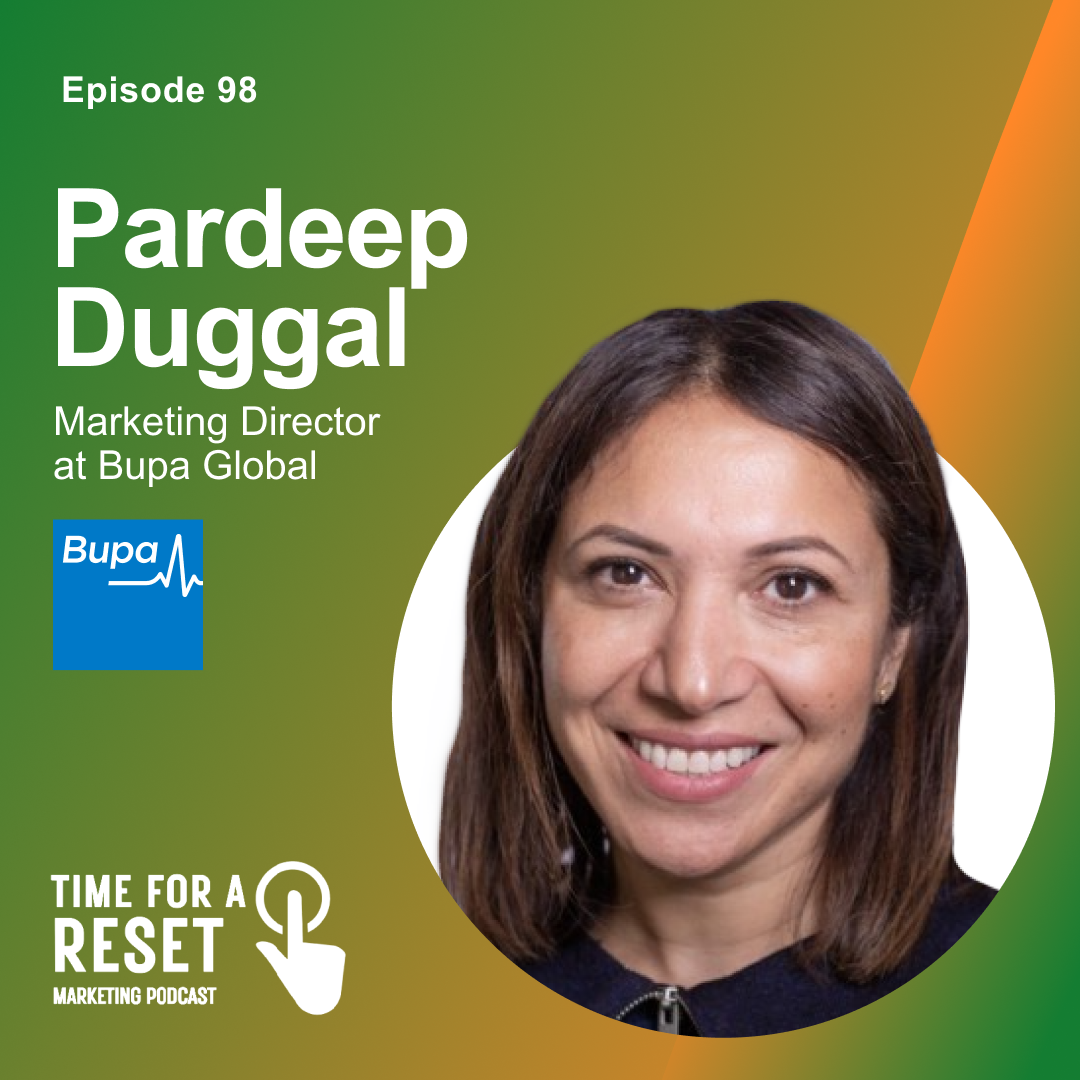
Nick King – 00:00:21: Welcome to Time for Reset, the marketing podcast that gets behind the thinking of the industry’s sharpest leaders shaping the world’s most iconic brands. We ask the big questions. What does it take to drive real change? How do you stay ahead when the rules keep evolving? From shifting consumer expectations to marketing’s seat in the boardroom, every episode dives into what’s working, what’s not, and what’s next. Expect smart conversations, real-world insights, and a bold perspective on modern marketing leadership. Let’s hit reset and turn strategy into action. Now into the conversation. Today, we’re joined by Pardeep Duggal, Marketing and Digital Director of Bupa Global. Pardeep has worked for global organizations across banking, energy, international healthcare, insurance, and retail with a track record of achieving growth through senior roles at E.ON, CVS, Santander, and Barclaycard, as well as high-performing private equity companies. Pardeep, welcome to Time for a Reset.
Pardeep Duggal – 00:01:15: Oh, thanks, Nick. Great to be on. Excellent.
Nick King – 00:01:20: So we always start in the same place, and that is: what would you hit reset on in the marketing industry?
Pardeep Duggal – 00:01:28: For me, it would be that marketing isn’t part of business transformation. For me, marketing transformation is a fundamental component of any business transformation.
Nick King – 00:01:40: And that’s really interesting. And do you know what? That’s the first time that anybody’s said that, and I can see the background of your career. I can see how that sort of started to shape your views. But how have you come to that conclusion and through your experiences? Where’s that sort of thought process started?
Pardeep Duggal – 00:01:56: So, fundamentally, I think marketing is about getting the customer proposition right. So fundamentals of the four Ps is what marketing is about. It’s not just about communications. It’s not just about the messaging that one lands. And with the advent of technology, it’s increasingly about digital ubiquity. So if marketing is about customer and digital, and business transformation is about meeting customer needs and dealing with the rise of digital technology and digital ubiquity and data, then my conclusion is that marketing transformation is absolutely integrated within any business transformation, business strategy, and business goals.
Nick King – 00:02:43: And you’ve led large-scale marketing and digital transformation in big, complex environments. How is it different, I think, in those sort of—I hesitate to use the word legacy, but it feels like the most relevant phrase. Yeah. Those legacy large companies. How is it different, I guess, compared to a smaller business or maybe a local business?
Pardeep Duggal – 00:03:00: Yeah. I think it’s culturally very different. So when I talk to peers or friends who work in an organization that uses new technology or perhaps is in a newer industry, they have slightly different challenges. Whereas the organizations I’ve worked in have been traditionally very heavily regulated, are looking to transform their customer experience, and becoming much more customer-centric. So I think the challenges are more cultural, more nuanced around what does that mean, and identifying how we can transform that customer experience in a way that takes people on a journey. My calling card is always about delivery first. So in any transformation, you deliver something and demonstrate the customer impact, relate that to your business goals, and then you gain further investment. So an example of that would be joining an energy company. Very much the CEO at the time was looking to transform how the organization engaged with its customers and the reputation of the organization. And so for me, it was about showing that our customers were already digitally engaged, showing the data, developing really simple customer experiences and showing their impact on both engagement and cost, and moving that forward then into gaining further investment.
Nick King – 00:04:38: And you talked a little bit about the CEO there, and I’m always interested how businesses get those senior stakeholders involved. And, yeah, depending on the organization, marketing isn’t always seen as that strategic driver. So how do you get that, I guess, the C-suite? And we talk a lot about the fact that marketing needs to move into the boardroom, and sometimes it’s just nowhere. So how have you gone about engaging those stakeholders and bringing them on that journey?
Pardeep Duggal – 00:05:01: Yeah. I think as marketers, we’ve got a real superpower, and that’s our creativity. So I think I really lean into that. But before that, you’ve got to show credibility, and that’s really understanding the commercials, how we make money, the business model, and the levers that marketing can pull. So as you say, growth is around sustainable growth and revenue and understanding that part of things, understanding, certainly, digital transformation, how engagement drives not just NPS, but retention and lifetime value. So for me, the way that I’ve always worked is definitely show up with your credibility in the data and know in digital, for example, how digital data is aligned with business outcomes. So that’s a given. But then I think as marketers, where we’ve got license is really bringing the customer to life in a really theatrical way so you can really show creativity in how you bring that customer experience to life. I’ve done some really interesting things, like I’ve taken some of my CEO’s suite, um, their direct reports to hotel rooms and set those up as a customer’s living room, showing how customers are engaging with our brand in situ over a period of time. So you’re bringing that drama and theater and making customers real—from doing that to actually customer immersion sessions and having customers in the room, and the customer doesn’t know who the representative of the organization is. So they don’t have any hang-ups about sharing their experiences in real life with the C-suite, and that has a real emotional connection. So I think marketers have got loads of room and scope to really be present in the boardroom, but as ourselves and as creative leaders.
Nick King – 00:07:00: No. I love that. I always love it when people engage in the real world. One of my experiences working with a senior marketeer who whatever country we ended up in, we would always go and do a store visit, have a look around, how was the brand, what were customers saying. And she just had this way of going, “this is what it’s really like,” not in a bland presentation. I think anytime you can bring that to life is so valuable. I always think it’s really interesting where teams are trained and get these experiences, and a big part of transformation, ultimately, is people. You’re building high-performance teams. You’re making them change often before you’re making whole business change. What are the capabilities that you’re looking for? And I always think this is interesting. I spend a lot of my time thinking about how the next graduate intake or even non-graduate intake needs to think about things, and I’d love to hear your view on what are those skills that first-job or second-jobbers, but even fifth-jobbers, need to be thinking about to work in your world.
Pardeep Duggal – 00:07:55: Oh, gosh. I’ve just had my two-day off-site with my team, and I started the day with this incredible video. It’s done the rounds from Barack Obama. It’s his LinkedIn video around “you just have to do the work and don’t wait for someone to solve problems.” So delivery is definitely something I think, regardless of where you start your career, is something that you need to gain experience of because I think in any role, you need to deliver and deliver and demonstrate that related to business outcomes. So wherever you are in your career, I’ve always done that. And then I look for three things. So, Nick, it wasn’t until I was over 40 that anybody called me “talent.” So I’m probably not the right person to ask if you’re somebody who’s got a really structured career path because that’s not me. But I think there’s three things that have always stuck with me. So when I was told I was talent, I was told that there were three things. One is you have to have IQ, so the ability and intelligence in order to understand what’s happening, and I think that’s kind of a given. The second is an ability to work hard. I’ve never personally experienced any type of success or achievement without having to work hard for it, and that’s a given. And the third one is the ability to learn, and I think it’s called “learning agility” now is the proper term for it. But for me, actually wanting to grow and develop and wanting to do something more is something that I think is how I see a high-performing team is built. So you have people that won’t have those three facets, and then you work with them on that. And you strive towards goals, and there’s loads of management consultancy books and all of that stuff. My leadership ethos is really simple. So I like to bring in new talent with fresh ideas from different industries, who I marry and match with—and not marry in real terms, but I match with people in the organization, but who have been there a while, know the unspoken ways of getting things done. And you bring those teams together, and that’s where real magic happens because you get this really high-performing team that’s a mix of people that understand the business and people that know how it’s being done in other places, and they’ve each got that learning agility and they go and deliver. That’s been my mantra.
Nick King – 00:10:48: Yeah. I love that. I think too many companies just want a single point of view that resonates through, and maybe they’ll get somebody from their direct competitor, and that’s it. I love the fact you’re bringing in people from different industries. I think it gives such valuable insights.
Pardeep Duggal – 00:11:03: Yeah. I’ve never worked in those industries where you attract somebody because you are at the cutting edge. I’ve always worked in brilliant brands but are looking to transform. So, actually, the value proposition for somebody joining a marketing or a digital team in the company I’m working on is: you’ve got the chance to transform an industry, and that’s the hook. So if you really want to make a difference to the customer and the organization, it’s all to play for. That’s how I attract the best talent.
Nick King – 00:11:32: Fantastic. I think it’s almost a legal requirement that any marketing podcast has to talk about AI and what it is, but it’s—I’m fascinated about where we’ve come from in the last eighteen months, and I’m always interested to see how businesses are actually, actually using it in the day-to-day, not a flashy press release or whatever it might be. How are you bringing the world of AI and the data that you have within your business to sort of embed that into business strategy?
Pardeep Duggal – 00:11:47: So I will start with, when I read loads of articles on customer and technology and translated the two because I start with: what does the customer want, how is the customer engaging, and then the technology is an enabler of that. I was really keen that I didn’t become now that person that is usurped by the people that are talking about AI because to me, it’s not really that new. Definitely, things we can do now are different, but as marketers, we’ve been using data and technology and AI for quite a while in chatbots, in the way that we buy media. All of that real-time data decisioning is something that we’ve had for a while. What AI and LLMs allow us to do is to use AI to start to work on more complex challenges and problems. And the way I’ve gone about introducing AI, certainly to my teams, is just get hands-on with it. So immerse ourselves in the way that our customers are using AI. So things like not using Google search and the way that customers are searching for propositions using artificial intelligence, whether it’s on Google, whether it’s on Apple, whether it’s Perplexity. It’s “how is the customer transforming the way they engage,” and then “what’s our role in it, and what’s our response.” But, also, I’ve got people in my team. Remember that learning agility? They want to go out and try new things. So I’ve got somebody in the team at the moment who’s really championed AI, but from a bids and pitch perspective. My leader of that function has gone out and instead of recruiting more people, because bids and pitches are getting more complicated, we’ve looked at what proprietary AI is available for us to really use and solve that business challenge. So my take on it is: let’s not see it as big and shiny and new and something that we have to create a whole new function around. But how do we start to use it in our everyday role and understand the value it drives? Because it’s going to change. It’s going to change over the course of the year.
Nick King – 00:14:17: One of the things that I’ve realized—that I’m definitely getting old—is the realization that, as you said, that it reminds me so much of how digital started and all of those challenges that we faced in sort of late nineties, early two thousands in terms of how you had to operate and how everything was changing. And you sat there and to your point of the development, like, you had some people who just said, “I am never, ever going to embrace this,” and then you had a whole cohort of people who just went, “Yeah. I’ll work in a different way and completely functionally change how I do,” and yet all the core principles of business remain the same.
Pardeep Duggal – 00:14:55: Yeah. I just think it can’t be separate to your business, a bit like digital transformation was. It’s got to be embedded, and it’s the cultural change piece. And, certainly, I’m slightly different than I was when digital transformation came along. I’m in a slightly more senior position, and I don’t want to be that person that I was preaching to. So, yeah, I’m very aware of my age and experience and new technology as well.
Nick King – 00:15:24: Fantastic. And I’m always interested. Is there anything that you feel is potentially overhyped in the AI world, or you just kind of in that element of embracing it? You’re just going “there’s all value in everything that we’re doing”?
Pardeep Duggal – 00:15:32: I’m really practical. You can probably tell I’m from Yorkshire. So for me, it’s about, okay, what does it really mean, and how do we really start to use it? So I think it’s so big and broad. You could get really consumed by it and really overthink it. I think you need to start to use it, learn from it, and then grow your confidence, and the culture will change. So for me, I use AI personally. I want to be a consumer. I want to take myself into that consumer mindset, like you said, when you follow people around in different countries and you’ve seen how consumers are engaging with it. So my take is work with what you’ve got, use it in the parameters of your business, and learn. And some of this stuff that is coming along will be overhyped, but as long as you’ve drawing value from the things that are immediately in your reach, you’re not going to spend a great deal of time and energy on something that may prove to be something that’s not useful. So I’ll give you a couple of real-life examples. So AI—we’re a global business, and we have got a real huge team of people that work in our UK business, certainly from a global function. But we can use AI for language translation, for creating more material in the languages that we need to be in, whether it’s a corporate pitch or an RFI through to content for our social channels. That’s an immediate use case where we can unlock value. So using it in that way, in practical ways, gains our confidence in it as a team, but also starts to demonstrate its value.
Nick King – 00:17:31: Fantastic. You’re known for balancing commercial focus with sort of creativity and culture. I wanted to sort of really dig into how you’re measuring success when it comes to business transformation. I think you talked about data a little bit and on what the CEO wanted earlier. How do you measure and how do you understand what the success of those transformation programs are, really?
Pardeep Duggal – 00:17:45: Two things, right, really simple again. I always have—we’ve called it now—I’ve done it, I’ve brought this methodology, if you like, to most of the organizations I’ve worked, and it’s a “swoosh.” So you start off with fixing the basics. Like, what is it that you’re there to do? What’s broken? How do you solve that problem? And you earn your credibility. So that’s your seat at the table. But you paint a picture of how you’re going to transform over years. So it’s never about short-termism. It’s about taking a relatively long-term view, so a three-year horizon, but how you’re going to build and deliver over that period. So: fix the basics, change and transform the team, um, the delivery to then really transform within the organization. So that’s the approach I take, which is over a period of time, I set expectations. And then I always try and overachieve on those expectations with some really clear goals and stories. So year one for me was about—certainly, my current role—was about launching new propositions to market that hadn’t been done before and transforming this capability in the team, so restructuring and bringing in new talent and promoting existing. So that was year one. And balance that with “these are the outcomes we’re going to drive.” So business outcomes, whether it’s revenue, customer numbers, NPS. That’s how I did it, and then employee engagement. And then you start to then build your business case and investment for the larger scale transformation. Year two for me was all about really transforming our digital assets: our website, our mobile app, the way we go to market, starting to use personalization and data, and, again, relate that to business outcomes. And then the third year is around transformation. So how do we really become integral and a part of our broader business transformation program and bring together what data is, marketing technology, so whether it’s CDPs, digital asset management, personalization in your CRM. You can’t talk about that because that’s quite complicated from a point of not having delivered and shown the evidence of why it’s needed. I believe, as a marketer, certainly, that’s been my way of leading, and I love the people aspect of it. So I love the fact that I’ve had the opportunity to grow and develop in teams, and for me, it’s really important that we do that. And now that I’ve got the privilege of a leadership position, the talent and the opportunity for the team is there, and the culture’s there for them to grow and have really interesting careers where they develop and learn.
Nick King – 00:20:39: And you talked a little bit about culture there. Where’s your view? Do you take the company culture? Do you have, like, an intra-team culture? Where do you balance those between a close group and making sure that it’s replicable across the whole business, really?
Pardeep Duggal – 00:20:54: It’s a really great question, Nick. So I have been in roles where I’ve had to create almost a sub-team culture in different organizations, actually, where you’re brought in as a bit of a—I think one of my HR directors once called me a “disruptor.” I’m not sure how positive or negative that was, but we’re looking to change the way things are done and perhaps operate slightly differently. For them, it was very much about creating a subculture within the team about pace, agility, customer centricity. But I learned very quickly that in order not to get “tissue rejection”—that’s an awful phrase—but you need to take the organization with you because you can change really quickly. But then when you want to change the big things, you come up against resistance. So my thinking and experience has been you adopt the culture of the organization. So I’m really fortunate at Bupa. We’ve got a really great culture and three core values, which is we’re brave, responsible, and we’re caring. And it’s about actually embracing the culture of the organization because it’s highly relationship-orientated, but then bringing the pace and creating culture in marketing because we’re professional marketeers where we develop our skills, our soft skills, in order to work in that culture to get things done.
Nick King – 00:22:23: What excites you about the future of marketing, where we’re going as an industry, and all of the opportunities? I mean, we talked a little bit about AI in the past, but where is your mind going into where we’re developing as an industry and the opportunities that are available?
Pardeep Duggal – 00:22:36: See, I don’t subscribe to the model that it’s really “marketing’s not in the boardroom” or “marketeers are having the toughest conversations ever” and “marketing’s not a great place to be.” That’s not my experience because I think all functions and all leaders are having to deal with a pace of change in their respective professional disciplines where you have to grow and change. And I think as marketers, we’re in exactly the same position as other functional leaders. And, actually, the opportunities for me, I think, for us as marketeers, are far greater because I’ve not seen any organization not want to be more customer-centric and any business strategy not being around developing a proposition—the a long-term proposition—to grow and develop and lean into that change. Certainly, there’s no industry that isn’t going through a transformation, and the number of channels that are available to us as marketers to engage customers have never been greater. It was an exciting industry for me to join thirty years ago. I actually joined when banking was going to be all deregulated, and building societies were no longer going to exist, and digital was coming along with the advent of MoneySupermarket and those aggregators. And, actually, if I look into the future and things like social commerce, globalization, and the ability to create greater engagement, and the data that’s available to us of the technology, and what AI unlocks through efficiencies and learning, I don’t think there’s ever been a better time to be a marketeer.
Nick King – 00:24:28: I totally agree. I always find it interesting when you talk to people, “if you have children, would you recommend them into your industry?” And the number of people that I know from finance and even medicine in this country, people are like, “Oh, I don’t think I’d recommend my children to go into it.” I sit there and go, “Oh, great opportunity.” I go into my girls’ school and talk about the opportunities that we have in a sort of semi-nonstandard career. So no, I agree. You may not agree with this question, but I was going to ask you what your advice would be to marketing leaders to sort of give them practical integrating marketing into the business, but it feels a little bit that you’ve worked in businesses that it’s already integrated. But I wonder, do you have advice to people that maybe don’t work in an organization where it’s quite maybe in lockstep?
Pardeep Duggal – 00:25:18: I think there’s real opportunity where marketing isn’t something that perhaps is a table topic for a boardroom where, quite understandably, it’s more finance-driven and numbers-driven. And I think the opportunity for marketers is: we’re never going to be able to compete on a purely numbers basis because that’s not our strength. Our strength lies in our ability to be adaptive and creative. And I think most of the marketing leaders I speak to are really passionate about customer and are really passionate about creativity. And so I think, lean into that. Find a way in which you can tell the story of customer centricity and the value that you bring as a function into that business and paint a picture of the art of the possible and engage on that emotional level. Because let’s face it, numbers are unlikely to be the things that gets an executive team as engaged as painting a great creative or a brilliant customer experience that is the best experience, bar none, rather than just looking at your competitor set to compete because that’s not how customers are.
Nick King – 00:26:33: Yeah. I think that resonates, and we have a lot of clients in the US. And I feel like there’s a whole Super Bowl question of: should you advertise on the Super Bowl or not? And it seems to be what is the ROI versus creativity as if they’re two completely separate conversations and that it’s a starting gun for that customer centricity and standing out within a very busy world. Even as marketers, we’re still reduced to debating “what is the ROI on that,” and you’re going, it seems so reductive and not actually having a great answer at the end.
Pardeep Duggal – 00:27:39: I think as marketeers, we should embrace inclusion much more because I certainly sit around my executive team table, and I know I’m there because of my skill set and experience in marketing. And I think if you get into conversations that are reductive, just about ROI, you don’t actually contribute as an executive team member because you don’t bring to the table your creativity and the ability to think differently from your peers who are there for their expertise and professional experience. I think sometimes we complain as an industry about how marketing is considered rather than being really confident in our diversity of thought. I was on a marketing site call this week, and I heard Rory Sutherland talking about “marketing talk like astrologers,” and that really resonates with me. So you’ve got to be able to understand the commercials and the business model, but bring the creativity in the context of that business model. But it doesn’t have to be a direct line of sight of “this activity here drives this revenue.” I don’t think it needs to be that because leaders are not that reductive. We all operate in the gray, and we should be able to tell that story and be confident in it.
Nick King – 00:29:13: Yeah. I wish I’d been there. I read his book, Alchemy, over Christmas. And, yeah, a nice antidote to some of the reductive nature of the industry. You slightly touched on this there, but in terms of the important attributes for senior marketers of tomorrow, you’ve talked about how not to operate, I guess, but what are you looking for from your senior leaders, and what are your expectations of the marketeers that are coming through the ranks now?
Pardeep Duggal – 00:29:31: So I think creating a team that’s got really different skills and experiences is really important. So I think my leaders have got different specialisms, but they also bring different thinking and different viewpoints. So I think that’s really important for marketing leaders to have diversity in their leadership team. I think it’s also really important—and I say this to everybody regardless of level in my team—is that you need to understand the commercials because you can’t influence without understanding your contribution. I think you need to talk the language of the business and tie your contribution to the business outcomes. I think that’s really important. And I think understanding how you communicate and storytell of what you do and the part you play in developing and driving that business forward is something that I would always look to marketers to do. So those three things that I talked about at the beginning: level of intelligence, the ability to work hard—because let’s face it, marketing’s not a profession for the fainthearted. It is demanding because there’s just so much to do—and the ability to learn and grow because there’s always going to be something new coming on the horizon, and you’ve got to keep up and keep pace.
Nick King – 00:30:57: Yeah. And at the risk of turning this into a therapy session, I always fear that people end on this by turning on to you and getting very personal. Where are you focused on improvement and becoming a better marketer into the rest of this year?
Pardeep Duggal – 00:31:12: Really good question. So for me, I really want to work on my communication and presentation. So I’ve seen and I’ve read that the better you are at communicating, the more effective that you will be. So that for me is a really big area for me. So: how do I communicate and improve my communication skills? So that’s something that I’m working on, and listening skills. So my team will tell me that sometimes I’m a real red, and I just want to get things done. So I’m really trying—one of my friends taught me this phrase—it’s about “connection before correction.” So looking to my listening skills and empathy before giving feedback. So there are things that I’m developing and learning and growing in. Got loads to do.
Nick King – 00:32:01: Yes. Yeah. There’s so much. But, no, I really appreciate you sharing that; it’s very vulnerable. I think a lot of people would think that by the time they get to your level in your career that, you know, that communication presentation skills would just be completely locked down, but it’s great to hear that you feel that there’s an opportunity to develop, and, hopefully, it gives people in the start of their career the sense that they didn’t have to be perfect by the time they’re 23. Thank you so much for your time.
Pardeep Duggal – 00:32:26: Thank you. Thanks so much, Nick, for your time. Thank you.
Nick King – 00:32:29: Yeah. Thank you. It’s been fantastic to have you on. Really appreciate you spending the time with us.
Pardeep Duggal – 00:32:34: Thank you.
Nick King – 00:32:36: Thanks for listening to Time for a Reset. If you got something out of today’s episode, share it with a colleague or drop us a review. For more sharp thinking and practical tools to help you lead modern marketing, follow us wherever you get your podcasts. Until next time. Hit the reset button and get change over the line.