[00:00:01] Joanie Kwok: Sometimes I tell people just squint a little bit, and you don’t have to get all the fine tuned data. Just start making the generalizations and then validate it when you’re working with consumers so that you have the data Right? You already are primed with maybe some biases, and then you talk to consumers and say, hey. But this is happening. Let me understand the why.
[00:00:20] Tiffany Wilburn: Welcome to Time for Reset, the marketing podcast that gets behind the thinking of the industry’s sharpest leaders shaping the world’s most iconic brands. We ask the big questions. What does it take to drive real change? How do you stay ahead when the rules keep evolving? From shifting consumer expectations to marketing seat in the boardroom, every episode dives into what’s working, what’s not, and what’s next. Expect smart conversations, real world insights, and a bold perspective on modern marketing leadership. Let’s hit reset and turn strategy into action. Now into the conversation.
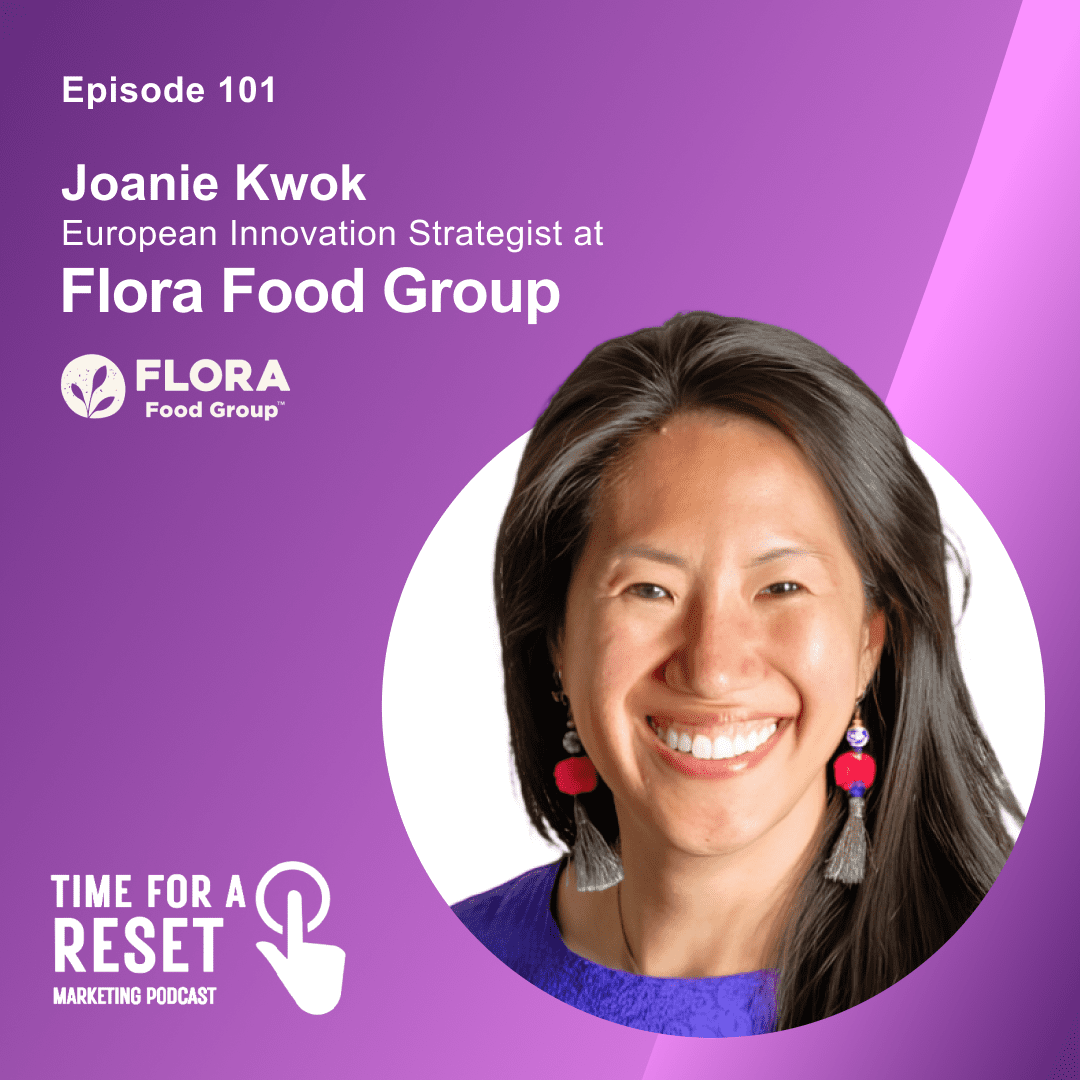
[00:00:55] Unknown: Welcome to Time for a Reset, the podcast where we sit down with marketing leaders from some of the world’s most beloved brands to uncover how they’re driving change in today’s fast evolving world. Today, we’re joined by Joni Kwok, who most recently is a European innovation strategist at Flora Food Group. Joni has built her career around reinvention of roles, brands, and FMCG products. She has spent ten years in media strategy, eight years in brand and category development at Anheuser Busch US, and the last three in pipeline innovation at Flora Food Group. Her specialty is untangling ambiguity and turning culture, creativity, and commercial growth into ideas people actually want. That same spirit of reinvention runs through her life. She tries three new things every week to cultivate curiosity and push past trepidation. I am excited to share my conversation with Joni with you today. So, Joni, what, if anything, would you hit reset on in the marketing industry today?
[00:02:11] Joanie Kwok: Thanks, Tiffany. I’m really excited to be here today. So I’m gonna answer this in a a little bit differently. One of the reasons why I actually switched over from media and into brand building and product was because I saw there was such a big divide between brand and product. And on the media side, you end up being at the very end of the ecosystem and that you’re pushing the creative or the campaign message forward. But sometimes I noticed that the product didn’t line up to what consumers wanted. And I think that it’s really important to be correct in the very beginning of what product you’re launching, which makes it much easier for media teams at the end to be able to support the campaign. And so I really wanna make sure that the product is at the center because the consumer is at the center. The product is the brand. And I think that’s very important now with, you know, the tariffs going up, raspberry prices going up, that it’s really important that the consumers are having a real reason to choose the product. And I think that’s really key for us.
[00:03:15] Unknown: That makes a lot of sense. And being a brand marketer myself, I echo your love of deep understanding and being close to the consumer. Where do you think data has helped bridge that gap for you, and where has it actually maybe made your job more difficult or even divided?
[00:03:35] Joanie Kwok: I mean, data is a great tool. It helps surface what consumers are doing, but it doesn’t really answer the why, or it tells you so many different data points that it’s hard to pinpoint where exactly is the problem. And so there’s also a difference between what product people do versus brand team does. So product teams look at, for instance, um, more of the commercial aspects. So how often do people purchase? What is your basket size? Like, what is the right format that we need to get into this channel? And the brand teams take a look at, you know, long term equity growth around awareness or consideration. And because they’re looking at these different datasets, you end up with different consumer portraits of what someone is looking for. And that divide can get worse or but there is just too much data. And I think where it’s really important to look at the data is upstream where, you know, innovation is being developed. So especially when we think about the three year pipeline, you’re learning how to read cultural signals, trends, or long term trends, and how that evolves also over time with different macroeconomic inputs as to why someone might be purchasing something and whether or not that would be a product that’s sticky enough that will last after the next three years or so. So having making sure there is a combination of what’s happening culturally with what’s the behavior in market is really important to make sure that we’re really resolving the tension around the consumer.
[00:04:57] Unknown: I love that you talked about up upstream data utilization and how you have used data from a product innovation perspective upstream to influence your pipeline. How might that upstream data be helpful comms side of the business as well as the product innovation?
[00:05:17] Joanie Kwok: How long can it take for our conversation to go before we start mentioning AI? I mean, AI is an incredible tool. I’ll give an example of how we’re using on the innovation side, and then I’ll I’ll delve into how I think it might be useful for comms. But from an innovation side, it’s really transformed how quickly we can think about concepts. So we actually have been testing a concept with, I’m using exaggeration, 800 different claims on it to see which was the most appropriate claim matching with the concept. And that gave us some real time in market data of this is what a consumer will likely be thinking about this product. It doesn’t tell you what might happen in three years because that’s not where AI is. It’s not really predictive on where consumers are going. It’s really just this is the assumption of what consumers are like today. Waste of time. Exactly. And I think that’s really important to have in the space of things. And then on the comm side, there’s such a large library of what historical brands have done over decades, what new brands are doing. So you’re able to archive all of that together and and understand where are some learnings, where are some emotional gaps that other competitors are not able to resolve right now, where can we fit into this, or even what are the gaps in our values that are not resolving the consumer tension as it is today. So I think some of the things that are happening right now even with Burger King where there is such a trust gap that’s happening right now. Did you hear about that?
[00:06:40] Unknown: I did, but maybe our listeners haven’t. So give us the short version. Yes.
[00:06:45] Joanie Kwok: I thought it was really impressive, and I’m gonna summarize a little bit.
[00:06:50] Unknown: Are you talking about tiny bite gate? That’s what I refer to it as. The CEO where he was taking the bite and maybe not demonstrating as much hunger or satiation. That’s the way I would say it.
[00:07:02] Joanie Kwok: Right. And I think the flip side of what happened afterwards was then they said, okay. Let’s be more trustworthy. Let’s talk about what you want us to fix and really talk about the king is really you as the consumer. We keep always talking about consumer for us blah blah, but they really put that in there and send us what you want us to fix. And that resolution of you tell me the problem, and I’m gonna go fix it, I think has really helped more than anything else. And I think that’s an enormous amount of data set that they just got in as well when you talk about upstream. They just got so much upstream data or back end data of all the things they could fix. They have their comms product pipeline probably for the next ten years that they can work on. And I think that’s amazing and also very brave and also kudos to your CRM team to be able to get all that data in.
[00:07:52] Unknown: Yeah. I love that example because, in my opinion, it’s taking upstream data that we were talking about and putting it into new learning models, truthfully. Like, how is our consumer behaving? How are they evolving their belief system? Are they more or less trusting of brands in general, you know, removing ourselves at that point in time from the conversation. And I think that entire approach helps brands understand what their next step should be with creativity and advertising. So I’m wondering, in your experience, what role do you think data should play in shaping creativity, specifically whether that be in the comms side, but it could also be in the packaging or even, you know, the product creative positioning.
[00:08:43] Joanie Kwok: Yeah. I’m gonna provoke a little bit on this one as well. Data is amazing. It tells you where the tension is and also doesn’t tell you how to resolve, and that’s what I was mentioning before about the why. But the moments that you can really help resolve in a product packaging experience comes in the human interaction. And I’ve been having a lot of these conversations with some of my friends in marketing is where does AI or data what jobs will will they not steal? And I think there’s, like, the human element that AI will never be able to replace those things like sales or being able to have a one on one connection with consumers. Those are the things that data won’t be able to resolve. And I will probably talk about this later, but I think the thing that will really help shape creativity is brands that are actually woven into people’s lives. So not just campaigns, but how are they embedded into supporting communities or people themselves. So I think there’s one of the programs that I really love that the Floor Fruit Group has done, not in my market, so I had no interaction with this. But it’s something that I’ve really admired is they’ve been working on a breakfast program across Africa, and it’s really about supporting and, um, nourishing the youth in those countries. And I think that it was really amazing to see how there’s this brand, but we’re really trying to help the community itself.
[00:09:56] Unknown: I love that. And many moons ago, that concept was discussed in the framework of purpose. Like, I feel like that conversation is bigger than just a purpose initiative or a purpose campaign. And if you extrapolate that even broader, what you were talking about is a brand that has created a community that understands it is living. It is evolving with the people versus maybe just optimizing a campaign for better ROI. Are there any other brands that come to mind in your experience? You talked about that one in Africa, but maybe that are doing a really great job of building living brands versus just optimizing for campaign efficiency and effectiveness.
[00:10:46] Joanie Kwok: I mean, Nike run clubs are always the ones that everyone talks about. The creation of the community that goes back into the product that is also at their store, I think that touches upon all of their different branded assets, and I have always loved that because it makes it an integral part of Nike. Even if you’re not running with Nike and you’re running with something else, you’re like, this is where I meet my friends. It’s at their store. It’s at this run club that they’re sponsoring. Some of the things I’ve actually seen in my community in Amsterdam, I’m not a runner, but what I’ve seen is their run clubs based on different passion points. So for instance, female CEOs are running together. And that’s a way of building community, and and that’s another way for if a Nike wants to tap into, they could. And I think that’s amazing to really hold on to that.
[00:11:30] Unknown: I think that is so cool because run clubs are all over Dallas where I am presently, but I haven’t actually witnessed any brands double tapping on that life style component of the run club. You know, they’re still at the broad run shared belief level. They haven’t done that additional level, which is really, really interesting, and I’m sure there’s someone that can borrow that with pride, just the thinking.
[00:11:58] Joanie Kwok: Or even just, like, an Airbnb, for instance.
[00:12:01] Unknown: Say more on that. Now we’re
[00:12:02] Joanie Kwok: just riffing on ideas for other brands. My cousin, who is 20 years old, I admire her so much for doing this. She insists that she wanted to go on a solo trip to Taiwan. Just first solo trip going to Taiwan. Does not speak the language, but that’s great as well. She said she wanted to meet people, and she just found a run group and started running with them. And I think that goes back into the Airbnb purpose we talked about. Right? Like, a live what was it? Travel like a local? And she just picked up and ran with this group, and they ran to a food destination. There’s a little outcome in there, not just community. And I think making friends is hard. And then talk about longevity and and having community as one of the biggest indicators of our old age is having community and purpose. And I think brands and that goes back to being a a strong brand too. Who’s your community? What is the purpose? There was something provocative I read today that said, if your brand was missing this role, what conversation would not happen because it was it wasn’t there? What impact would you have on someone’s life?
[00:13:02] Unknown: I constantly find myself pontificating on this topic because you and I are both brand marketers, and so we appreciate the nuance in cultivating that relationship with your consumer. And I wonder, do you think enough marketers are doing enough to meet their consumer where they are? Are they going to the spaces that their consumers they’re trying to attract are? Do they really understand consumers’ fears, wants, and wishes? And if they’re not, I mean, how would a marketer even begin to take those steps in your opinion?
[00:13:41] Joanie Kwok: No. I I don’t think we’re doing enough to spend time with real people, with our consumers, even with ourselves, thinking of ourselves as the consumer. And I think that comes with, uh, not because no one wants to as a marketer. I think marketers are inherently really curious people because we want to resolve tensions. But because, you know, we’re doing the next stack, we’re preparing for this meeting, we don’t have the time it takes to go and say right now, do a kitchen test or an answer for sit at the bar and watch people drink for a while and understand what they’re what they’re currently like. And I think that is really important, something that, um, I wanna make it as a a skill point where you go into someone’s kitchen and you watch someone cook and watch them read a label, see how they shop and see how, you know, the the economy is really affecting them. And then you understand what the moments of friction, also, what little small delights there are that don’t make it into into report that you might get from your insights team. And then you also see, I think this is also really key too, is how people find a workaround solution, and that workaround solution could be the thing that is your next product or your next idea that you give people. You see what the new use cases of a product. I think about Vaseline and and slugging. Do you know that one?
[00:14:56] Unknown: Oh, I do. I slug with Aquaphor every couple of nights because a girl’s got to glow.
[00:15:04] Joanie Kwok: Exactly. And that’s and, you know, you wouldn’t know that one until you see you see that popping up in different places. And that’s amazing. And there’s no substitute for for talking to consumers, um, and being curious, but it is also it’s it’s also scary, and we’ve become so far away from that with as much data and as much other digital touch points there are. And so the practical answer is just to make consumer time a part of your practice. Make a budget for it because that’s important. Budgets drive where we end up going to. I think that’s really key. One of the things I actually loved when I worked at Anheuser Busch is, um, um, and this was when I was on the media team, my foreign manager, she actually set aside a budget where because we were working in New York, we would have to go to different parts of The United States to understand how consumers operated. And I worked on a brand that was really focused on the Midwest. I’m from New York City, born and raised in New York City. I don’t know anything about the outdoors. The my outdoors is Central Park, and it’s very curated. But I went to a bass fishing pro tournament, and it was so amazing. It was so amazing just to understand that. And I really got the passion that people had about fishing, which I didn’t understand. And I wouldn’t have understood that magic if I wasn’t there. That human emotion can’t be translated otherwise.
[00:16:18] Unknown: I concur completely. I had a experience very early on in my career where we were doing in home observations, and we had, as you were mentioning, the opportunity to observe a mother and her young son preparing his after school treat, his little snack. And it was so interesting for me at that time to hear or to observe how she prepared his snack and compare that back to the data she had given in a previous report in terms of what she did to prepare his snack. And so for me, what was really eye opening were the differences between those things that she was doing that she wasn’t even aware that she was doing. They were so ingrained in her habits, and they were so natural to just her approach. She completely forgot to mention that in the report. And so I wonder how have you or in the past or maybe even in the future, how would you recommend people approach balancing behavioral data, which we we get in a report? And sometimes it’s stated behavior on the consumer’s part, but sometimes it’s a aggregate understanding based on a composite of many, many consumers. How
[00:17:41] Joanie Kwok: do you
[00:17:41] Unknown: go about balancing behavioral data with the human observation? Because there’s there’s truth in both. They’re not inherently false, but, like, how do you balance that?
[00:17:52] Joanie Kwok: Oh, that’s a tough one because there is no balancing effort because they’re both overwhelming. Because you can get overwhelmed the amount of data where you can’t find what the result is. And sometimes I tell people just, you know, just squint a little bit, and you don’t have to get all the fine tuned data. Just start making the generalizations and then validate it when you’re working with consumers so that you have the data. Right? You already are primed with maybe some biases, and then you talk to consumer and say, hey. But this is happening. Let me understand the why of maybe why this is happening. Is this true for you? If it’s not true for you, why is it not true for you? Because that answer is also really important just like the workaround solution. So now you’re using a consumer narrative or qualitative to almost make sure the quantitative is correct versus the other way around. Because sometimes I think people do the qualitative and then do the quant to assume the qualitative is correct or not. And I really like it the other way around where consumer then tells a story behind the numbers.
[00:18:47] Unknown: First of all, my heart skipped a beat when you said squint a little because I am a self identified artist. I have not painted or drawn in I don’t know how long. However, I watch portrait artist of the year, which is a British
[00:19:05] Joanie Kwok: Do you know it? No. No. I don’t know anything about this.
[00:19:08] Unknown: Oh my lord. So I could go on and on about portrait artist of the year. But what I appreciate about what you just said, squint a little. When you’re an artist and you’re creating a portrait, you’re looking at your subject, but the great artists of the past and present, they have to squint a little because they’re creating color blocks. Instead of trying to see the detail at the beginning of the portrait, you’re squinting a little just so that you can get the color and the shape and the understanding before you start trying to chisel in the detail and all of the nuance and the the gradation of your colors. And so I love that you said squint a little because I see the applications with even data. Don’t attempt to go in for the details at the onset. You’re squinting. You’re trying to see the nuance. You’re trying to see the the associations that if you went in straight for the details, you potentially could miss.
[00:20:07] Joanie Kwok: That was great. I had no idea.
[00:20:09] Unknown: You mentioned that your career began with media strategy, which in my experience, is arguably one of the most data driven areas of marketing. Or it’s one of the areas of marketing where you have the most data minded marketers versus maybe some of the creative or open minded marketers that tend to gravitate towards, uh, brand and innovation. So but you started with media strategy, and then you moved into brand and innovation. So how has your personal relationship with data evolved over that journey? How have you maintained or maybe even reconsidered what data means to you and how you use it going from media strategy to brand and innovation?
[00:20:59] Joanie Kwok: Yeah. So my relationship with media has been one that has ebbed and flowed. So I graduated before the any of the recessions or any of those things happened. So I had a lot of more choice than I think some of the newer graduates will have. I knew I wanted to go into marketing, and I graduated from a liberal arts college. And so I what I did was I applied to all the disciplines of marketing, and I said the universe will bring me where it needs to go. And I ended up at Beyond Interaction, which was the digital arm of Mediacom before it fully got absorbed into Mediacom. And so I started from the digital space where anything was possible and also very data minded. But the digital space was evolving was evolving so fast at that time where, you know, this is Hulu was being created. Facebook ads was first being started. I remember talking to my first client about how moms are on Facebook, and they needed to advertise on Facebook. Um, this was a very long time ago. And so my relationship with data has always been one that reinforced the way that I had felt about the creative or where things needed to go. So it wasn’t really a linear path. And then as I moved on into outside of digital into more of the integrated media, so then looking at TV, which took on all of the budgets and stuff like that. That became a separate conversation because now I’m looking at the entire integrated landscape. I’m looking at how all the data works together or how one GRP goes into the next one, how you can follow the consumer through their entire day if you really wanted to if they’re connected to Wi Fi. And then moving into Anheuser Busch where we spent a lot of money in TV where if you could outspend your competitors really, really easily, and that led to, you know, awareness or consideration. They led to actual measurable brand differences. And then you had the challenger brands that came up where then you started to see, well, challenger brands, actually, they’re not beating us in GRPs or share of voice or reach or frequency. They’re beating us because they’ve now created a cultural moment or a reason to exist in someone’s life that, you know, a GRP couldn’t manufacture. They’ve made their own GRPs with organic, and that shifted how I hold data now becomes less about a decision making tool and more as a diagnostic. So same thing with the squinting. It tells me what the structure I need to be looking at, what might be under stress, and then goes into deeper of, like, where do I now wanna build more into? What do I wanna ask more questions? And do I look at trend data? Do I look at cultural anthropology? Do I look at food systems? Do I look at what cuisines are popping up? What flavors are interesting? And that informs how I now think about the overall pipeline that I’m building. So less so heavy about data, but maybe think about data as the overall structure and knowing that, you know, there are other brands and challenger brands which are exciting who are gonna find ways to circumnavigate what traditional brands are doing. And then going back to you with one of our early conversations on product, do you remember when Graza, and this is a US brand, for olive oil, first launched their, like, squeezy bottles. It was such a such a simple thing. I mean, they probably chose it because it was cheaper than doing glass bottles, more sustainable, blah blah. But they turned it into this thing that people will now prefer because it it’s easier to use, and it also looks really cool because Graza has made it cool. So they made their packaging format the GRP. And I love that. It brings me back to how chefs will actually drink out of the plastic Tupperware containers and how those are really cool.
[00:24:22] Unknown: I’m curious from your perspective because what we were just talking about is essentially performance based marketing and then that leading into long term brand building, but the newer term on the block is vibe marketing. So what do you think about vibe marketing? How does that fold into what we’ve been talking about in terms of performance versus long term brand building? And what, if anything, do you think vibe marketing adds to this conversation?
[00:24:52] Joanie Kwok: I think vibe marketing is just another way of talking about value based positioning. Your vibe is the brand world. If you wanna use the old terms, the brand world of your value. Vacation sunscreen is, like, a very good example of that. They’ve created a vibe about what a vacation might smell like, and that’s in their sunscreen. They’re not like any different from any other sunscreen, but they’ve created that vibe. And same thing with Poppy, with their colors, they’ve created that vibe, but it’s still their values. It always makes me think about Budweiser standing for America. What is the vibe of America? How does that shift? And the brand, if the value that you’re basing on might shift a little bit over time? Like, we’re not gonna get into that one. I think then the drawback around vibes is vibes change. How do you move that with where the consumers are looking at? What do you think about it, Tiffany?
[00:25:40] Unknown: You know what? I love that you mentioned vacation sunscreen because I think they just got acquired or got some funding. And when I saw that, I was like, I wonder what the market sees and beyond the value of the product, obviously. Because when you when you have that opportunity to command a formidable price in the market, what you’re really doing, in my opinion, is you’re also demonstrating that you have a close relationship with the consumer, that the consumer you you have an understanding that maybe transcends beyond the product. Because to, you know, what we were talking about vibe marketing, you understand maybe those unstated wishes or needs. Or in my world, you know, because my background is in sociology, that’s how I got to marketing. It’s understanding behavior and language and belief. And so I love that you used vacation sunscreen as an example because I think when brands like that are acquired, they have signaled to the market that they do potentially will evolve. Because beliefs aren’t concrete and singular. They’re influenced by other things around them to your earlier comment. And I think the dashboard data is one input that helps inform the belief construct, but then it’s as we were talking about human observation And I love the vacation sunscreen example because, again, it’s potentially, they were using both that behavioral data and their human observation. And through their values, vibe, marketing, they created a product that actually scaled. So when I bring us back to the topic of product innovation on that front, I think and what’s really interesting for me is to think about, like, how have you, in the past or maybe an example in the market that you’ve been watching, how have you used data to inform your product innovation pipeline just from, like, an identifying opportunities perspective? What does the next version of the brand look like when you’re taking into consideration the data that you have available? Because you’re, in some ways, predicting what the consumer might want. So how have you approached that
[00:28:14] Joanie Kwok: clear that it’s not even just the data that shapes innovation pipeline, but also the ambition of the company imposed neither in in my current role or my previous roles. It’s where does the company wanna go into? How big do they want to challenge? And so, for instance, I worked in Anna Zippos on Beyond beer, and that was going after a completely different taste profile than the beer consumer. So we’re going after, you know, hard kombucha or hard teas. Those are different than just beer. It was super interesting, but it was how much do we want to continue supporting that? What is the long term growth of that look like? How do we want that delivered? I mean, in the first couple years, you’re not gonna make as much money in some of these newer products because you have to spend so much more to invest in it. Um, it takes a long time to build a brand or a build product or build a new category, and you have to have the appetite for that in the way that I think challenger brands are doing that because they are trying to find ways to break it through some of the more traditional brands. So they have to create this new category, and that is all they know. So that’s all the thing that they’re pushing on versus a larger company with a much larger portfolio of different products. So right now, for me, the where we wanna get to is super important, and that then ties back into what data I’m looking at because you can get inundated with the amount of data that’s out there. Am I looking at I don’t know. Like, am I looking at, like, how plants grow? I think there’s, like, these sensors that you can plug into, like, tomatoes or something or plants, and you hear the music each of the plants play. But then what do you eat after that? I don’t know.
[00:29:48] Unknown: But, again, like, to what degree does the data inform your next steps, and what are the next steps as they pertain to the business vision? I think that you’re totally spot on with that.
[00:29:59] Joanie Kwok: Yeah. So I think at the very beginning, you’re in the opportunity identification phase. And so your opportunity can either be really broad or really narrow. And I like to be really outcome based of where do we wanna get to, and then that’s the opportunity as I start looking at it. Because I can look at all the cultural data in the world, but that’s too much, and we’re not gonna be able to capture all that. And that’s great for me as a person to be able to understand some of the stuff because I’m curious, but that’s not great for the outcome of where we wanna be. I mean, we’re we wanna grow commercially, so it’s really important to look at how the something could be supported in the long term as well. And then I also wanna look at category adjacent behavior. So for instance, if I’m in toys, I also wanna look at games or what are the places that children spend their time on. That’s really important for me, not just in the current category and seeing how that might influence or might take away from what the consumer is doing right now. And then you look at overall shifts from research papers and things like that. So just really broad directionally and just overall just challenging what I previously might have thought or just reinforce a thing that I’ve already been thinking about and seeing how some of it might have shifted over time. So I think we talk a lot about, like, pre COVID and post COVID of what that did to people’s dining habits, how has that changed now, um, how has that affected the restaurant industry, etcetera. And then the next phase is really about validation, and then the data becomes a lot more concrete there. In this phase, you know, you can use a lot you can use AI first to help you get more concrete of, is this attention that a lot of people have been saying right now, which I think AI is really good at harnessing all of the what is currently being said right now and then moving in further of what has not been captured yet. And that’s, I think, where the human element comes in of what do you start building on to further develop this. And then the next data point is around commercial framing, and this is really of how much money can we put in to support this, what do we think the growth looks like, basic things like, what could distribution look like, what are the channels we go in, and then you start really framing this back into is this the business decision we should be taking in?
[00:32:00] Unknown: First of all, just to kinda we could have a whole conversation just on the step between all of the innovation opportunities and the commercial growth framework because I feel like a lot of marketers lose sight of that required component. It’s not just innovation for innovation’s sakes. It’s also what does this innovation contribute to the total commercial engine, but we’ll table that.
[00:32:26] Joanie Kwok: I mean, I have personal feelings on it, but I have professional feelings about this. My professional feeling is about commercial growth.
[00:32:33] Unknown: Yeah. Okay. So maybe then my follow-up question makes sense, and and you’ll be able to talk about your personal and professional feelings, whichever you think is appropriate. But what we haven’t talked about exactly, but we’ve been kinda, like, skirting the narrative is the nuanced difference between and it’s maybe not so nuanced. It’s quite specific. Sustaining innovation, sustainable innovation creation versus disruptive innovation.
[00:32:57] Joanie Kwok: Because when
[00:32:57] Unknown: you were talking about the kombucha example, when you were at Anheuser Busch, in my experience, that’s typically more aligned with the disruptive innovation. We’re trying to disrupt an occasion that consumers are not yet even considering this type of a solution for versus sustaining innovation is maybe innovation that allows us to maintain our footprint in the market or it allows us to keep our competitors at bay. Have you done both sustaining innovation and disruptive innovation? And then if so, which do
[00:33:29] Joanie Kwok: you prefer and why? Sustaining innovations takes commitment and conviction. Do you believe that this is going to be the future? And it’s really hard, you know, and I I don’t envy CEOs or chief CFOs really on this of, do we wanna spend the money on this? Do we wanna spend the people on this? Is this gonna really contribute to our bottom line in the next ten years? And, unfortunately, we’re not in an environment anymore where we have ten, fifteen, twenty years. I mean, we have to build something. Coca Cola wasn’t built ten years ago. It was it’s a very long lasting brand, and, unfortunately, that’s not the landscape we’re in today. Consumers have so much more choice now than they did before, so they very quickly will tell you if they’re not interested in something. Or if they don’t hear about it anymore, then they’re on to the next thing.
[00:34:16] Unknown: I’ll decide, I’ll demand.
[00:34:18] Joanie Kwok: Exactly.
[00:34:19] Unknown: The goldfish phenomenon just continues the duration that people can recall a name, a brand, a wish. It’s shorter and shorter and shorter. So yeah.
[00:34:29] Joanie Kwok: Right. And so sustaining innovations are really hard, especially if it’s an overcrowded category. You start losing your differentiation both as a product but also as a brand. I am shamefully still a Lululemon purchaser. There’s a lot of things about this brand that they have some issues. But as a product, they work for me, and they’ve worked for me for the last fifteen years versus some of the newer brands that I’ve encountered, and so that’s why I’m still sticking with them. Sustaining innovations are really hard because you have to have, even just right now, a little limit because they’ve built that equity in my brain of their product works, I’m still willing to purchase them. I don’t go to any of their events. I just buy their product. I go in and out of the store.
[00:35:10] Unknown: But there’s so many disruptive innovative brands that just continue to get airtime, so they earn a greater earned share of our mind when we’re think especially as a marketer, when we’re thinking about who’s winning and why. So it’s an it’s a really interesting dynamic for marketers to allow themselves to reflect on. I think a lot of marketers have a bias towards disruptive innovative brands or working on the disruptive innovation side, but you just mentioned a brand that has been doing sustaining innovation for years and years, and you’re still a loyal customer. And so I think there’s validity on both sides.
[00:35:49] Joanie Kwok: But what I loved about the disruptive innovations, if we’re still using the Lululemon example, is that one of the things I didn’t like about the brand in the very beginning was that they didn’t have a lot of assortment of colors or variety of styles. And because of all the newer brands that came in that were really looking at, like, you know, the look, the vibe, and not so much about the performance, the brands the aluminum start taking on and start building more of that into their portfolio, which I think is a really great and also something to keep in mind on for some of the larger brands is take a look at what disruptive brands are doing. Let them be your market research. You don’t need to be on the forefront. You’re making your money on your core products, but you should keep an eye on disruptive brand to see what is it that you should just take on from them. And this is where the GRPs come in handy.
[00:36:37] Unknown: The GRPs. Never forget your GRPs, kids. Okay. So I know we’re getting close to the end of our time together today, but I love all of the splinter paths of this conversation that we could go down at a later date. But there’s a lot of young marketers or mid career marketers that listen to this podcast, and so we always like to impart a little a little of our wisdom for them as for consideration. In your opinion, the most important attributes that you think marketers should be learning, capabilities they should be building, and why.
[00:37:16] Joanie Kwok: Yeah. And I think you also deframe it as versus AI. What are you gonna achieve more than just what AI or what AI is gonna build back for you? So the first one, cultural fluency. So one of the things I think is really important is you’re reading about all the different cultural trends, what other brands are doing. How are you drawing the connection points between those all those things that are happening? And I think part of the reason why this conversation with you has been so great is we’ve jumped from topic to topic because we’re able to see the through line in all those things. And that’s something that you have to learn how to do. You don’t get stuck in this one trend, but see how they’re all connected together. People are complex. So the things that you’re looking at also needs to be complex too. But find the things that come together so that you’re able to talk about it and use it as a data point for your conversations. And then on data, you have to be able to have the courage to champion ideas that score badly even in research, and that comes if you understand consumers. And by that, I mean, you have to under you’ve got to be with a consumer, understand where they’re going through, or even in your own lived experience. Use yourself as the consumer. Why do you think that data is wrong? Now help push the thinking. Don’t be afraid to provoke. And I think that’s one of the things I love, um, the most is in challenging a conversation forward. And the third one, and we’ve talked about this already, is understand commercial levers, understand how p and l is run. And that’s really important because sometimes as a market, you get focused on these beautiful brand positionings or you don’t think about where the outcome needs to go. How is the thing that I’m doing going affect a pricing architecture? Is what I’m doing going to increase the worth to consumer that I can charge more later, or am I giving something back to the consumer that they’ll value the long term on a brand equity? And that will lead to higher frequency. And really think about all of the different touch points on there. Or even just how will I sell this into a customer, not just to a consumer. What are the different ways that I’m talking about the end outcome here, not just the beautiful things and slides.
[00:39:14] Unknown: And I love it because your words reiterated what you demonstrated, and what you demonstrated was the fact that you are a multifaceted marketer. And I think marketers of the future, you know, some of the senior, um, or up and coming senior marketers should heed your advice, should understand that consumers are multifaceted. They are not myopic. Therefore, you should not be myopic. You should not only allow yourself to understand one area of the product process or the go to market narrative or the relationship you need to have with your your retail partner. So I love that. In closing, it’s always a point of interest, I would say. And sometimes it’s helpful for our listeners to hear from you and our guests on a topic that maybe is demonstrating a little bit of vulnerability on their part. And, really, what we found that they’re hearing is what is a thing or maybe a few things that you’re working on to either improve yourself or to become a better marketer. And that might be really natural for you because you try to learn three new things every week. But what is a thing or two that you’re trying to work on for yourself to help you become a better marketer?
[00:40:33] Joanie Kwok: Yeah. I do the three new things because it helps me it incentivizes me to be uncomfortable because no one wants to be uncomfortable. I think everyone wants to be in a comfortable place, but that gives me a moment to be humbled a bit about how much I still don’t know and really push myself to try and and be diligent about this. So, I mean, earlier today, I just opened up Claude and built a new skill that I was just I was like, I don’t know how to use this. I’m gonna try to figure out and understand what I’m do using this for versus all the other AIs out there. And that keeps you honest about how much you don’t know. And I think the other thing is just being inspired and odd means you have to be out in the world to do that. So I just came back actually from Shanghai, which is why I was gone for a while. I did a traditional Chinese medicine retreat. That gives something back to me. It fills my cup so that I can go forth and do more things because now I’ve been made aware of another thing. That image came to my mind of inside out where they’re going to, like, different parts of the brain. That part of your brain lights up. Light up all the parts of your brain. Go on a professional fishing journey. Do something that’s different. Because if you don’t walk on a different street or anything like that, you won’t find something new, and that something new is something that you can then pull into other parts of your life to inspire you. That’s the part about the cultural fluency. And use AI to do it. Plug in three different things. Ask AI to teach you how to find, uh, connection points between them so that you’re building the structure of how to do it on your own.
[00:41:58] Unknown: Joni, it was super fun chatting with you today. I thoroughly enjoyed myself. We will be offsiding on that, uh, traditional Chinese medicine retreat. I do wanna hear more about it. And I really, really thank you so much for participating and sharing a little bit of what you have learned because, you know, there’s so much more that we didn’t unpack today with our community. So thank you so much, and I appreciate you joining. Likewise. Thank you.
[00:42:29] Tiffany Wilburn: Thanks for listening to Time for a Reset. If you got something out of today’s episode, share it with a colleague or drop us a review. For more sharp thinking and practical tools to help you lead modern marketing, follow us wherever you get your podcasts. Until next time. Hit the reset button and get change over the line.