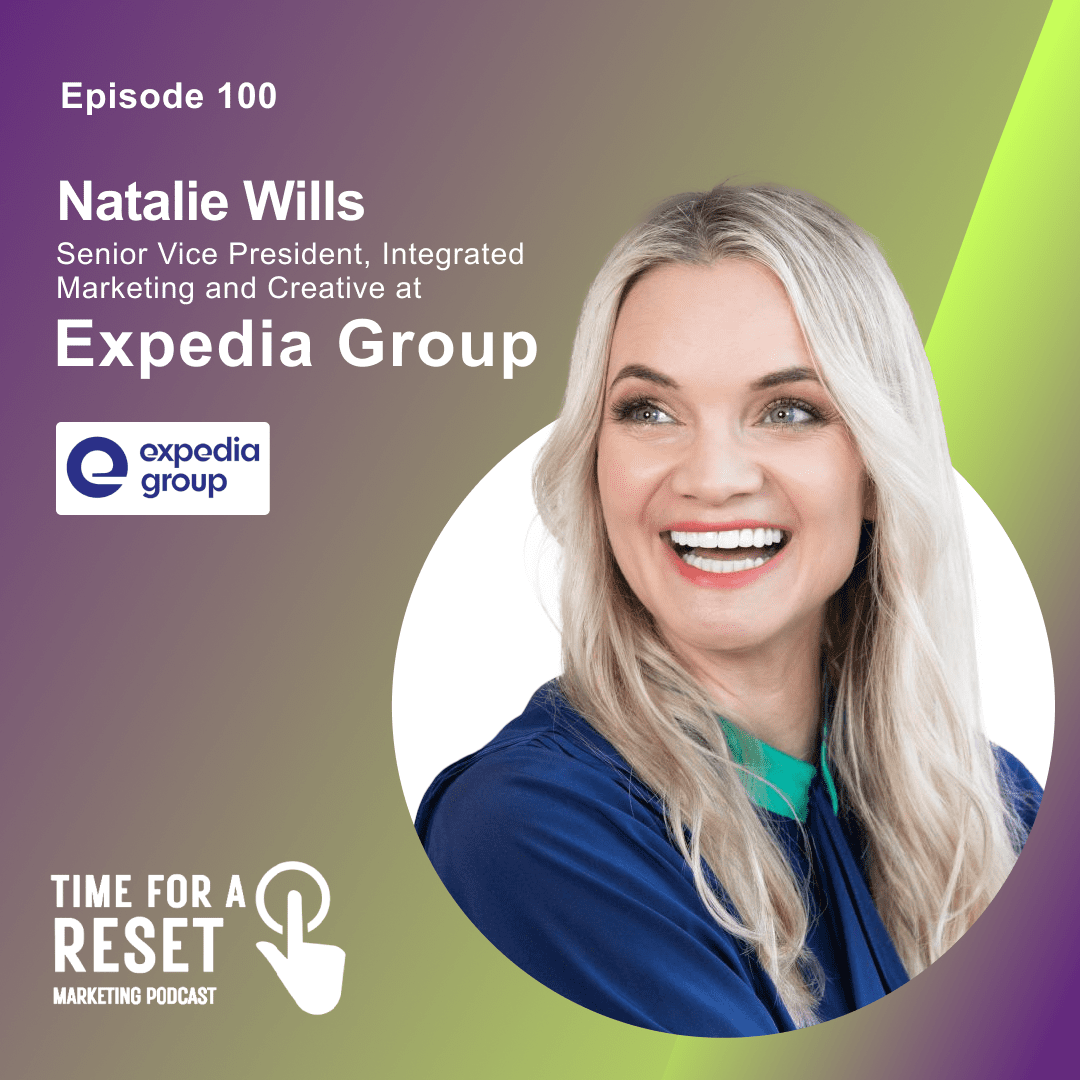
[00:00:01] Natalie Wills: Your customer doesn’t experience your brand creative and your performance creative. They just experience you. So when your performance marketing feels cheap and disconnected from your brand, you’re not just leaving conversion on the table. You’re actively eroding the brand equity your extensive brand work is trying to build. So you’re spending money really to cancel yourself out.
[00:00:24] Nick King: Welcome to Time for Reset, the marketing podcast that gets behind the thinking of the industry’s sharpest leaders shaping the world’s most iconic brands. We ask the big questions. What does it take to drive real change? How do you stay ahead when the rules keep evolving? From shifting consumer expectations to marketing seats in the boardroom, every episode dives into what’s working, what’s not, and what’s next. Expect smart conversations, real world insights, and a bold perspective on modern marketing leadership. Let’s hit reset and turn strategy into action. Now into the conversation. Today, we’re joined by Natalie Wills, senior vice president of brand marketing and creative at Expedia Group. Natalie leads the global brand vision for Expedia Group, united marketing, product creators, and CRM to shape how millions of travelers discover and book their trips. She has rebuilt brand platforms, launched product driven campaigns, improving how integrated storytelling can shift consideration and drive conversions at global scale. With a track record of transforming iconic travel brands and delivering measurable and commercial impact, she brings rare inside experience on what it actually takes for product to marketing to operate as one. Natalie, thank you. Welcome to the Time for a Reset podcast.
[00:01:35] Natalie Wills: Thank you for having me. It’s super good to be here.
[00:01:38] Nick King: Great. So, Natalie, let’s start where we always start. What would you hit reset on in the marketing industry?
[00:01:45] Natalie Wills: Well, great question. So thanks for that. I would say in an AI world where products and services are becoming increasingly commoditized, brand and creative is your only truly defendable asset. So if you think about it, we pour so much creative thinking and time and effort into normally two or three hero assets, and what I would like to see is how do we do the same for all assets across channel with creative agility? So I would say my reset is bring the same passion and rigor to every piece of creative across every channel with creative agility and stop dividing brand performance, brand creative and performance creative for example because the best work does both. Creativity isn’t just a campaign moment, it’s your entire growth engine. It’s really your superpower.
[00:02:42] Nick King: Why do you think the industry still separates that brand creative and performance creative elements?
[00:02:48] Natalie Wills: I think it’s happened actually on purpose because it’s been born out of more of an organizational structure. So I think not necessarily a customer reality. So as companies scaled, they built separate teams, brand teams focused on awareness and equity, performance team focused on clicks and conversions, and different KPIs, different agency relationships evolved over time. And then the structural divide became the creative divide, and brand was asking, doesn’t this feel right? Well, performance was asking, does this convert? And nobody was asking the same questions at once, I think. And the biggest problem with that is that your customer doesn’t experience your brand creative and your performance creative. They just experience you. So I think at every touch point, whether it’s a retargeting ad or an onboarding email or a social post, it’s just forming an impression. That’s what brand is. Right? It’s just forming an impression in your customer’s mind. So when I think your performance marketing feels cheap and disconnected from your brand, you’re not just leaving conversion on the table. You’re actively eroding the brand equity your extensive brand work is trying to build. So you’re spending money really to cancel yourself out. So, yeah, I think it’s such a big issue, and many companies are not really looking at this in the way that I think they should be.
[00:04:08] Nick King: So if you take Expedia, obviously, I’m guessing because you wouldn’t be here if it wasn’t the case. I’m guessing that you do bring that together. But so how does it look like in an organization like Expedia Group where you’re actually bringing that together?
[00:04:21] Natalie Wills: I say that it’s no easy road. Right? Because, obviously, all of these organizations and Expedia is also an incredibly matrix organization, and we wanna move fast. So I would say bringing rigor and passion to every creative channel at Expedia has really started with the customer and what we’ve had to do is get a real deep understanding of who they are and what they need at every stage of the journey. So from that foundation, what we’ve done is we’ve built very clear brand north stars. I’m not sure if everyone on the podcast knows, but we have three incredible consumer brands, Expedia, hotels.com, and Vrbo. And each of these plays a very different role for our travelers. And, basically, what we need to do is translate that into North Star’s key messages that every team works from. We need to make sure that we’re translating these into practical tools that people can actually use to do their jobs. So things like channel playbooks, best practice frameworks, design systems. But building that North Star is not the only thing you need to do because I think getting the right people is fundamentally important. You don’t just need brand creatives. You need specialists that genuinely love building performance marketing creative and understand the craft of what makes an impact in that specific channel or placement. So for us, the goal is never to be the brand police. I think that’s never what we wanna be. We don’t wanna be the brand team that’s like, you put a pink elephant in the performance marketing. You can’t do that. Obviously, we would not want that to happen, but it’s about being, like, more brand enablers. So we need to give our teams the right north star, the right tools, the right skills, and the conditions for, like, real agility where the teams can move fast, they can test and iterate, and they can respond to moments without ever losing the creative thread that makes the work, unmistakably, Expedia or hotels.com or Vrbo to our traveler. That’s, I think, the key point for us.
[00:06:18] Nick King: Okay. And you’ve rebuilt those brand platforms across the three. I’d love to sort of hear how that refresh started. You can see how it’s sort of happening now, but how did you start that refresh? And how do each of those platforms sharpen each other and also become distinct and and give value to the travelers that you engage with on a daily basis?
[00:06:39] Natalie Wills: We started, like, every marketing team starts with actually like what our travelers or what our customers actually want. And I think the key thing for us is we have three incredibly iconic brands that offer travelers very distinctive things. So from hotels.com, that’s a pure play hotels platform, to Vrbo offering incredible vacation rentals, to Expedia which is our one stop shop of all your travel needs. We really didn’t have to make these things up because the products are truly differentiated in themselves. And there’s just great stories to tell that we just needed to make sure we were consistent in applying those stories to travelers all around the world. So we really started, as I say, with the traveler insight, but we also obviously needed to make sure that we line that up with our product road maps because obviously, there’s nothing worse than a brand that overpromises in marketing and under delivers in product. So products and marketing, like, working in lockstep together is such a key part of everything that we do at Expedia. I’ll first talk about hotels.com because actually today, we’re launching the new hotels.com brand platform. So hot off the press, hotels.com has launched a new brand platform today which is called It’s All in the Name. And if you think about what does hotels.com mean to you, Nick, I hope that Hotels comes to mind because it’s that simple. So basically, the new brand platform is hotels.com is exactly what it sounds like. And what we’ve done, and we’ve cleverly brought in associations from real life, which are not what they sound like, to give a comparison of how important it is for our hotels.com brand to be incredibly literal. Customers don’t want fluff, and they don’t want to have to sort of do homework to understand things with our brands. They wanna basically look at hotels.com, get exactly what they want. They want the reward system to be super easy, and that’s the brand platform that we’ve launched today. So it emphasizes that while so much of life and travel isn’t what it seems, hotels.com is exactly what it sounds like. And I’m so excited for you guys to see the creative because it’s super cheeky and it’s absolutely been like a joy to make. So that’s coming soon to a multiple channel universe near you. Then Expedia, which is such an incredible iconic brand and one of the key assets that always pops up when I say to people I work at Expedia, they go expedia.com because there’s a couple of things that have been around for so long that people remember. So with Expedia, it’s about reinforcing our brand fundamentals that travelers know and love so much. So we are the one stop shop of travel. You can book everything in one place so you don’t have to open multiple tabs on your laptop or open multiple apps. It’s all in one place. We have incredible rewards, and so our new brand platform is designed around telling travelers that Expedia is the one place you go to go places. So you just open one app and you have everything at your fingertips, and we help your travel needs. And then finally, Vrbo, which is actually a thirty year old brand, I’ll have you know, which a lot of people don’t know that it’s the OG of vacation rentals. And after doing extensive consumer research, we realized that especially in the vacation rental category, what customers want is just very simple. They want consistency. They want reliability. They want support if anything goes wrong, and they wanna arrive there and the vacation rental should look what it looks like on the pictures. But it’s amazing how many times that doesn’t happen. So with Vrbo, we are being bold and crisp in our new identity, and the brand platform is all around if you know you Vrbo to reinforce to customers that you can really trust us. And with that, we’re launching our Vrbo care product, which is incredible, which is our industry first guarantee that if anything goes wrong in your Vrbo, our Vrbo team will basically move you to a better place at no cost to you. So we really want to make sure that travelers understand that you can really trust us, we’ve got your back, and Vrbo is literally the one place that you can book vacation rentals that you can know and trust. So there’s so much happening. It feels like the last six months has been like such an incredible journey but I’d say to sum up from my perspective, creativity always has a purpose and at the end of the day, we have a product and a service and our mission in marketing is to interpret that in a way that makes people generally want to use our products and services.
[00:11:11] Nick King: Yeah. Having been in this industry for a long time, you sum that up quite succinctly, I can imagine there’s hours and hours of work that have gone into all of that to be able to do it in a couple of minutes. So kudos to you.
[00:11:23] Natalie Wills: It’s felt like really exciting every day bringing back some of the memorable icons of the brands and making them fit for the future. It’s been like an incredible challenge.
[00:11:33] Nick King: Awesome. So you talked a little bit about the loyalty programs there, and I think in the modern world, they’ve become really, really complex. And you’ve talked a little bit about the rollout of the hotels.com rewards. How are you sort of using that to demonstrate the brand’s commitment to travelers and really make their lives easier?
[00:11:54] Natalie Wills: So it’s actually, like, such a brilliant question because I remember vividly sitting in consumer groups and a consumer on the hotels.com loyalty groups said, uh, these loyalty programs with OTAs, OTAs – online travel agency, are just homework and I’m so tired of doing a brand’s homework. And that really stuck with me and my team and we were like, wow, well, we really are onto something. So as I said, hotels.com, we wanna be literal. We don’t want our customers to have to do homework. We wanna be exactly what we sound like. So that’s why in The UK, our rewards programs all around stay ten nights and get a £100. So that’s super simple. So you know what you’re gonna get. I’m gonna stay ten nights and I’m gonna get a £100. And you know what? You can use that a £100 on a work stay, a personal stay, on whatever you want because it’s your way, how you want to save and how you wanna spend your hotels.com cash. And I love that because it’s just bringing the simplicity back to rewards programs, which have got really, really convoluted and difficult to understand. So it’s really got simplicity at its heart.
[00:13:03] Nick King: I love that. So as somebody who’s on an airplane a couple of times a month, simplicity is all I desire as a traveler.
[00:13:10] Natalie Wills: And obviously, a hotels.com customer.
[00:13:13] Nick King: A 100%. I have no favorite brands, but I am a hotels.com customer. Great. I’m always interested how big organizations operate. And Expedia Group, you’ve got some huge brands, and you’re unifying marketing products, creators, CRM, all of these different elements of marketing. How do you keep alignment in a big organization and make sure that storytelling, those products experience, and those North Stars that you referenced earlier? How do you ensure that they remain front and center across all those teams and all those people, no doubt, in many different countries?
[00:13:51] Natalie Wills: I think one of the key things is that most organizations these days are incredibly matrixed and scaled, and it’s not a one size fits all. Right? You have to sort of adjust, I suppose, your style and your different tools to the organization that you exist in. But I think one of the key things for me is I never wanna be seen as the brand police and I wanna really be in a brand enabler. So I want teams to be given the tools and the frameworks that they need to do their jobs better. So I think we’re absolutely ruthless at making sure that we have clear guidelines and playbooks that aren’t just one and done, that we constantly iterating and when something’s best practice, we add to it and make sure that people are updated. And then there’s not just a send out a presentation and here are brand guidelines. We have a lot of incredible tools within the company that help us to release new information. We do a lot of education sessions to make sure people are onboarded. But it’s a really exciting job as the brand team or the marketing team to constantly, like, bring people up to speed with new discoveries you have per brand. So it’s more of a verb than a noun, if you know what I mean. So the brand team, you need to be active and selling the sizzle of all the different discoveries that you have, new best practices, keep the conversation going, communicate, give people exciting things to look at and work with. And, yeah, I just think the main thing is is, like, allow agility to happen. Don’t be stuck in consistency for consistency’s sake.
[00:15:18] Nick King: Yeah. It’s interesting you talk about it as a verb, and that leads me to that development and the growth that creative drives. But how do you balance that creative ambition with commercial accountability? It’s a challenge that every brand faces, but particularly when you’ve got three brands. How are you looking at that and thinking about that and making that reality within Expedia Group?
[00:15:40] Natalie Wills: I feel that ultimately where we are with creative is creative defines the ingredients that make us who we are. And obviously, like, we are here to tell travelers to use our products and services. So creative without commercial accountability is just a waste of time because obviously, like, we’re not here to just win awards, we are here to really, really differentiate ourselves and drive the business. So I think creativity can be our total superpower because if we do that job right and we’re telling travelers in all the right channels and all the right places why use our products and services and then obviously on product give them an incredible experience, we’re just gonna be driving more and more growth for the business. So I don’t necessarily see them as separate, they are one and the same and I think that if more creative people had the business goals in mind, it would help them to deliver way better work because ultimately, it’s creative to drive business versus creative to win awards.
[00:16:42] Nick King: Wise words. I’m not sure every marketing leader thinks like that, but it is great to hear that you think that way. I often joke that it’s almost a legal requirement that I ask you about AI and what it’s doing within your business. But how is AI reshaping that creative development, and where do you draw the line between efficiency and originality and using the tools that are available?
[00:17:06] Natalie Wills: Yes. I mean, AI is such an incredible hot word at the moment that everybody is using that crazy. But I feel for me, AI is obviously reshaping creative development in genuinely exciting ways. So it’s giving teams the ability to move faster, to personalize at scale, to localize at scale, to spend less time on production and more time on ideas. So we want people to spend less time on the busy work and more time on the strategic big thinking work and AI is enabling them to do that. So in terms of where we’re using AI, we obviously use it to accelerate everything from copies to visuals to asset adaption, localization. Things that used to take weeks now take, like, a matter of hours, which is incredible to see and our teams are, like, absolutely super enjoying working with AI. But I think that there is a line and where I draw the line is efficiency without originality is just really going faster towards mediocrity. So AI is exceptional at, like, scaling ideas, but it can’t necessarily originate them. I think it can’t develop a genuine point of view. It can’t deliver what does travel mean to an actual traveler. It can’t feel the cultural tension moments and take a creative leap on a campaign and do really, like, brave work. That’s a human job. So I think if you can think of an analogy, I suppose AI raises the floor and great creative people raise the ceiling. So you need both.
[00:18:39] Nick King: Crazy. Faster towards mediocrity will be my call to arms in meetings and things.
[00:18:45] Natalie Wills: I mean, if I have to see one more digital ad that looks exactly the same, it doesn’t matter if it’s fashion or travel. I mean, if that’s not mediocrity, I don’t know what is.
[00:18:54] Nick King: No. I totally agree. And how do you see that sort of evolving over the next three to five years? How are you thinking about that future with the bikes of your teams and also the output that you’re expecting them to deliver?
[00:19:07] Natalie Wills: I mean, you don’t have to be far away from any podcast or any person’s impression when they say that, obviously, AI is making creative go through one of the biggest transformations since the shifts in digital. So I think it’s a huge shift, but I honestly believe that we’re gonna come out stronger. So I would say over the next three to five years, I think the role of creative splits. So two things become more important, not less. So I would say the first is your creative strategy and ideation and the ability to develop a genuine brand point of view, a distinctive brand. As I said in the beginning, that’s your most defendable asset. So, really, that’s gonna be the first one. And then secondly is, I suppose, the technology fluency. So an understanding of how to harness AI data and personalization tools that express that creative idea in every channel at scale without losing the creative thread or why the customer should care about this piece of creative, that’s, I think, how things are gonna evolve. And I suppose creatives that thrive are gonna be ones that do not mind taking up the AI tools because they see that they can help them with efficiencies, but they still are very much required to come up with the bold thinking and the creative ideas. So I see it in so many people in my team, like, they are really getting under the skin of all these AI tools. They’re finding them fascinating to work with, but it’s allowing them to just do such a much better job. So I think don’t be afraid of the tools because the AI tools are there to really make you a much better creative, a much better marketeer.
[00:20:44] Nick King: here. That’s a welcome call to arms for using AI without the fear mongering. I love it. You’ve talked a little bit there about what you’re looking for within your team. Taking half a step back, what are the attributes that you’re looking for in the senior marketeers within your team, and what are you expecting them to deliver tomorrow and beyond?
[00:21:05] Natalie Wills: Yes. I think it’s got more exciting for people because people that are naturally curious and have an aptitude to take more risks and learn and lean in, I think they are only gonna become the best marketeers amongst us. So what I look for is always gonna be people that have incredible creative thinking and have done delivered creative work that is exceptional or has delivered work that has really powered the business. But I’d say in the future, I think what I’m looking for is teams that also are really happy to embrace more of the creative technology side of things. So it is going to be an and, not an or. You are gonna have to have the creative skills or the marketing skills and be able to know which AI tools you can use to help you with efficiency. I would say that that is where it becomes more of a challenge because also when you’re recruiting people today, these people don’t necessarily exist with tons and tons of experience. Most of my team are learning AI tools as we go, so I think really the key attributes we look for now is more like curiosity and the will to sort of lean in and learn and discover the unknown and discover how we can increase our efficiency and our creative output using AI tools versus having all the experience in the world because I don’t think that that necessarily exists right now.
[00:22:27] Nick King: Yeah. I think those core fundamentals, curiosity is so important. I was speaking at my daughter’s school, and it’s like you don’t need to know all the AI tools. Just think about how we approach them.
[00:22:37] Natalie Wills: And the best way to learn is on the job and with practice. So I think that’s another thing I would say is that it’s often difficult to know where to start. But if you just start and start playing around with things, it’s amazing how quickly these tools are very easy to use, and you will become a pro in no time.
[00:22:56] Nick King: And then where we always finish, I always ask people where are you working to improve yourself and be a better marketer? I always think it’s important that people understand that even when you’re at the top of the profession, that there’s always things that you’re working on. I’d love to hear what you’re focused on.
[00:23:11] Natalie Wills: I would say, well, I’m obviously not only a marketeer. I’m also a mum, and I have many other jobs in my life that are super rewarding, and I wouldn’t change it for the world. But I think as probably you get more senior, every aspect of your life becomes more demanding, and you feel like you’re juggling a million balls. And I think there’s sort of an unspoken pressure, especially for women in senior roles where we need to be performing at a 100% of every aspect of our life simultaneously. And Michelle Obama says it perfectly. You can have it all, just not all at once. And I love that quote so much because as a single mum who’s got a big job and I’m trying to stay fit and healthy, trying to get enough sleep, trying to spend time with my friends, all of these things are often pulling in different directions. So I would say the thing that I’m working on is consistency versus intensity of every day, and you don’t have to be winning in every aspect of your life every day because that’s just honestly not being honest with how people actually need to live their lives. So I’m working on consistency, being more patient with myself, and taking a little bit more time to enjoy the times that I have off and to focus on other aspects of my life where I don’t have to be at high performance all the time.
[00:24:27] Nick King: I love that in a world where work is all around us all the time because of the connectivity. I think that’s really important. Natalie, it’s been amazing to speak to you. Thank you so much for your time. Looking forward to seeing all of the launches that you have coming out and that you talked about today.
[00:24:43] Natalie Wills: Thanks so much for having me.
[00:24:45] Nick King: Thanks for listening to Time for a Reset. If you got something out of today’s episode, share it with a colleague or drop us a review. For more sharp thinking and practical tools to help you lead modern marketing, follow us wherever you get your podcasts. Until next time. Hit the reset button and get change over the line.