[00:00:02] Intro: Welcome to Time for Reset, the marketing podcast that gets behind the thinking of the industry’s sharpest leaders shaping the world’s most iconic brands. We ask the big questions. What does it take to drive real change? How do you stay ahead when the rules keep evolving? From shifting consumer expectations to marketing seat in the boardroom, every episode dives into what’s working, what’s not, and what’s next. Expect smart conversations, real world insights, and a bold perspective on modern marketing leadership. Let’s hit reset and turn strategy into action. Now into the conversation.
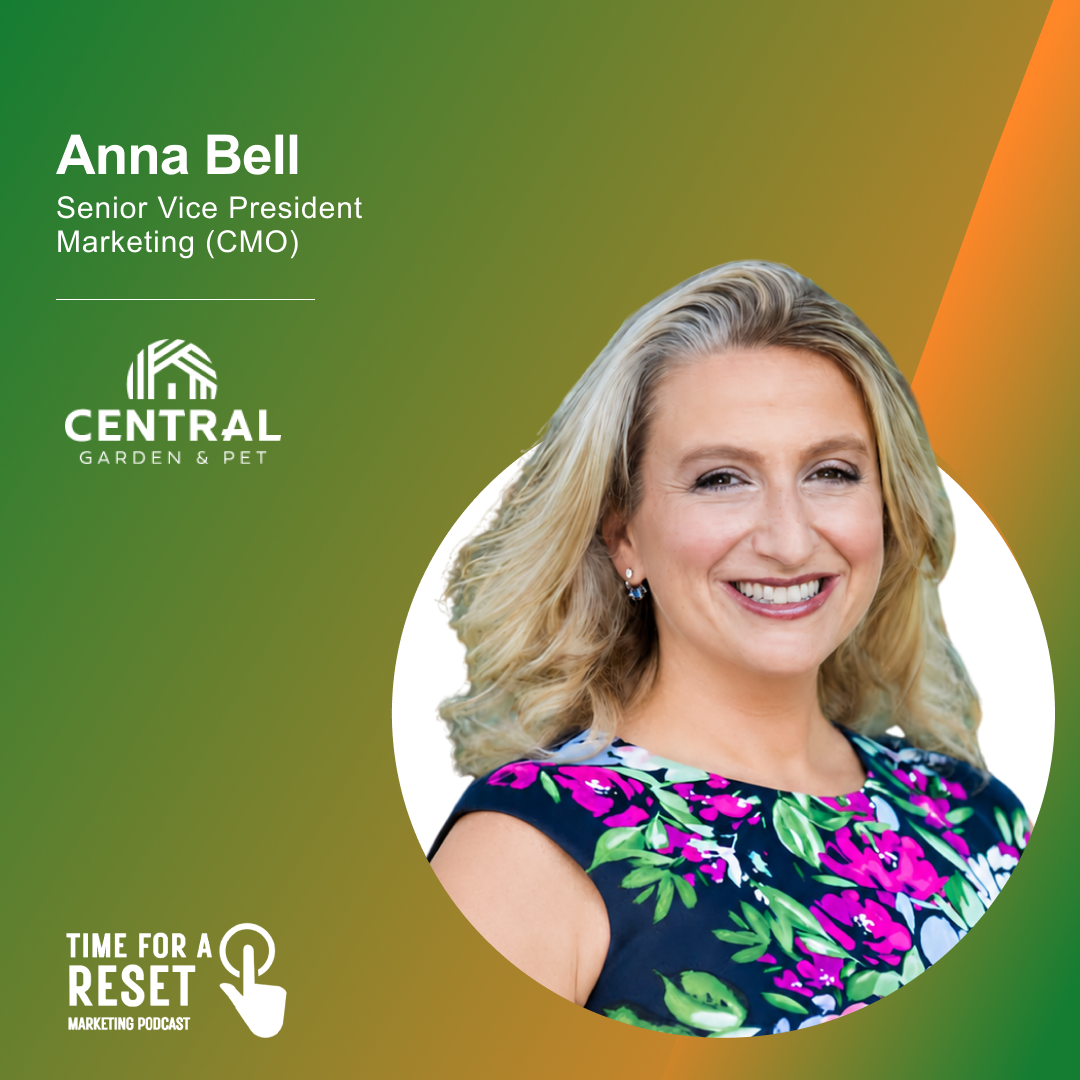
[00:00:37] Tiffany Willburn: Welcome to Time for a Reset, the podcast where we sit down with marketing leaders from the world’s most beloved brands to uncover how they’re driving change in today’s fast evolving world. Today, we’re joined by Anna Bell, senior vice president of marketing for Central Garden and Pet. Anna is a seasoned consumer enterprise executive who has spent her career at the intersection of growth strategy, brand reinvention, and cultural relevance. With over twenty years of experience leading both billion dollar global brands and fast growing niche businesses, she brings a balanced perspective on scaling innovation while protecting long term brand equity. Anna oversees marketing insights, innovation, digital, and customer care for a diverse portfolio of brands, serving both pet owners across retail, ecommerce, and b to b channels. She is known for driving profitable growth, building high performing cross functional teams, and modernizing legacy businesses through consumer centric innovation and transformation. Early in her career, Anna held senior roles at EJ Gallo Winery and SC Johnson and Sons, where she led global marketing for iconic brands including Barefoot, Glade, and Raid. Her leadership at Gallo delivered sustained incremental growth both across a $1,000,000,000 portfolio and brought multicultural and digital strategies to the forefront of the wine industry. A passionate advocate for purpose driven brands and businesses, Anna focuses on how culture, technology, and innovation intersect to unlock new sources of growth. Named a woman of impact by the American Heart Association in 2025, Anna brings both strategic and human centered leadership to all of her roles, combining financial acumen with a collaborative style that fosters innovation and inclusive growth. I am super excited to have a chance to talk with you, Anna. I really I have so many questions, but we always start the episode with a very simple, but I think relevant question for today’s marketer, which is what would you hit reset on in the marketing industry today if you could?
[00:03:09] Anna Bell: Yeah. And, Tiffany, thank you so much for the warm welcome and lovely introduction. I’m trying not to blush, but thank you for that. I love the question. I love the idea of what would you hit reset on. And for me, it might be a little bit surprising, but I would hit reset on the word efficiency. I think efficiency is a word that is important. Of course, we need high ROI. We need high return. But if you focus first on efficiency, you lose all of the magic of what marketing is meant to do, which is really growth consumer centric innovation and, hopefully, curiosity about what’s possible. And so for marketers, I think our job is about the craft, whereas efficiency is something that now in today’s world, really, AI can take on. So it’s not to say we wanna get rid of the word per se for marketers. It’s more of let’s allow the tools to do the work of efficiency and let the humans do the work of humans.
[00:04:04] Tiffany Willburn: I love that. And it resonates with me because early in my career, the word efficiency was constantly being presented to me as a KPI, but at least I had the benefit of the balance of efficiency coming with effectiveness. So is efficiency and effectiveness. So you make a really interesting distinction between efficiency and experience. What do you think marketers have lost by becoming so focused on optimization or efficiency, and what does it mean to put the craft of marketing back at the center of the work?
[00:04:38] Anna Bell: Yeah. I love that question, and I love the point. Efficiency on its own is the issue. Efficiency is part of a broader set of KPIs that work together, work hard. That’s really the key and what we’re looking for. And I think the difference is when you focus first on efficiency, you lose relevancy with your consumer. You lose differentiation from your competitive set. And quite honestly, over time, you actually lose efficiency because what ends up happening is if you don’t stand for anything differentiated or if you’re not relevant for your consumer, over time, there’s only so much the lower funnel can do without some feeding and nurturing of the upper funnel. And so I think to your point, it is the combination that is critical for marketers to be focused on. It can’t be the first thing and, quite honestly, the last thing we talk about.
[00:05:32] Tiffany Willburn: I cannot agree more. And I love that you’ve had such iconic experience working on brands like Barefoot, Glade, and Raid, and then now your current portfolio, which includes an assortment of brands in the pet category. But looking back, what experiences or maybe even just moments most fundamentally shaped your philosophy on what makes great marketing or what a great marketer looks like?
[00:06:01] Anna Bell: Yeah. I have had the privilege of working on some really interesting and big brands and little brands across lots of categories, both domestically and globally. It’s been a gift. And what for me has always been the beginning of most conversations I have, especially when I onboard a new young marketer, is listening and really trying to empathize with what the consumer is saying, whether they say it out loud or even between the lines and listening for what they’re not saying is, I think, the unique talent that a marketer needs to hone and bring to the conversation. And I’ll give you an example. One of my very, very first roles in marketing was actually for Wrigley in The UK. I had an opportunity to go be a brand manager over there, and I was put on a brand that at the time was really a medicinally focused brand, kind of think Holes, but in a gum form. And it was doing fine, but it stopped growing, and we started listening for what’s happening. Why is it not growing? And what we learned really quickly was there’s an entire target group of people who were using the product even though that was not at all who we were targeting or even the messaging we were saying. And by listening between the lines, we actually uncovered this massive growth opportunity for the brand, and it really turned the trajectory around that allowed us to say, oh, actually, this product is incredibly relevant for these folks in this way, and it’s really fun, and there’s a lot more of them out there. And so that was a critical learning point for me as a new young marketer of, oh, well, it might have been what we thought we were gonna do and maybe it was research at some point in time, but listen to the environment, listen to the consumer, pay attention to the culture, and then lean in, and that’s what happened. And I’ve been trying to do essentially that since a long time ago, couple decades ago. Now we have a lot easier tools for doing it than we did then. We literally went into one on ones and focus groups, and now you don’t have to do that as much. But it was a critical learning for me and the difference between just having a really good tight strategy and being willing to listen and change that strategy because it was not serving us.
[00:08:08] Tiffany Willburn: I resonate with everything that you just said. And when I think back on my career, I don’t wanna date myself, but when I started marketing, digital marketing was an option. Everything was analog. And when I think now about what I think makes a great marketer, my point of view has evolved. I’m curious, has your definition of great marketing or what a great marketer does, has it changed or progressed over the trajectory of your career?
[00:08:36] Anna Bell: For sure, but I would say the fundamentals are the same. I am constantly thinking about the same kinds of fundamentals. Right? Who is my consumer? What is relevant to her? Why is she going to buy my product versus something else? Where is she gonna buy my product? How am I gonna interrupt her? The how, I think, is the big difference. And like you, sounds like we may have started at the same time. Digital was optional. You could put it out on TV, and you pretty much knew people were gonna see it or in a magazine. I mean, I don’t even know if they print them anymore. Right? Those things were mass reach and that were called mass for a reason. Today, that’s not the case. And so I think for marketers today, the big reset on being a good marketer is being very agile, staying in tune with the culture, and being able to pay attention to places you may not naturally fit in. I’m a woman of a certain age. I live in a certain place, but I need to know about young Gen Z ers living in a very different culture than I grew up in. And being relevant in that space requires me as a marketer clearly not to insert myself in the conversation, but to bring other people in that can teach me, that I can listen to, and I can empathize with. And I think that’s, um, much more needed skill set maybe than ever before because of how fractured media is and how fractured our society and culture are.
[00:09:57] Tiffany Willburn: Yes. And those fractures and culture and the requirement of agility that you’re talking about, I see that in lots of industries as like, a cornerstone of critical capabilities that you need to establish. You earlier were talking about the distinction between efficiency and effectiveness, but then the outcome of that is real business impasse. What should marketers actually be measuring to know whether they’re creating not just the immediate value, but lasting brand value, that long term brand equity?
[00:10:34] Anna Bell: Yeah. I think that’s such a good question, and it’s so hard to answer. Right? Measuring marketing has always been, let’s be honest, the toughest thing for us to really nail down. That’s, I think, why efficiency gets such a positive mention in most marketing KPIs as you can measure it. Did your ROAS go up or down? Right? That’s efficient. Yes or no. Marketing is harder to measure, but I I think for me, when I think about successful long term business impact, of course, I wanna see our growth on the top line going up year after year after year. I think that’s critical. If you’re not growing, it’s not working. Right? As marketers, we really only have two jobs, growth and equity. And so for me, growth is critical. You gotta have it. You have to make business impact. But I think some of the measures underneath that tell you if that’s sustainable have a lot to do with customer retention. Are your consumers coming back? Are they coming back and buying more? Are they recommending you to other folks? Are they engaging with your content? That’s when you really start to see, oh, I matter. And I think that mattering is, again, very hard to measure in one. There’s not one metric. But I think if you start looking at all of your tactics and all of your toolbox, you can start to put together a picture that says, yeah. Actually, this is going in the right direction or, you know what, we’ve got a problem. We’re not getting repeat. We’re not getting mentions. We’re not getting engagement with our influencers. Right? People don’t care. And if people don’t care, you’re in trouble that you’re in trouble. You can only buy marketing for so long, and I think that’s where the efficiency conversation becomes real inefficient because now you’re buying every single click.
[00:12:10] Tiffany Willburn: You said a few things that gave me goosebumps. Mattering, I refer to it as the magic of mattering. It is so important. The fact that repeat. Are people coming back? It’s one thing to be invited to dinner at your friend’s house once, but did you get an invite to come back? Exactly.
[00:12:28] Anna Bell: Did you use the right fork?
[00:12:29] Tiffany Willburn: Yeah. Yes. Those things matter. They’re indicators that you belong, and we want to have a relationship with you versus a transaction. You are also a marketer that is near and dear to my heart because you don’t manage just one brand. You oversee a portfolio, a very diverse portfolio of brands across the entire pet category with very different consumers and channels and stages of growth. Like, it’s a complex cast that you have on your desk. How does that change the way you think about marketing strategy?
[00:13:04] Anna Bell: Yeah. As part of what actually appealed to me about this role is it was the same thing for me at Gallo. I managed a large portfolio with you know, it was all wine for the most part with different types of wine. And here, it’s all different brands that are meant for different species. You know? So my day can start with talking about horses and horse owners, and it could end with talking about people that have bearded dragons, you know, and literally everything in between. It’s very exciting and fun to be able to really think about just the breadth of this portfolio. And I think for me, we do manage business unit by business unit, so my role gets to come in and bring best practices over to each other and bring ideas that maybe one team had over here and another team might think about that’s more relevant for them. But I really approach it as personalized and customized. I don’t think there’s a one size fits all marketing strategy for anybody. I don’t think there’s a one size fits all media strategy for anyone or even an innovation strategy. I think that in general depends on where you’re going, how are you selling, what is the offering, then you tailor it there and you take best practices to say, oh, you know what? There’s something kinda similar over here in this portfolio that worked or it didn’t work. Let’s not make that same mistake twice. And so for me, that makes my job really fun. It could be really challenging and very specific, but that’s what makes it inspiring, and I’m learning every day.
[00:14:29] Tiffany Willburn: I love that. And I’m curious because you mentioned one size fits all marketing strategy isn’t necessarily the approach, but where, if at all, can you create efficiencies with managing a portfolio or maybe even just shared capabilities across the brands that are under your responsibility without losing the distinctiveness of what those brands are required to do?
[00:14:54] Anna Bell: Yeah. I think a lot of it comes in the framework. Right? The framework is always the same. You come in. Who’s your consumer? Can you identify that? Can we work with the marketing team to be really crisp and clear so that when we do bring it to the media agencies or to the communications agencies, those briefs are tight. Right? The tighter the brief, the better the work. And so having that consistent framework of analyzing your business, thinking about how to approach it, not the answers, but the questions can be consistent. And I think that makes it more efficient. Is it perfect? No. There’s always pros and cons to having kind of that umbrella one size fits all marketing pillar in this organization and, honestly, in many of the organizations I’ve been in, that hasn’t been as successful. It’s usually much more successful when you’re tailored. And so, again, I’d say that’s where it’s okay. Let go of some of the efficiency. Make it a little bit messy. You’ll come up with a better answer for that business and that brand and make better growth, hopefully, come out of it and stronger equity.
[00:15:54] Tiffany Willburn: There’s magic in what you’re talking about, and I love that. And a lot of times when we have these conversations with brand marketers who are overseeing one brand, there’s a apprehension to maybe take some risks because it’s all requiring the success of this one campaign or this one new innovation. Does having a portfolio of brands give you the ability to maybe take different risks or more risks than folks that are managing individual brands?
[00:16:24] Anna Bell: I think so. And I think the way I would maybe reframe it is you have more opportunity to test and learn. So taking risk is scary. It doesn’t matter how big your business is. You don’t wanna fail. Right? Nobody wants to fail. But you have more opportunities to test something, see if it works, and then apply it either bigger for that business or maybe for another one that could do it differently. And I do think there’s some real advantage to having a portfolio to do that because, look, some of my brands are small, and so trying a couple of things on a small brand doesn’t have quite the impact of trying something on a big brand. And, look, if it works exponentially better for the small one, and now the big brands can take advantage. And so I do think there is quite honestly a big advantage to having a portfolio of brands to play with because you have that opportunity to learn.
[00:17:09] Tiffany Willburn: I love thinking about that from a learning perspective, and I’ve leaned into that myself. And it is a value. You know? There’s less risk if it doesn’t work over here, but I’m going to lift and shift what does work into the spaces where maybe I’m not able to be as courageous as I I wish I were. But I’m also curious. A lot of conversations we’re having right now with marketing leaders as everyone in all functions is discussing as AI. And one of the obvious promises of AI is that it can help, if not do, but it can help a marketing organization do more with less. And I’m wondering when you’re managing a portfolio of such different brands, do you see AI primarily as a way of creating scale, potentially efficiency, or do you think there’s a bigger opportunity there to give marketers more time back to focusing on the human craft and the mattering that we started the conversation with you talking about?
[00:18:15] Anna Bell: Yeah. I mean, I think it’s yes to all of it if I’m really honest. What AI provides is the ability to do things that used to take us weeks. You can do them in days, sometimes hours. That gives everybody time back. It gives us the ability to test, and I’m gonna call it a clean environment, some things that you wouldn’t necessarily bring to the consumer, but you could bring to an agent or to a persona, that’s, I think, a cutting edge space that is really going to help marketers because it does take some of the risk out of trying some things. And if you can really personalize that AI for your organization and your product, that can have some powerful impact. I also think there is, let’s be honest, just some busy work that is important for marketers to do that AI can just handle. It’s amazing. Like, some of the things you can put in there and just say, listen, I need you to spell check. I need you to check. Does this statement of work have the same legal language as the other one before I send it to the lawyer and save her time and save me time? There’s just so many really good uses for it, and I think we’re just scratching the surface on what’s going to be possible. Of course, safety, security for all of us, terrifying, but I do think there’s a lot of upside that we’re going to continue to see. I think, you know, again, it’s gonna be messy because I don’t think there’s a really clear, this one works great yet. And so we’re kind of working through some of the stuff that doesn’t work as well to get to truly a powerful tool and partner to make the work easier, better, faster, and allow us time to do the human work.
[00:19:49] Tiffany Willburn: Yeah. I wonder the typical profile of a marketer is someone who is typically quite agile. They’re interested in many things. They’re good at many things. And I wonder some of the criticism that we hear about AI and marketing is that AI is gonna take away the creativity of the marketer. But I wonder if, truthfully, AI is best tested with marketers because we are so adaptable and agile, and we’re able to find value in potentially areas or spaces that other functions in a business would not. But if we think specifically about creativity, where do you draw the line, so to speak, between using AI to accelerate creativity or test creativity and allowing it to start defining or constructing creative ideas that would influence long term brand equity or long term campaign big ideas?
[00:20:49] Anna Bell: It’ll be an interesting space to watch. I think today, for the most part, it’s not there yet. I think today, the way that I use it for creativity is more around, hey. I have this idea. Let’s say it’s an innovation idea. Here’s the thing. Mock it up. Give me something that I can use as a concept board that I can share with my engineering and operations team so they know what’s in my head and I can visualize it. But we all know it’s not the final product. Right? It’s something kinda AIE as we all kinda know what that looks like these days. So it’s not there for consumers. It’s not there to at all influence equity, but it is there to allow the creativity that is in a lot of marketers’ minds to come out on something physical that you can then build from. And I do think it is there. I do think that ability to create mock ups, to create inspiration boards, to do some editing. You know, I do actually quite a bit of editing with AI, particularly Claude, and it works really well. It’s there. It’s starting to learn my voice. There’s words that I tell it, never use this. You sound like AI when you use it, and it stops. So I think there are some really good uses. I don’t think we’re anywhere near creativity being handed off. I think we’re at a space where creativity can be partnered and made better, again, made faster, you know, I will say from a production design all day long. Right? Cut this into seven different shapes and sizes. I no longer need to physically do that with Adobe. Great. Let’s go do that, but that’s not creativity. That’s just production. And so I think there is this reality we’re in. Now in the future, could we see it get there? Maybe. But I think it’s gonna be really hard to imagine a universe where human taste and human emotion really can be automated. It that just doesn’t feel like a reality.
[00:22:37] Tiffany Willburn: Interesting. Part of what I was gathering from what you were just sharing was in relation to, like, culture because you’re talking about creativity, and these are some of the social contracts that we are agreeing, that we abide by. Given that you’re responsible for such a broad organization that spans marketing, insights, innovation, digital, customer care. What kind of culture do you try to create within your teams to make people remain curious as you were talking about or remain creative and stay close to the consumer?
[00:23:12] Anna Bell: I love that question because team is really the most important thing in any organization. Right? It’s the humans that run it. And for me, it’s really critical that the culture of our team is respectful, collaborative, open. So I like to get my team together and talk about what’s happening in their worlds. You know? It’s personal. We are all a bunch of humans, and when you start to create real relationships, even if it’s on Zoom, my team is distributed, and yet I feel very close with my team because we have a personal relationship, and that creates willingness to try some things. It creates willingness to ask questions. You feel safe when you’re in an environment where you feel I think it’s always been critical. I think it’s actually more critical now than ever just because the world is what the world is. And having a safe space where you’re trusted and allowing that creativity and curiosity and agility to come through, I think that is the job of all senior leaders right now in corporate America. We have to make it a space where people feel like they can speak up because I’ll give you an example. I had a really great marketing director in my last company that was super attuned to culture. And he came up with this idea. I think this was just pre pandemic that it sorta happened, but we had a very diverse team, really interesting group of folks. But, you know, trying to get to know everybody in a large team is tough. And so he created this idea called Culture Soup. And on Monday mornings, we would have Culture Soup. He knows who he is if he listens to this. I always give him credit for this. And anyone could contribute. You didn’t have to. It was not mandatory. But if you wanted to share your culture with the group, give an example, you know, whether it’s a concert they went to that maybe you don’t even know about that kind of music or it’s like a Asian New Year kind of approach, and here’s what actually happens in my family on that day. It was so impactful, not just to the people and the team, but actually to our work because we were so much more open and attuned to all the different cultures of people that might be using our product that new ideas came up. People were inspired. It really became, honestly, one of the most powerful things that I have ever experienced in a team. He really changed how we work together. It was amazing. I love that, and I might borrow it with pride. Deal with pride. I tell everybody, do culture soup. It’s game changer.
[00:25:28] Tiffany Willburn: Yeah. I think, specifically, one, the activity sounds very engaging, but the outcome and the impact it’s had on your business and your behaviors is what I think is really like there’s something magical. And it matters. Exactly. Exactly. So I wonder if that director had come to you earlier on in your career, would you have maybe been as receptive to his idea? Or even more broadly, has your leadership style changed as you have matured with your understanding of marketing and how to build and cultivate teams?
[00:26:04] Anna Bell: Yeah. No doubt. What wasn’t in the bio that I sent you was I started out as a finance person. So I’m one of those kinds of marketers that made the switch. Right? And I spent a lot of years actually in finance first. And I do actually think that’s a really nice grounding for folks because, you know, being afraid of the numbers is not a great thing if you’re a marketer. So having that finance foundation’s great. But I will say when I made that first switch from finance to marketing, finance is much more structured and it’s much more linear on how to think, and I had to really let go. I’m naturally a creative. I’m an artist in my free time, all this kind of stuff even when I was in finance, but I never brought that to the office. And as a marketer, you really can. It’s actually additive to the work. And so
[00:26:47] Tiffany Willburn: I think had he brought that
[00:26:48] Anna Bell: to me early days, I probably would have said, I don’t sure, but I don’t know what this is gonna do. I think it came at the right time for me and my leadership journey to really understand the difference between a strong team and a truly you know, I hate the high performing, but the really formed super team. We had a formed super team. And that couldn’t have come at a better time, but it also was I was ready for that in my phase of leadership then too. So marketers, I think, over time, if we don’t evolve, we’re never gonna be good at our jobs. You don’t necessarily want your finance person to change their complete perspective on finance, but you kinda do on marketing.
[00:27:28] Tiffany Willburn: Yeah. Exactly. Well, what is your art medium of choice?
[00:27:32] Anna Bell: I do a lot of things. I’ve been playing around for a long time, but I’m into multimedia at the moment. So I do visual art with all kinds of multimedia, and everything I do is upcycled. So I go and find cool pieces at, like, the Goodwill and then bring them all back to life.
[00:27:48] Tiffany Willburn: I love that. I am a charcoal artist. I work with charcoal in the human form. I do live portrait sessions once a week, and I’m I’ve also just started getting into oil painting, which I love.
[00:28:03] Anna Bell: Very that’s hard.
[00:28:04] Tiffany Willburn: Well, you know, everyone thinks it’s hard, but it’s not. I feel like oil painting has been even more agile, to use our marketing terms, than acrylic because it dries slowly. You know? It’s not your firm in it in that regard. You can constantly come back to it. You can look at it in one light and then come back another day, and you’re like, you know, I’m not vibing with that. I think it actually should be like this. So I love the fact that you’re a marketer who plays because, truthfully, that’s what we’re doing. We’re playing. We’re testing. We’re iterating, and I think that’s what marketers really should be feeling that it’s in their best interest to do. So if you think of one lesson, because I just gave you mine. Marketers should be they should play. They should be more willing to be bad at things. What is one lesson you wish you had learned maybe twenty years ago in your career?
[00:29:01] Anna Bell: That is a great question. I’ll take it back to the culture soup. Listen to literally everybody in the room. Everybody in the room has a perspective, has a culture, has a background, and because our entire job is to get people to love us. If you don’t know them, they can’t love you. And I think that to me feels critical to being a successful marketer. Just listen to them all. It really will make the work not just better, but so much more fun to your point about playing because you get to insert yourself into other cultures and, really, that’s inspiring.
[00:29:35] Tiffany Willburn: I love that. Well, we have a tradition on the show. We usually like to ask folks, how can you help the next generation, if you wanna call it that, of marketers that are building their career, or maybe they’re just curious. They might be little financers out there, budding marketing individuals that are curious and you never know. So being vulnerable for a moment, what are some things that you are working on yourself, whether they’re to improve your art or your craft or maybe even just to be a better marketer?
[00:30:07] Anna Bell: Honestly, for me right now, it is a lot about the tools, and that’s probably overstated right now. But in general, finding the space to really see what’s possible with the tools that are out there. And the reason I think that’s important right now is, as you said earlier, when we started out, social media didn’t exist, and it came into existence pretty early in my marketing career, and that was a time to really embrace what was going to come. And I honestly think we’re in the same moment now where the world is really pivoting quickly, and what’s coming, we can’t really predict, but we know it’s not gonna look like it did yesterday in a big way. And so I think leaning in and really learning, and technology can be super intimidating, especially the older you get and the more set in your ways. But I think if you don’t stay ahead of it and be willing to learn and make the mistakes and ask my teenage boys how to do some of this stuff, you fall behind. You know? So I Snapchat with my boys. I do AI on the side. There’s just all these things that I’m playing with, and I do think it’s critical. Especially as a young up and coming person coming into marketing, I think having that willingness to learn and to recognize you don’t know how to do it and just lean into that because that’s gonna serve pretty well throughout any career, really.
[00:31:28] Tiffany Willburn: I love that. We will be twinning out here in the streets snapping our sons because that’s my son’s mode of social preference right now. So, yeah, I love that, and I really love and appreciate the conversation that we had. I truthfully could continue on for a longer period of time, but I’m grateful for the time that we had together today, and I’m confident that the listeners are really gonna enjoy this one. So thank you so much for having a conversation with me today, Anna, and thank you so much for being on A Time for a Reset. Thank you, Tiffany.
[00:32:05] Anna Bell: It was a pleasure. Really fun talking to you, and I’m with you. We could talk for hours.
[00:32:09] Intro: Thanks for listening to Time for a Reset. If you got something out of today’s episode, share it with a colleague or drop us a review. For more sharp thinking and practical tools to help you lead modern marketing, follow us wherever you get your podcasts. Until next time. Hit the reset button and get change over the line.