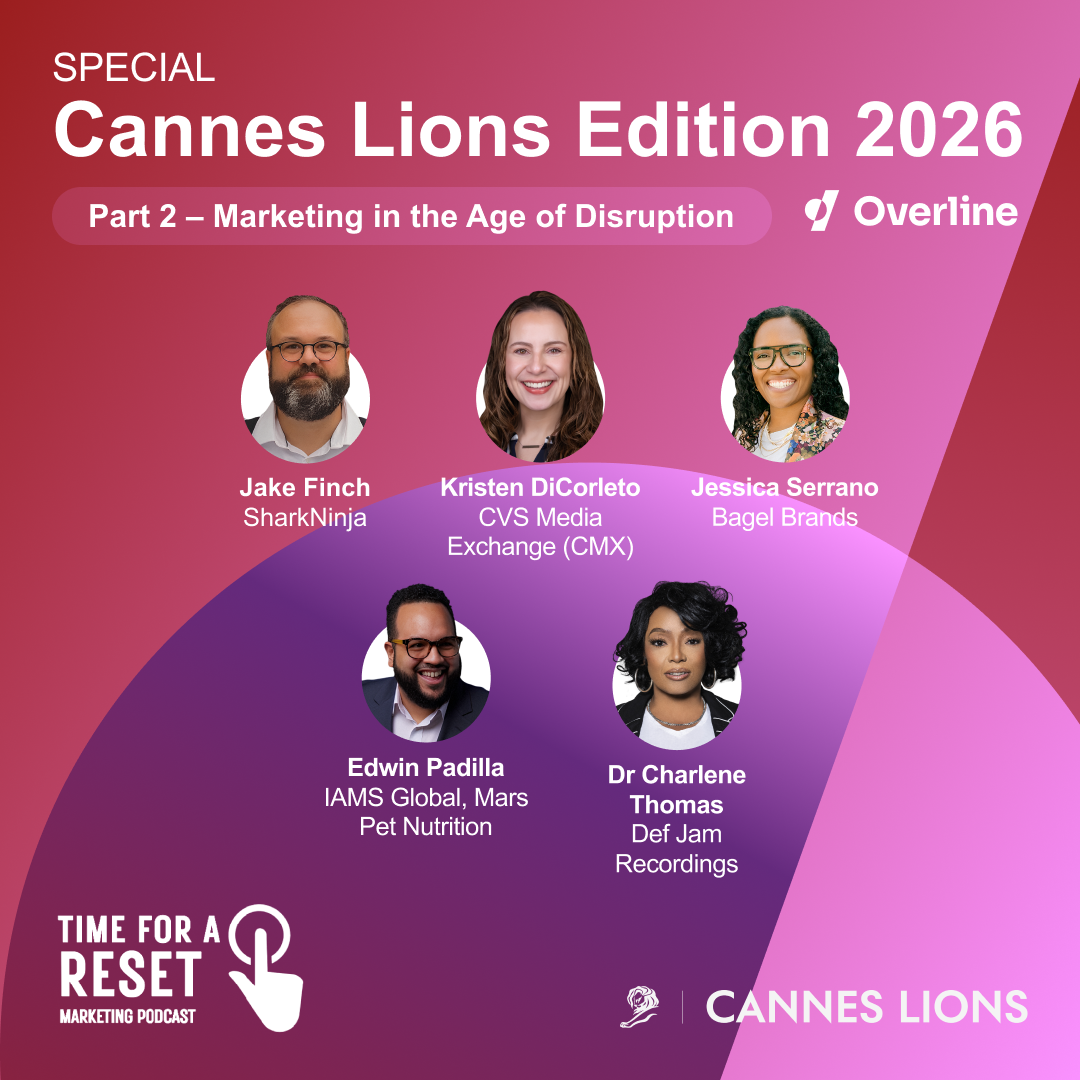
[00:00:01] Nick King: Welcome to the second part of Time for a Reset hosted by Overline Consulting, recorded live from Cannes Lion twenty twenty six, where we sit down with senior marketers from global brands and retail leaders to discuss the biggest question shaping modern marketing and the retail media landscape. In this episode, we’re chatting to Jake Finch, VP Global Consumer Experience for SharkNinja, Kristen DiColetto, the Head of Marketing for CVS Media Exchange, Jessica Serrano, the CMO of Bagel Brands, Edwin Padilla, the VP of Marketing for Mars Pet Nutrition and IAMs Global, and finally, doctor Charlene Thomas, the SCP global strategy for Def Jam Recordings. As in part one, we’ll explore what they learned from Cannes and look at their views on the shifts transforming our industry from changing consumer expectations, emerging technologies to new approaches to creativity, culture, and growth. We’ll also discuss what’s driving change in their business, the opportunities they see ahead, and what marketers should be resetting as they prepare for the future. Dave Finch, welcome to Time for a Reset.
[00:01:03] Jake Finch: Great. Thanks for having me.
[00:01:04] Nick King: We always start with what would you reset in the marketing and, I guess, CX industry?
[00:01:12] Jake Finch: For me, the reset would be along the lines of looking into how you engage one on one with the consumer. I think AI is going everywhere, but I think it’s still the humanity in it and looking at how those moments build trust in the brand. Right? It’s all well and good you got them in the funnel, but now they’re there. How are you keeping them there? How are you engaging with them? And how are you building that loyalty and trust?
[00:01:34] Nick King: Yeah. And you talked a bit about one to one. I know that you come from a CX background, not a marketing background. How did you get into this wider side, and what’s your view of Cannes as maybe a I hesitate to say outsider, but maybe somebody that’s adjacent.
[00:01:49] Jake Finch: Yeah. It is adjacent, but I think it’s starting to blend in more and more into what marketing could and probably should be as things evolve. You know, I’ve done as many round tables at Cannes. You gotta meet people. You go around and you listen to different opinions. And one thing that I found very interesting coming from my background that’s not in marketing is around some of the metrics that you hear, impressions and all these sorts of things. We’ve seen billions of impressions. But, really, what we think about at Shark Ninja is, great, someone saw it or someone engaged with us, but did they then become a fan? Did they then become a creator? So impressions, I find, are interesting versus, say, did it actually drive to an action? And that’s what I see more in my world being the outsider is that there’s a direct. You have the conversation, there’s an action, there’s an outcome. You can measure and look at it in a very direct and specific way, that is we did something, and therefore, the consumer reacted. And, ideally, all those reactions are positive.
[00:02:40] Nick King: And how does that manifest at SharpNinja? You know, you’re obviously a huge brand. Yeah. I was talking about that earlier. But how do you see that sort of maybe not a unique brand, but something that that one to one relationship is important?
[00:02:53] Jake Finch: I think it all comes down from a cultural mindset. We look at things from a lens of putting the consumer in the middle. Many brands talk about what we built for the consumer. Right? But, you know, what’s interesting about SharkNinja is that myself being from CX, the call center, I don’t know how many brands are like this where I have a seat at the product table. So if we’re running into a scenario where it’s not passing what we would call the mom test, like, would you let your mom buy this product that we’re about to launch? I have you know, and our CX team has enough influence in the business that we’re able to say, no. This isn’t good enough for mom, and, no, this isn’t the type of product that we would like to put in the market, or it’s not quite finished yet. We just gotta fix this one last or these last two things, and then we’ve got this great product that drives this you know, our CEO, Mark, always talks about building our brand, this huge brand that’s come from I’ve been there sixteen, seventeen, eighteen years. From where it was growing 20% every year is one five star review at a time. So you have to earn it. You don’t just get it because you had a cool marketing slogan, you get it because you have an amazing product at the end of that slogan. And that’s where we spend all of our time putting that energy back into the product and for the consumer.
[00:04:00] Nick King: Yeah. And so you lead that CX side where people in so many different places, so many different opportunities to engage. How are you thinking about that on a day to day basis?
[00:04:10] Jake Finch: That’s a great question. So that’s been probably the single most interesting journey we’ve been on over the last five to six months and I’ve been going back and forth with. So funnily enough, I checked into CX’s inside of brand and marketing, and been going back and forth with our CEO of how do we start engaging better in all the place like, we sell on TikTok. We see reviews on Reddit. We see people engaging on Meta. You name a social channel, we’re engaging with the consumer. So we are not just selling where the consumer is. We’re also responding and engaging with the consumer everywhere they wanna be. Sort of, like, a bit of a mantra. If the consumer wants to buy on TikTok shop, we’re gonna be on TikTok shop. If you wanna engage with us on Reddit and do an ask me anything, we’re gonna support the ask me anything. Right? So it’s definitely moving past the realm of having those one on one conversations on the phone Yeah. To having those one on one conversations in a Substack, in a conversation on a TikTok thread. You name that area, we’re gonna do our absolute best to find and engage with you there. And certainly, on my side of the coin is if you do run into an issue or a problem, we’re gonna fix it and make that right.
[00:05:09] Nick King: Yeah. So you have a new CX platform. How did that come about?
[00:05:14] Jake Finch: We did some interesting research with consumers. A couple of fun facts that we found out is and certainly with our consumers at SharkNinja, you’d be surprised how personal some of our products become in the sense that we found that, you know, I think it’s somewhere around 50 to 60% people actually start naming the products they have. And when it comes to our robot products, we can actually see some of the fun names that people give them. Personal favorite is Clean Latifah that someone named their robot when that was fantastic. Right? But because we know it’s personal, we wanna engage with these consumers at a more personal level, and we so we came up with this good call concept. And the good call is really the principle that no one really wants to call customer service. So there’s an element of, like, how do we stop you from doing this? How do we remove those friction points? But if you do happen to call, we want you to leave going, hey. You know what? That was pretty good. And how do you do that? We do our utmost to be there on time. We know consumers hate waiting. Who wants to call and be like, oh, good. I’m on hold for twenty minutes. Right? So we aim to answer the phone in under a minute. Right? It’s one of our aims. Are we successful every time? No. But it is absolutely the goal. But more importantly is, like, if you run into problems with a product or you run into a service failure, how quickly we make that right. Right? Like, your time shouldn’t be at our expense. So we look at your end warranty. How do we send you a replacement right away? Like, if we don’t have it in stock, let’s say, your Magic Blender goes on the fritz, right, we will make sure that you get one. And certainly, if you’re in The UK, you know, next day, we’ll either send you the replacement part or we’ll even upgrade you we don’t have it. Yeah. Right? So those are the types of things where we try to remove those friction moments because we want you to walk away from that going, not only was that a good call. Right? And now as we enter into the social commerce age that you start to become a bit of a brand fan.
[00:06:53] Jake Finch: if you become a bit of a fan, maybe you’ll create something. Maybe you’ll create something about that moment that you then you decide to go and post on one of the socials. And that’s how we’re starting to engage from this platform and show that weird melding into marketing and engaging with consumers in that way. And if people choose to go and post about it, more than happy to support those as well.
[00:07:13] Nick King: Yeah. No. I think that’s really interesting. What we saw then talks about is sort of turning those negative engagements into something that actually people walk away. Yeah. A lot of brands talk about it.
[00:07:22] Jake Finch: We try to build it into how we do, and we don’t often celebrate and talk about it. I think we’re starting to come out of our shells. Like, actually we’ve been doing this for a long time, and this platform of calling it the good call and sort of branding it a little bit is really just more of an homage to what we’ve been doing for years. Because I was saying before, we build it one five star review at a time, but you also will build those moments when, oh my god, it went horribly, horribly wrong, but we stepped in and fixed it. Right? Like, you mentioned you have an air fryer. Right? And let’s say I’ve had this happen to me where, unfortunately, my wife was out of town. We don’t have to go down that road. But I couldn’t get the nuggets to work in the air fryer. Right? But we try to help out a consumer. Like, you know what? We messed that up. We know you’re struggling, dad. Here’s an Uber gift card for Uber Eats. Yeah. Right? Go order yourself dinner. That’s on it. And then we’ll fix it all up afterwards. Right? So it’s creating those little moments of delight, removing those little moments of friction. And we realize now that those are maybe something that we were just doing that we weren’t talking enough out in the universe to talk about how we build it as a five star service on top of the product.
[00:08:18] Nick King: Yeah. You mentioned that this is one of your first times in Cannes. Oh, yeah. What’s really stood out to you from that learning perspective, the conversations that you’re finding interesting?
[00:08:28] Jake Finch: Well, one, as we’ve all talked about routinely, it is hot. Two, from a conversation perspective, it’s been interesting to be, as you mentioned, a bit of the outsider talking a bit about different things and how engaging with the consumers at a more personal level versus at the macro level of we created this really cool campaign. It’s got 17,000,000,000 views, it drove this and this and all those metrics. And I was at one of the insider round tables, and we started talking about, well, we look at the product. Right? At the end of the rainbow, the product is what you engage with as a consumer if you don’t have a great product, and that seemed to be a bit of an a-ha for a lot of people. It’s like, yeah, we focus a lot on these metrics. What about the star rating of the product? What is the actual consumer saying at the end of the rainbow of all of this marketing that empowers them and gives you that real feedback of all those metrics that is, well, the product actually did what you said it was gonna do in all of your great advertising.
[00:09:23] Nick King: Yeah. You’ve talked quite a bit about some of the data points that you’re constantly getting. I think it’s a legal requirement I ask about AI. How are you starting to think about a yeah. You’re clearly collecting and using this data. How are you using AI within that one?
[00:09:38] Jake Finch: Well, one fun thing about a call center is absolutely everything is measured. Most of us that are in the call center in the CX universe, we all answer the phone at one point. Every minute is tracked. One of the powerful things we’ve gotten that has actually empowered the GoodCall platform is leveraging AI to look at moments in the call. If you’re having a tricky call and the agent isn’t delivering up to our standard, AI will not flag that for us. Right? And I understand. Now from a reporting and the data and all that perspective, you know, what’s been interesting at SharkNinja, we did this thing, and if you follow us at all on on LinkedIn, called Jailbreak. And we took four days off for the whole business. Mark, our CEO, was like, we’re just gonna get in. Like, some of you are using AI. Not all of you are using AI. We’re taking four days, and we’re learning. They brought in consultants, and we did 20 big company wide projects. And one of those projects I was likely gonna have to be a part of was to look at all the insights of this data that’s coming in, and how do we feed that back into the product development? And to spur the innovation of the company of getting into the all this AI is he also put up a million dollars in prizes. So go embrace it and learn how to do it. Not to replace what we do, but to augment all the stuff and remove some of those you know, everyone here at AI says, you know, remove the menial task. We are finding that we can look into the data just so much faster and find more problems to solve.
[00:10:56] Nick King: Yeah. And then you said you’ve been at SharkNinja, I think, seventeen, eighteen years. How do you advise people coming into, I guess, the world of work, but the CX world, the marketing world? What’s your view of the challenges they face, and what would you advise?
[00:11:12] Jake Finch: The best advice I ever got, and I continue to hammer it home to myself, is two things. One, say yes to the opportunity. Right? Yep. Amount of times, people are like, I don’t know. Maybe. Just say yes and see where it takes you. And the second piece is all the things you don’t like doing, put more effort into those than the things you do like doing, and it’ll pay off immensely if you focus on the things that might not be of keen interest to you as much as the ones that do interest you.
[00:11:38] Nick King: Yeah. Fantastic. Jake, thank you for your time. It’s been great having you on Time for a Reset.
[00:11:43] Jake Finch: Yeah. Great. Thank you.
Kristin DiCorleto
[00:11:45] Fiona Davis: Welcome back to Time for a Reset podcast. I’m Fiona Davis, your host on GM of Overline Consulting. And with me, I have the lovely Kristen from CVS Media Exchange today. Welcome. How are you doing?
[00:11:55] Kristen DiCorleto: Yeah. Thank you.
[00:11:56] Fiona Davis: So I’m gonna dive right in, Kristen, with a question about value creation in retail media network. You obviously run the marketing for your network. What do you think the biggest opportunity is for retail media to create more value for brands and the audiences that they have?
[00:12:18] Kristen DiCorleto: Yeah. That’s a great question. So at CVS Media Exchange, I think our biggest value is our loyalty program data. So and the trust that we’ve built with that program over the past twenty five plus years of its existence. So everything we do is focused on our ExtraCare customer and ensuring that we deliver the best possible experience for the ExtraCare member and the CVS customer each and every day. And so for us, it’s really about making those personalized connections between our brand partners and our customers. And when we originally launched almost six years ago, that really started off of our CVS platform first, which was much opposite of how other retail media networks were getting started. And that was really just because of our customer behavior and where they were consuming media, consuming brand messages. So we started that originally off-site, then we started to bring those messages on-site to cvs.com in our app. And now we’re really excited to really have a fully integrated in store offering off-site, on-site, and in store. And so as we really think about what is that complete end to end experience, it’s not just taking a programmatic ad and throwing it up right on the new front store screens that we have in store, but creating those really dynamic moments for the consumer and really bringing those brands to life. And at the end of the day, it’s all about measurability. And how do we really show and drive performance and insights and deliver those really robust insights during the campaign as well as wrapping that campaign up with a bow at the end. And not just delivering the performance, but delivering again the insights that our brands can use to continue running campaigns with us, but also take those insights and improve their performance in other places as well.
[00:14:26] Fiona Davis: You guys operate in quite an interesting space as well because it’s not, like, direct comparable to, like, a supermarket chain or something because you’ve got all the regular store products where you can buy food, beverages, all that kind of stuff in store as well as the medications and stuff. So it’s quite a different experience than what you get like at a Walmart or something like that. Right? Yep. Yeah. How do you see the retail media space evolving over the next eighteen months?
[00:14:48] Kristen DiCorleto: Yeah. I think the really, the biggest evolution as we think about how retail media will continue to evolve, it’s gonna be continuing to build those brand experiences and those brand moments. And for us, it’s really been some of our partners really pushing us. Our partner, Opela, is a great example where they came to us with their brand, Xyzal, and really wanting to be able to create more experiential moments with our customers. And so how do we actually then start to take the store out of the store to the sidewalk, to the parking lot? Creating these experiential moments enables the brand to have a deeper connection with the customer. Right now, research shows that only about 30% of brands are activating experientially, but the performance when they do is huge. Yeah. And we know that, obviously, brands are investing in sponsorships, whether that’s sports or other. But what they can’t really prove is always what is it driving in terms of unit sales, what is it driving in terms of new buyer metrics and conversion to brand. And we have over 7,200 stand alone stores across The US. So when you think about just our overall footprint, our localized community assortment and messaging in each of those stores, we can help those brands bring their brand message to life, whether they’re activating in that local community through a sponsorship or through a sporting event. And how can we really show that they can really test into experiential as well? So they can start small with a small sidewalk event, or they can go really big and really follow a sponsorship that they might have through multiple sporting outlets and activate that through sampling, through couponing, through having a small sporting activation. Yeah. We have brand partners who are sponsors of different sporting events, and how can they actually give our customers the opportunity to participate in that sporting event in our parking lots and then take away some really cool free gifts.
[00:16:56] Kristen DiCorleto: But we’re also showing that we’re actually not only driving same day sales, but when you actually look at the next sixty days of performance for those brands in the stores in which the events took place, we’re seeing a really huge incremental sales lift, which the brands have been really happy with.
[00:17:11] Fiona Davis: That’s interesting, isn’t it? We’ve seen so many great examples of experiential marketing this week and had some great stats that we were talked about. Actually, last one was in New York. They had Netflix and Mastercard experiential thing where they literally had people come to the red carpet. It was like a fake red carpet.
[00:17:29] Fiona Davis: activation, and people were buying all kinds of merch there.
[00:17:32] Kristen DiCorleto: It’s what the consumer remembers. Right? It’s creating that really special magical brand moment, which not only helps to continue to increase the value of the CVS brand, but also the value of the CPG brand that we’re partnering with as well. Well. So it’s a really special moment that we can bring to our customers and to our stores and the local communities in which we serve every day.
[00:17:54] Fiona Davis: So that was my follow-up question to you. Obviously, you’re starting to see retail as you started out in a performance space because it works in a performance space. You can measure the closed loop. But now there’s more demand, or are you seeing that same demand from the brands to go more into the upper funnel and more into that, not just at the consideration stage and the brand awareness levels? Is that something you’ve seen the shift towards in the last twelve months as well?
[00:18:18] Kristen DiCorleto: Absolutely. I think we’re all aligned that the typical marketing funnel that we all learned, you know, in business school is really no longer fully relevant because the journey to discovery and purchase is
[00:18:27] Kristen DiCorleto: not linear at all. Right? Chatting about creators previous to jumping on. So we’re learning about different products and services in all different ways. And what we know is that our customers who are going to our website to do research are typically making a purchase in store, not online, right, within forty eight hours. So there’s over 50% of customers who are doing the online research and then going in store to actually make that purchase in store, and that’s where it’s a lot harder to measure. So we have, as we mentioned before, in store screens. Right? When you walk in the store, we have a front entrance screen. We have our trend cap screens within our drive aisles. We have our waiting area screens. We have screens at the point of sale. It’s a lot harder to measure those in store placements, and so we are working together with partners like the IAB to make sure that we are utilizing measurement standardization, measurement best practices, and really working towards that attribution layer to be able to correlate between what somebody saw off-site when they come in store, what was that message that they might have seen on the screen or through our audio channel, and then what did they purchase, not only that day, but within the next thirty days attribution window as well. And so we are working really hard together to continue to strive for performance and performance standardization
[00:20:00] Kristen DiCorleto: But also transparency. Like, we’re all in this together. We’re really working on getting to what does good look like. And the more that we can push each other, our brand partners, our ad tech partners in the industry, it’s really just gonna improve everything that we do together.
[00:20:16] Fiona Davis: Yeah. That measurement one is the one that the refrain about, we’ve gotta have standardization. The reality is that’s much harder to do than to say out loud, isn’t it? It is. People measure categories different. The way people think about what’s net new to brand, what’s net new category is different depending on the type of retailer it is as well.
[00:20:35] Kristen DiCorleto: So That’s right. But we have to be transparent in how we’re measuring. Yeah. Right? Because it’s not fair to the brands that are investing in us to not be able to compare their performance across their entire spend either. And so media networks can’t grade their own homework. They need to be really transparent and follow those standards in order to be transparent in how they measure, what they measure, and then ultimately the performance that they saw so that the brands can make those informed decisions about where to put their next ad dollar. And we’re really confident in our performance in our platform that we’ve built something with those brand partners that push us to be better every day.
[00:21:14] Fiona Davis: Interesting. So you’ve just almost answered my next question about how you’re partnering with brands. But what would you say the biggest misconceptions about retail media from brands that you’ve come across so far?
[00:21:26] Kristen DiCorleto: I think one of the biggest misconceptions is that we’re fragmented, right, and that we’re difficult to work with. And I think that definitely can be true with the number of retail media networks or even media networks, commerce networks, that are in play today. But I think each of us holds a really important place in that brand’s media portfolio. And so the brands need to have really clear objectives. And the more that we can work together around the table with the shopper marketing teams, the brand teams, the media teams, the agencies, the better that we can all be to really create and make it easier for them to work with us. And so if we’re really clear upfront and they’re clear with us about what they’re trying to achieve, then we can make it seamless for them to work with us in terms of making the right recommendations for audiences, media channels, ensuring that those media channels don’t feel fragmented, that they’re all working together in orchestration for the customer and, ultimately, to drive brand performance.
[00:22:33] Fiona Davis: Last question. It’s all about AI this week. It is the creativity festival. What are the other things other than AI that you’re excited for in Cannes this year and things that you’ve heard on the Croisette that piqued your interest?
[00:22:46] Kristen DiCorleto: Yeah. Great question. I think one of the biggest things, it is experiential and how each of the brands that are here are bringing their brand to life in really memorable moments, whether it be with some really cool branded item that you’re walking away from the meeting with or whether it’s something that you’re interacting with in their space. And I think the other thing that’s been really interesting is just the conversations that are around the table and the challenges that we’re all having and facing and how can we overcome those together. Some of them are on just speed to market. Right? Like, how can we better utilize our tooling and the technology to get our campaigns into market faster, and how can we continue to optimize those campaigns real time with the data that we have to make really informed decisions, which is an exciting place to be in. It’s all about performance, and we’re gonna continue to optimize that performance for our brand partners.
[00:23:43] Fiona Davis: Fantastic. Most memorable swag you’ve seen so far on the Croisette. You’re a marketer, I have to ask you.
[00:23:50] Kristen DiCorleto: And we are here on the Quasset looking at the beautiful sea. There’s been some amazing beach bags out there. And someone that lives on the South Shore Of Massachusetts and enjoys the beach myself. The beach bags have been really eye catching here, really bright colors, really cool fabrics. So excited to take mine home. We’ve got really good swag, but
[00:24:12] Fiona Davis: I have to say, my favorite so far has been the homemade ice creams at the Expedia activation. Were the bomb. Shout out to the Expedia crowd.
[00:24:20] Kristen DiCorleto: And anything that you can consume is a lot easier to get home.
[00:24:24] Fiona Davis: Thanks so much for coming in today, Kristen. Lovely to have you.
Jessica Serrano
[00:24:34] Nick King: Welcome to the podcast, Jessica Serrano, CMO of Bagel Brands.
[00:24:37] Jessica Serrano: Thank you for having me.
[00:24:39] Nick King: Absolute pleasure. We always start with what would you reset if you had that opportunity within the marketing industry or sort of business in general?
[00:24:47] Jessica Serrano: In business in general, I would reset the way we approach meetings. I think a lot of meetings could probably be emails, but most importantly, I love a meeting that has an agenda and an objective. And if we don’t need to have a meeting to discuss or review something, better to do it over email asynchronously. Hopefully, we come out of the meeting having achieved an objective more of that, please.
[00:25:10] Nick King: I wholeheartedly agree with that.
[00:25:14] Kristen DiCorleto: every We just all have to agree. Right?
[00:25:15] Nick King: Yeah.
[00:25:16] Jessica Serrano: Exactly. So it starts with us. So it’s something that I do with my team. So at least within my remit, we always start meetings with agendas and objectives, but sometimes you end up in meetings where the person who invited you doesn’t share the same
[00:25:29] Nick King: principle. Yeah. Totally. So speaking of meetings, I’d imagine you’ve done a couple this week in Cannes.
[00:25:36] Jessica Serrano: So many.
[00:25:37] Nick King: What is it that’s really stood out for you in terms some of the key themes, what you’re thinking about to take back to Bay of Random?
[00:25:44] Jessica Serrano: What surprised me is how much we talked about creators here this week, and I’ve learned quite a bit of things. I’ve achieved a fresh perspective on how to think about creators. So I actually came to speak on a panel with a partner that helps to source my creator partnerships, and we really value giving a brief to creators and letting them work their magic and not over scripting them. And I heard a lot of encouragement to continue to pursue that and some interesting debate about what do you give up in terms of brand control if you’re not enforcing product placement and distinct brand assets. But one person said, consumers are already making content with your product anyways, and you have zero control over that. So why would you think anything differently about reaching out to creators? You really have to let them showcase their product in a way that’s true to them and resonant with their audience, and you have your other channels for controlling your brand narrative. Another thing that I heard that I found was interesting is that some brands are leaning into multiple handles on social where they feel uncomfortable sharing content on their primary channels that feels off brand. They’re going and doing fun handles that give them permission to push the brand in ways that maybe they would have been uncomfortable with otherwise. I really admire that. I think it requires you to have, from a resource standpoint, the capacity to manage more handles, and we already have a lot of channels as it is. But I’d be curious to go back and follow that trend and see how that’s working for brands that are experimenting with that. Yeah.
[00:27:16] Nick King: And I guess it probably feels like you’re giving up an element of control. How does that make you feel as a
[00:27:21] Jessica Serrano: So that’s what this week helped remind me is that it’s an illusion of control. And so what are you giving up by trying to control as opposed to the upside potential, perhaps, of letting go of the reins a bit and letting your audience hold a mirror up to you and the role that you play in their lives.
[00:27:39] Nick King: Yeah. And in terms of these creators, how does Bagel Brands turn up with them? You obviously got a huge portfolio, so I’d love to hear a little bit about some of the brands that you think about and work with on a day to day basis.
[00:27:51] Jessica Serrano: Sure. Well, I’ll start by clarifying that Bagel Brands is four brands. So we have Einstein Brothers Bagels, Brugger’s Bagels, Noah’s Bagels, and Manhattan Bagels. They’re all in different geographies throughout The US. And so the primary the largest brand that we support is Einstein Brothers Bagels. It’s been around thirty years. So we have just started to be more intentional about creators. So in years past, the team dabbled a little bit with briefing around a product launch. But this year, what we’ve been doing is more so evergreen content of reaching out to creators and asking them to show us how our bagels what role it plays in their lives. And we’ve been really pleased with just how much stronger the content has performed as opposed to when it feels a bit, still feels like an ad if you give them too many talking points. And so I will tell you in that experience, sometimes my team brings me creative that I’m like, okay. I’m not the audience for it, but what I’ve had to do is let go of the hesitation there. And what I remind myself is that we can always delete it. You know, we’re not getting it tattooed. So the KPIs have shifted for the social team, which is less about it has to perform. But if it’s teaching you something about what works and doesn’t with the audience, then that’s valuable.
[00:29:11] Nick King: Yeah. When you’re learning in that sort of teaching moments, how do you measure that success across the group, whether it’s creators or any other form of creative?
[00:29:20] Jessica Serrano: I mean, it really does come down to some of those on platform metrics, and we’ve started to look at things like what percentage of people get past three seconds and what that falloff rate is at various points and really trying to assess what are the themes about what makes a good hook, what makes people stay on longer, what are we seeing to have maybe high engagement rates. So some things maybe not as strong from an impression standpoint, but if people are sharing it, something’s resonant about that in a different way. So really just taking the time to digest those insights so that we’re optimizing as we go in terms of content that resonates.
[00:29:57] Nick King: Yeah. And the other probably big talking point has been AI within marketing Yeah. And how it all operates. How are you actually using it within Bagel Brands? I feel like this is the year when all the hype turned into something real and Yeah. Business is actually using it day to day.
[00:30:14] Nick King: I’d love to hear a little bit about how you were using it as a marketing team, but also maybe the wider business.
[00:30:19] Jessica Serrano: Yeah. You know, if you would’ve asked me last year, I would’ve suspected that we as a team would have been further along by now and using it for creative, but it’s just not been the case yet. We’ll see. Ask me in a year if we’re feeling differently about the role that it can play for us when it comes to creative production. We have used it for voice over and had some success with it in that regard, but more so systems and ways of working and guest research. That’s one of my favorite use cases. So in the restaurant business, receipt data for decades has been a primary means of getting back NPS type insights, but they’re quite static. And, you know, you’re asking someone a day later how their experience was. And so we started working with a team that actually has conversational AI that the guests can engage with right in within the four walls. And the feedback that we’re getting is so much more nuanced than on rate your experience on a scale of one to five, you start to hear things like, well, I would have liked more high chairs, or I didn’t like the way that I had to serve myself the coffee as an example. And those are the kinds of insights that really are much more actionable than, like, this bakery has a 3.5 and this one has a four y. Like, we’re really able to get into what actually drives those metrics. So that, I think, we’ll continue to see. I mean, something I’m curious about but haven’t yet experimented with is synthetic guest research. So we’ll see. That’s something I’d like to experiment with, but I certainly wanna be cautious on that front because in some ways, I’m just old school and I’m used to a good old fashioned focus group with people around the table. But, you know, I think in this day and age, you have to hold on to the foundation that you know is sound, but also be willing to experiment and see where AI could take us, where we could advance when it comes to using AI.
[00:32:10] Nick King: Yeah. How do you see it developing over time? I mean, you touched on that synthetic data piece. Do you feel like you’re interested in exploring AI and creative, or is that something that maybe you’re I do. Changing your view on?
[00:32:22] Jessica Serrano: No. I really do. And probably it’s just a factor of not quite finding the right partners yet. It really does require carving out the time and having the courage to break away from systems and, you know, maybe perhaps we’ll test it on one of the four brands as an example in terms of moving forward on it. But to answer your question, the future of AI, I mean, it really will be these agents. So I envision a future where my team is able to delegate to an email agent, a social agent, and come up with campaigns that are cohesive across all the different verticals, but we’re not there yet today as a team.
[00:33:00] Nick King: Yeah. I think a lot of teams aren’t there. Yeah. And in this rapidly changing world, like, you’ve had a great career over the last twenty or so years.
[00:33:08] Kristen DiCorleto: Mhmm.
[00:33:08] Nick King: But what would you advise somebody who’s coming into the industry Yeah. Now, those are new graduates or maybe not even graduates who are looking just go, I want to just get out there into the world of work.
[00:33:18] Jessica Serrano: Mhmm. It is a interesting, maybe even scary time. The future feels very unknown, but I suspect probably lots of generations have had some version of that in the past. And in the face of change, I try and think about what are the things that feel the most universal. And I’d say any opportunity to find a unique way to provide value. So I think if I were a young person, I might get my foot in the door by trying to offer reverse mentorship. We just talked about AI and social. And as a young person who might be more native to those concepts, could be a great way to get your foot in the door is reaching out to a leader and saying, hey. I’d love to offer reverse mentorship. I think a lot of people reach out seeking mentorship, but you can also provide value to someone who’s more senior than you as a young person who’s growing up just knowing these things from such a young age. And I pursued an MBA to get into this line of work, and that’s, while lots of people still do that, there’s a lot of ways to just get out there and start doing the work. And I think social is a potential avenue of
[00:34:25] Nick King: Yeah.
[00:34:25] Jessica Serrano: Just getting out there and learning what it is to represent your own brand, create content. So those would be the two areas I would suggest focusing on is either through the lens of content or creatively through adding value to somebody with a skill set that they might not have.
[00:34:40] Nick King: Yeah. I love that concept of the reverse mentorship. I mean, offering value to somebody else rather than taking is definitely for anybody, wherever they are in their career is Right? Wise thoughts.
[00:34:51] Nick King: Thank you so much for your time. It’s been amazing to speak to you, and enjoy the rest of you Cannes.
[00:34:55] Jessica Serrano: Thank you. You as well.
Edwin Padilla
[00:34:57] Nick King: Edwin Padilla, welcome to Time for a Reset.
[00:34:59] Edwin Padillan: Thank you. Thank you for having me.
[00:35:01] Nick King: We always start with a view of what would you set reset in the world of marketing. That might be from your view of Cannes or just something that you would change in the industry.
[00:35:10] Edwin Padilla: Yeah. So, look, I can’t help but not have the view of Cannes because of where we’re at, and we’ve been really lucky to see ton of good creative and a lot of insightful work. So I would say what we have and what the provocation from Cannes right now is to reset creativity across everything we do. And you can’t help but see how creativity is not only something that consumers experience or pet parents experience in my case, but how creativity is embedded to strategy, how creativity is embedded to just the deep thought and thinking around it. So I think it sounds like a cliche, but it is so important to get out of the operational way of looking at how we build communication and really ask ourselves, are
[00:35:56] Nick King: we really anchoring in creativity, and are we using that creativity in service of people and in service of growth? So it sounds like that you’re taking away the creativity piece. I sometimes feel that Cannes is the ad tech world. We sort of lose what it originally was, but for you, creativity is coming back to the forefront.
[00:36:17]Edwin Padilla: Yeah. And thank you for asking that question because one of my backgrounds, I am an engineer, so really understanding the technology is important, but then there is creativity in how you deploy technology into solving a problem. So I think what we see is even in the ad tech world, when creativity is unleashed and the tools that we have are used in non obvious ways, that’s where creativity takes hold. And to me, that’s where magic happens, and you have the multiplier. So there’s a linear way to apply all the tools we have, especially from technology. But then when they’re used in a nonlinear, non obvious way, that becomes a multiplier of effectiveness. And creating human connection.
[00:36:57] Nick King: And you talked a bit about sort of nonlinear piece, and I’m always interested people’s approach here. Fragmentation seems to be sometimes the buzzword of the year. How are Mars Pet really approaching that fragmentation challenge? It was such big brand, completely global. How are you thinking about that, and how are you challenging your teams to approach fragmentation?
[00:37:18] Edwin Padilla: Yeah. So fragmentation is certainly, I would say, the theme of the last decade, if you will. As we move and as brand builders, we evolve from putting out stories in the world that consumers can see themselves in to really be a part of those stories and really participate as brands into your unique story as a pet parent or your unique story. So that gives us a different vantage point about how you might navigate the communications engine or the communications funnel, which is not really a funnel. It’s essentially a loop or an infinity loop. So the way we deal with it is we look at our paid, earned, shared, and owned assets, and see each of those assets as really a gateway to an experience, a door that lets you into an experience that we’ve created. And we always say no dead ends. So make sure that door leads you to the next place and to the next place, always with the pursuit of generating value for you and what you’re looking for at that moment. And, again, back to the previous question, that’s where technology allows us to cater that experience in a way that’s always in service of you. And for us, it’s always the pet parent.
[00:38:30] Nick King: Yeah. And you touched on the technology a bit there, and, obviously, AI is so front and center and feels like every conversation in the agenda took place. But in terms of how you’re using AI to deliver some of those promises of moving between the doors, how is Mars approaching that?
[00:38:48] Edwin Padilla: Yeah. So I think there’s the more traditional I don’t wanna say traditional because AI there’s nothing traditional about AI, actually. The more widely spread way of leveraging AI, which goes into your media strategy and your audience strategy and really understanding that, Where I get really excited about AI is when we use it in addition to that to also solve problems. So in the no dead ends mantra that I’m telling you, we have an example on IAMS where for pet health, stool quality, so poop, feces, is a very important indicator of health, not only because there are science behind it, but because pet parents are exposed to it and have to literally pick it up. So then one of the things we do is we talk about that message and talk about how IAMS helps deliver that, but we’ve also created this digital tool called PoopScan that allows you to scan the stool of your pet and gives you insight as to the quality of that stool, and if it’s okay, if it’s too firm, if it’s too wet, and you need to take some action. The engine behind the image recognition of the stool quality, it’s completely AI powered.
[00:39:56] Nick King: Yeah.
[00:39:56] Edwin Padilla: So when you use AI to help people in a non normal way or non traditional way, it creates this magic, and that has become one of the gateways to our experience. A lot of people come in through the brand experience by the poop scan tool because they’re seeking for help. So that’s, I would just say, just one of the ways. And we have so many examples with pedigree adoptables, if you’re familiar with that campaign, who won last year. The use cases that I like are the ones that really help drive value to consumers or pet parents.
[00:40:29] Nick King: Yeah. And I love that also because it’s something that wasn’t possible a couple years ago. You’re not just reimagining something that already exists and badging it with AI. Exactly. Completely new. Just going back a little bit to going through the doors, I love that analogy. But how are you measuring those people and where they are? Because I’m sure sometimes they get stuck in the door to maybe overwork the analogy. How do you measure that journey?
[00:40:54] Edwin Padilla: Yeah. So that’s where really using AI and technology and tagging and ensuring you have the right taxonomy in your media is important, and it’s really finding the right partners and the right methodologies. That’s where our partnership with our agency with Publicis and Omnicom and even WebRTC ecosystem really helps us understand what’s the right taxonomy, what are the right KPIs that we’re trying to achieve, and then really setting up the infrastructure in place to measure what we need. Because in this day and age, we have so much data, but I think we forget. And maybe that’s another reset. It’s really using known performance indicators. That’s what KPI means. Yeah. It’s not just facts. And we get a lot of facts that are not necessarily known performance indicators, and we follow those. So we have very strong conversations at the beginning of what is that, what are we looking for, and how do we set an infrastructure, and we work with our partners. And we also have strong internal teams around media effectiveness and what are the right metrics that lead to actual conversion.
[00:41:54] Nick King: Yeah. Yeah. Because I would imagine that within Mars Petco, the your lifetime with a consumer is so much longer than so many brands because you, uh, as a dog owner, you have it from the puppy right through to old age and how you transition. So you’ve got such a long time to work with somebody and be with them.
[00:42:14] Edwin Padilla: Absolutely. So what you just talked about, we call that lifetime value. So how are we present in the key moments where consumers we call them points of inflection. And there’s usually a point when you acquire a pet, so that’s start of life. But then throughout the life, either through a different age transition from puppy to adult, from adult to senior, but also when you have health complications. Actually, digestive issues is the number one trigger of looking or reconsidering food. So being in those moments becomes important for us to either retain or recruit a potential pet parent into our solution, and then we can stay with them through the entire lifetime and hopefully give them the happiest, fullest life they can with their pet.
[00:42:59] Nick King: Yeah. I’m always interested how, in this modern world, you’re looking at your team. How are you working with them to help grow them and inspire them to work in an organization like Mars?
[00:43:10] Edwin Padilla: You talked a little bit about it, or even in your question, you say the first thing is inspire them, is to always anchor back on why is my work important. And I think that sometimes becomes, for us, we’re lucky it’s easy because we’re in the pet business, and it’s just very easy to say, we are here to make the world a better place for pets. And most people just get inspired with that. Then the second question is, I understand the mission, I’m inspired by it, what is my role, and is what I specifically do meaningful? And that’s where I think the biggest thing I do to the people that I coach and develop is showing them how what they do, their area of expertise or the specific task that they’re doing fits into an overall machine that creates an experience that actually delivers on the mission. And I think that is the perspective that we sometimes lose with being specific into one subject matter area. We lose sight of, okay, but how is this impacting pet parents? And how is this making the world a better place for them and improving their lives? So what I find myself constantly doing is provide people the perspective, because I’m lucky enough to see the entirety of the machine, and then see how that enables the end goal. And then at the end of the day, last thing is culture. Right? When we create a culture that people feel comfortable to bring themselves to work, comfortable with challenging or bringing new ideas, that comfort breeds trust, and that trust breeds competency.
[00:44:42] Nick King: Yep.
[00:44:42] Edwin Padilla: And when people feel comfortable and they trust you, they bring so many good ideas, especially the younger they are, especially the more in touch. They bring incredible ideas that we just need to be open and chase them.
[00:44:55] Nick King: Then finally, you’ve been in the industry for, sort of, twenty odd years. What’s your advice to people looking to get into the marketing world? How should they be approaching it in this new changing world, but also so many similarities from the whole of business?
[00:45:08] Edwin Padilla: Yeah. So my advice to people trying to get into marketing world or any profession is do something that matters to you. Because if it matters to you, you’re gonna put a lot of effort on it, and you’re going to be successful. Because the curve between talent and effort is nonlinear. You can have a lot of talent, but if you’re not enjoying it, you’re not gonna put a lot of effort. And conversely, if you have the talent and then you love it, you put so much effort that it gets you to a place where you get rewarded in front of the world. That’s where seeing a lot of people this week. So the hard thing is, how do I know if I love it? And that’s why I tell people, seek mentors, talk to people. We’re a lot more open than people think. I take so many calls. The challenge is almost mustering up the courage for someone that’s trying to get in to then call a senior leader. But at least in Mars, everyone is willing and open to talk to you. So just having that perspective, understanding what it is is critical so you can make the right choice for you. And then, look, it’s happened in my career too, not be afraid of change. I’ve tried some things that I didn’t necessarily like, so I pivot. A career is called a career for a reason because a very long it’s not a sprint. Yeah. Right? If you do it right, it’ll be a very long journey. And like every journey, you have to course correct along the way. And not being afraid to do that, I think, ultimately drives to the success, but also the enjoyment and the happiness of doing something that’s meaningful to you.
[00:46:42] Nick King: Yeah. Edwin, it’s been an absolute pleasure talking to you. Thank you for taking the time to speak with us.
[00:46:46] Edwin Padilla: Thank you. It’s been a pleasure as well.
Dr. Charlene Thomas
[00:46:49] Tiffany Wilburn: Well, I’m excited to have a chance to talk to you again, Dr. Charlene Thomas. We have been running from one end of La Croisette to the other this Cannes season. What, if anything, would you hit reset on?
[00:47:05] Dr Charlene Thomas: In relation to Cannes or just anything for the first six months in the year?
[00:47:10] Tiffany Wilburn:I am open to whatever comes to mind for you. What do you either just wanna do over? What do you want to do in a fresh way?
[00:47:18] Dr Charlene Thomas: I’ll start with Cannes. Okay. What would I reset? Finding a fan that was powerful, had some mist to it, and just not like one given out to you, like a real fan, maybe like a Dyson fan. Yeah. So maybe have packing that. I think I got enough flowy clothes, but maybe they could have been a little lighter. In materials.
[00:47:44] Tiffany Wilburn: Yeah.
[00:47:45]Dr Charlene Thomas: Because it’s super hot. Yeah. So that would be reset for Cannes. For the year, I wouldn’t reset anything that has happened because as I’ve gotten older, I do realize everything is supposed to happen for a reason.
[00:47:55] Tiffany Wilburn: Right.
[00:47:55] Dr Charlene Thomas: But probably just overall, and I think a lot of us executives might go through this, is getting better at balance
[00:48:03] Tiffany Wilburn: Right.
[00:48:04 ] Dr Charlene Thomas: So you don’t get a little burnout sometimes. Right. I do notice some of, like, my colleagues take reset weekends. And before, I was like, But now I kinda get it. Being inundated with so much information and everything
[00:48:20] Dr Charlene Thomas: That happens in your life, you do need a moment just to just kinda breathe.
[00:48:24] Tiffany Wilburn: Take some space.
[00:48:25] Dr Charlene Thomas: Yeah. And then it just it helps. There was this YouTube video I watched from a guy named Simon, and I forgot his last name. And he tells a story about two men that work in, like, the forest, and one cuts the trees quicker than the other one.: And the one that doesn’t ask the other guy, like, how do we come out at the same time, but you have much more output? And the guy says, could I take an hour off and take a nap?
[00:48:48] Tiffany Wilburn: Oh, I love it.
[00:48:50] Dr Charlene Thomas: Yeah. So the importance of resetting yourself. Because it just kinda just replenishes and you’d be and you’re more productive. So yeah. I would say trying to learn that a little bit better. It’s easier said than done, but getting a better grasp on that.
[00:49:04] Tiffany Wilburn: I love that. I love that. One of the things you just mentioned leads me into my next question. You were talking about balance in particular.So if
we move over and talk about your world, which is marketing, we are in an environment today where every single penny is being scrutinized that’s being spent on marketing. So how are you thinking about balancing the short term performance needs of every marketing dollar you’re spending with the long term brand building?
[00:49:35] Dr Charlene Thomas: Ideally, I would like for it to be because, you know, there are people that you have to report up to, and then you have your CFOs. And they obviously have the goals that they’re being given by corporate on what to meet and what to spend. So, ideally, I would like that we have some kind of tiered system where this project, it’s in its early stage, its infancy. I’m in one industry, but different industries might use different terms. So, like, if it’s infancy or emerging or developing, and that’s a set budget. And then the next tier, this is what it is. And then I think that helps balance between short term and long term goals. Because for me, being a marketer, especially in the music industry, every project I am a part of, a touch, I do expect it to be long term. I want that artist to win. Right. I work with creatives that are taking their life experiences, their communities, maybe even they are the breadwinner for their families, and they have their families and their responsibilities on their back. And they’re putting it into this art to give to us the world, so it has a lot of meaning to them. You know, every lyric they write, the way they sing the song or rap the song, however the iteration of it or the genre of the music. So for me, every one of those has meaning to that particular artist because it is an art, and I want them all to win. Granted, some don’t, but that is my objective as a marketer. I always look long term, seeing that they have a nice, healthy career. So I’m giving a little bit more guardrails because, like you said, in this economy today where a lot of companies are more data driven and it’s not as passionate as it was. Music, ten, twenty years ago, was more passion led. Now that the companies are actually paying attention and it’s bottom line. You know a lot of things are streamlined, a lot of things are stringent. So you are sometimes cut off at the knees with your marketing budget. But I think if we put some kind of tiered mechanism in place, it helps us to plan better. Yeah. And then you have those outliers. You have where, again, just relating it to music, you have where a song may work that you didn’t think. Right. You know? And then that requires something else, but it’s the exception as opposed to the norm. Yeah. And I think that might be a better way of balancing it.
[00:51:54] Tiffany Wilburn: And I wonder if sometimes a song works in one instance and it doesn’t in another. Do you think that has to do with the evolution of how your consumers or how people are finding or discovering the music? Because there’s such a fragmented customer journey that we are all dealing with right now. How do you adapt your marketing strategy to that?
[00:52:17] Dr Charlene Thomas: That is truly the case. Living in Manhattan, I always wonder, well, Manhattan is seven, eight million people. I think eight. And I wouldn’t just say this is just to music only, but we can tell 10% of that. Right? Because how many of us how many of our companies really just for Manhattan alone. Right? It’s just a borough Right. That we can say we sell seven or 8,000,000 products. Yeah. We only get a fraction. So just to even realize that we’re in this one city that spans from x amount of blocks Yeah. And we’re still not hitting every demographic. Yeah. But then on the flip side, it’s like, oh, there’s just so much more. There’s so much that everyone can get a piece of the pie. Yeah. So like you say, with music, they serve different fragments. They serve different sectors. Right. Because artists are also niche marketers. Right? They represent their communities. They represent certain cultures. Right. And how do we serve that? How do we what we use for one song and the way we market that, say, will this work for this? Right. I think that’s the marketer. Right. That all comes down to the individual that’s in charge of bringing this vision to life and out to the world, them understanding that everything is not the same.
[00:53:33] Tiffany Wilburn: Right. Maybe their audience is The owner responded in a manner, so they need
[00:53:38] Dr Charlene Thomas: times you it’s being a true marketer Yeah. Which is not gonna be done by sitting in an office. Right. You have to get outside. Right. Like, just give an example. We I live in New York. But I can’t say everyone that’s here in the South Of France is going to listen to a project that I’m marketing. But I will if I’m out here and I see, oh, yeah. It’s hot. And, you know, maybe they like songs that are like light. It’s being outside and actually paying and and, yeah, and getting context, trying to see. And, yeah, we can’t justify the whole world. Right. But if a marketer understand that we have to have different perspectives That it’s gonna be easier to deal with fragmentation. But then that’s also the benefit of having indies. Right? We’re here at Cannes.
[00:54:20] Tiffany Wilburn: Yeah.
[00:54:21] Dr Charlene Thomas: And I meet a lot of indie agencies. Yeah. It’s also being a great leader knowing that you don’t know everything. Right. So maybe it is me hiring an indie and coming to conferences like this Yeah. Where I can meet different people and I get different ideas, and they help me as part of a marketing rollout.
[00:54:39] Tiffany Wilburn: And I love that because it relates to my next question. So how do you think about partnerships and relationship building maybe with those indie agencies that you’re talking about to move beyond just the transactional level and really get into driving collaborative business outcomes?
[00:54:58] Dr Charlene Thomas: Well, a successful partnership has to have three parts. It has to be an understanding mutually between the brand, the partner, and the consumer. And one can’t have a deficit because then it’s not gonna be successful. Right. The second piece would be trust. Myself and the partner, we have to be able to trust each other. Right. Because I have to trust that you’re going to understand my brand
[00:55:23] Tiffany Wilburn: Right.
[00:55:23] Dr Charlene Thomas: My product, my vision, and then I have to be able to trust you that you can deliver it.
[00:55:28] Dr Charlene Thomas: You know your space and I know mine.Yeah. You know your space. That’s a perfect way of saying it. You know your space. I know mine. We have to have that trust. Right. And we have to be able to trust risk because you don’t want an agency that just comes in and says, I can do whatever. Yeah. You might want them to challenge you. Right. Because that’s why you’re hiring them. It’s like being a boss and having employees. Right. If you know more than every one of your employees, what do you need the employees for? Exactly. You should want people that better. Yeah. Know more than you and your team as opposed to, I just tell you what to do. Right. So you would like that. And then the third piece is understanding that we have to, again, get outside. We have to understand community. We have to understand culture. We have to be able to speak for the voices. We can’t just think we know everything’s sitting in the room.
[00:56:16] Tiffany Wilburn: Right. Community has evolved to be activated in digital spaces and places. And one of the things that we both have continued to hear a lot about at Cannes is AI Mhmm. And how it is building communities in some instances, but also how it may be disrupting communities. So as a brand leader, where are you seeing the greatest potential impact for AI in your industry?
[00:56:42] Dr Charlene Thomas: Well, before I get to mine, because entertainment is still a little bit behind and respectfully so because we have IPs that we’re trying to protect. Right? So not only in music, when I say in any creative space Yeah. I don’t wanna say AI is new. Like, people have to stop saying that where we started calling the phone and being prompted to press one if you wanna get to this person. That is artificial intelligence. That is what that is. It just seems like couple years now, and everybody’s like, AI AI. It’s brand new. It’s brand new. It’s not brand new. Artificial intelligence Just got a new outfit. So being that AI is not new. Yes. We have to, one, start educating ourselves. It is not going to make communities. Right. It is not. Let’s stop that now. It is there to do what it’s been kind of doing Yeah. Helping us move along in as we want to live like the Jetsons, become the Jetsons. Right? So it’s collaborative. I don’t even wanna say two. It’s a collaborator with us.. To help us with efficiency and processes. But the creativity is still gonna need us. AI is not gonna be able to build a community. I don’t believe that. So it will need the marketers. It would need all of us to go in and shape it. Because if all we do is going to prompt AI, all of us as companies Yeah. Then we’re all gonna start looking the same. It’s gonna take the individual person that’s prompting
[00:58:13] Tiffany Wilburn: To give it that je ne sais quoi Of course. Yes. It’s yeah. It’s gonna take that. AI is not gonna do that. Yeah. I don’t believe so. I’m sorry. And we’ve seen
a lot of individualism and creativity out here. Beyond individualism and creativity, what other themes or topics or even innovations have you seen this week that’s resonated with you being a brand marketer?
[00:58:36] Dr. Charlene Thomas: Well, AI has been on the top and it’s been all that. Yeah. That level of discussion has gone a long way about just ethically like, even when I was talking about we have to start making sure, especially for intellectual property Yeah. That we are addressing how we’re going to put guardrails in place. Because even though entertainment is dealing with the music artist or the athlete or celebrity or actor or actress, it’s also us. We don’t want people using our face, our likeness, just on whatever. Deep fake, we’ve seen the movies. We’ve seen catfishing and all that stuff, and may have, uh, whatever. But, like, that’s real. So we don’t want that happening every day. So we have to put some kind of guardrails in place and get those to start. That’s been one discussion that I’ve heard even down to the bias and not just at a gender level, culture, race, because, you know, again, it’s language models that have been given information Right. By whomever is inputting the information. I don’t know who those people, and it’s gonna be biased across the board.
[00:59:44] Tiffany Wilburn: Yeah. I had a really interesting conversation in a session, and they were talking about how they had purposely built a model that was reflective of a consumer who might have dyspraxia or dyslexia or other learning differences. And I thought that’s a really brilliant concept to not forget to do. Yes. Assume that the model is reflective of the entirety of your consumer base, but your consumer base, especially when you’re talking about younger consumers in particular, they have a higher propensity to some of these learning differences. So I thought that was a really interesting conversation.
[01:00:19] Dr. Charlene Thomas: I mean, we say it about the Internet. Right? We still say, like, go on Google or Wikipedia. Everybody always makes a joke about Wikipedia. Don’t believe Wikipedia. So just imagine that for AI. So that discussion But, again, I’m not against it by no means. I see the benefit of efficiency and process because we don’t wanna be inundated with having 3,000 emails or 900 emails, whatever your email count is every day. Right. And, like, shucks, I didn’t get to all my emails today. So to have AI to be able to help streamline those kind of tasks, and, hey, go research and pull this quicker before I go into a meeting. Right. Those are great, but it’s not gonna replace us. Right. Right. It just
[01:00:57] Tiffany Willburn: I’ve seen a lot of new marketers that are here and new talent. What advice would you have for them if they are interested in getting into the music industry or maybe marketing in the music industry?
[01:01:12] Dr. Charlene Thomas: Well, one and for myself, because although I’m in the music industry, I’ve done sports, I’ve done fashion is if you’re a marketer, you’re a marketer. Don’t go into a company and they just call you a product manager. That’s a skill. You wanna be a visionary. You wanna be a marketer. So if you’re getting into the entertainment industry, understand what it is your career path is. If you’re gonna market, market and understand everything because music is not gonna go anywhere. It’s sounds. It’s been here from the earliest part of time, and it’s gonna probably be going on after us. Right. So saying that, it’s because it also attaches to everything else. It’s a part of lifestyle. You see sports, they have a music element. You see tech, it has a music element. Fashion. So learn marketing overall. Right. And that’s how I feel about myself. I truly feel I have a saying that. I feel like I could sell you the Brooklyn Bridge and make you feel like you bought it. Because that’s what I’ll Shake those souls away. Yeah. I think they said suggestion passed away first. But that’s how you should feel about being a marketer. Right. The second thing is definitely learn AI. It’s not going anywhere. I went to CES this earlier this year in January. Everything you’ve probably seen in Terminator x or some or The Jetsons or something else, oh, it’s here.
[01:02:26] Tiffany Wilburn: Yes.
[01:02:27] Dr. Charlene Thomas: It’s not coming. You’re like There’s a landing. Behind the AI. You are 30 steps behind where the world is really at. Like, I saw robots. I saw the things you put on your arms and make it strengthen. Like, I was like, oh, wait. Yeah. We are far behind
[01:02:42] Tiffany WIlburn: Yeah.
[01:02:42] Dr. Charlene Thomas: And we’re we’re thinking technology is. So definitely learn AI. You cannot be afraid of it. Just find someone to educate. I will say that it’s only two months where I’m like, I get it. Yeah. Earlier this year, if you would have talked to me, I would have been like, no AI. But it’s because someone didn’t educate me right.
So be educated about it and learn everything. Like, especially if you’re in your twenties, go and learn everything. Learn some French, learn brand marketing, learn everything. Yes. Just learn everything.
[01:03:11] Tiffany Wilburn: Yes. You don’t know what you might call it.
[01:03:13] Dr Charlene Thomas: Be well rounded. Like, that’s what it is. But no. So okay. I’m in music, so we gotta make this a little fun here.
[01:03:19] Tiffany Wilburn: Of course.
[01:03:19] Dr. Charlene Thomas: And we’re gonna get some background
[01:03:21]Tiffany Wilburn: Yeah.
[01:03:21] Dr. Charlene Thomas: Into this too.
[01:03:23] Tiffany Wilburn: Yes.
[01:03:23] Dr Charlene Thomas: So okay. We say Def Jam. Yes. Now like I said, music’s not gonna go anywhere. Right? Yeah. And there’s a song in your life that is the soundtrack to your life, everyone in this room. Yeah. Give me a song from Def Jam. That’s the soundtrack to your life. Any artist. And if you can’t think Def Jam, I’ll understand. Just pick a song.
[01:03:40] Tiffany Wilburn: Wu Tang Cream. I was gonna say Wu Tang Cream, but I was trying to think of
[01:03:52] Dr: Charlene Thomas: What’s the big facts? Yes. Yes.
[01:03:54] Tiffany Wilburn: Okay. Now you’ve jumped in. What is yours?
[01:03:57] Unknown: No. That was it.
[01:03:57] Tiffany Wilburn: Okay. That’s it. Oh, you can’t have it because it was mine. I was trying to think of the opening statements. What is yours? And why? Yes. Is my question to you. I can’t answer that because likelihood one of my artists sees this. They’re like
[01:04:12] Tiffany Willburn: Oh. So I wasn’t top of mind. Okay. I’ll give you that. I’ll give you that. My song? Yeah.
[01:04:18] Dr Charlene Thomas: Yeah. Well, if that’s not a
[01:04:20]Tiffany Wilburn: film track to your life, then what about an outfit? No. Wait. You still didn’t answer the question.
[01:04:26] Tiffany Wilburn: I did. I did. Fiona jumped in and took my answer.
So if you’re not able to answer the sound, I totally get that. You don’t wanna show any bias, but I know that you do love fashion. Yes. I know that and you don’t have to name a designer. But even if it was a cut of an outfit or if I know my shoes Yeah.
[01:04:46] Dr Charlene Thomas: Any designer that makes a comfortable shoe that we could work this Croisette on, I’m loving you right now. So shout out to you. I like asymmetric. I love stones. And maybe it’s the marketer in me. Like, if you want Stevie, I’m her pants, so my birthday is July 10. Okay. Okay. Yeah. Like, if you I need a statement piece. Oh. I like statement pieces. I love fur. Yes. They’ll tell you that. Yeah. But not in this heat. Let me tell you something. Oh, no. Not for the fashion.
[01:05:14] Tiffany Wilburn: Not for the fashion.
[01:05:15] Dr Charlene Thomas: It’s just too hot. But if you said to me, like, this fur hat might work with this hat and you should wear it in Cannes
[01:05:21] Tiffany Wilburn: You were like, I would give that a second thought.
[01:05:23] Dr. Charlene Thomas: I’ll do it. Yeah.
[01:05:26]Tiffany Wilburn: Well, I personally love the idea of a fur hat. I might second you on that, but I’m really excited that we had a chance to connect, and I’m very excited about everything that you are working on over at Def Jam.
[01:05:36] Dr. Charlene Thomas: Thank you. Thank you. Thank you.
[01:05:40] Nick King: Thanks for tuning in to part two of this special edition episode of Time for a Reset hosted by Overline Consulting, recorded line at Cannes Lion twenty twenty six. A huge thank you to all of our guests for joining us and sharing their insights, experiences, and perspectives on the future of marketing and retail media. If you’re enjoying time for a reset, please leave us a comment or review on your preferred platform, and subscribe to be the first to know when a new episode drops. Catch you next time when we sit down with another industry leader. Uh