Lucas Mack – 00:00:01: Brand is the summation of all things. It’s a discipline of how you show up in the world with your employees, with your dealers, with your customers, and for yourself. The company has to tell the truth. And when the company tells the truth, that builds trust, and brand equals trust.
Intro – 00:00:33: Welcome to Time for a Reset, the marketing podcast that gets behind the thinking of the industry’s sharpest leaders shaping the world’s most iconic brands. We ask the big questions. What does it take to drive real change? How do you stay ahead when the rules keep evolving? From shifting consumer expectations to marketing seats in the boardroom, every episode dives into what’s working, what’s not, and what’s next. Expect smart conversations, real-world insights, and a bold perspective on modern marketing leadership. Let’s hit reset and turn strategy into action. Now into the conversation.
Tiffany Wilburn – 00:01:08: Welcome back to Time for a Reset, the podcast where we sit down with top marketing leaders to uncover what needs to change in today’s fast-moving world of marketing. Our mission is to help you rethink how brands connect, inspire, and grow.
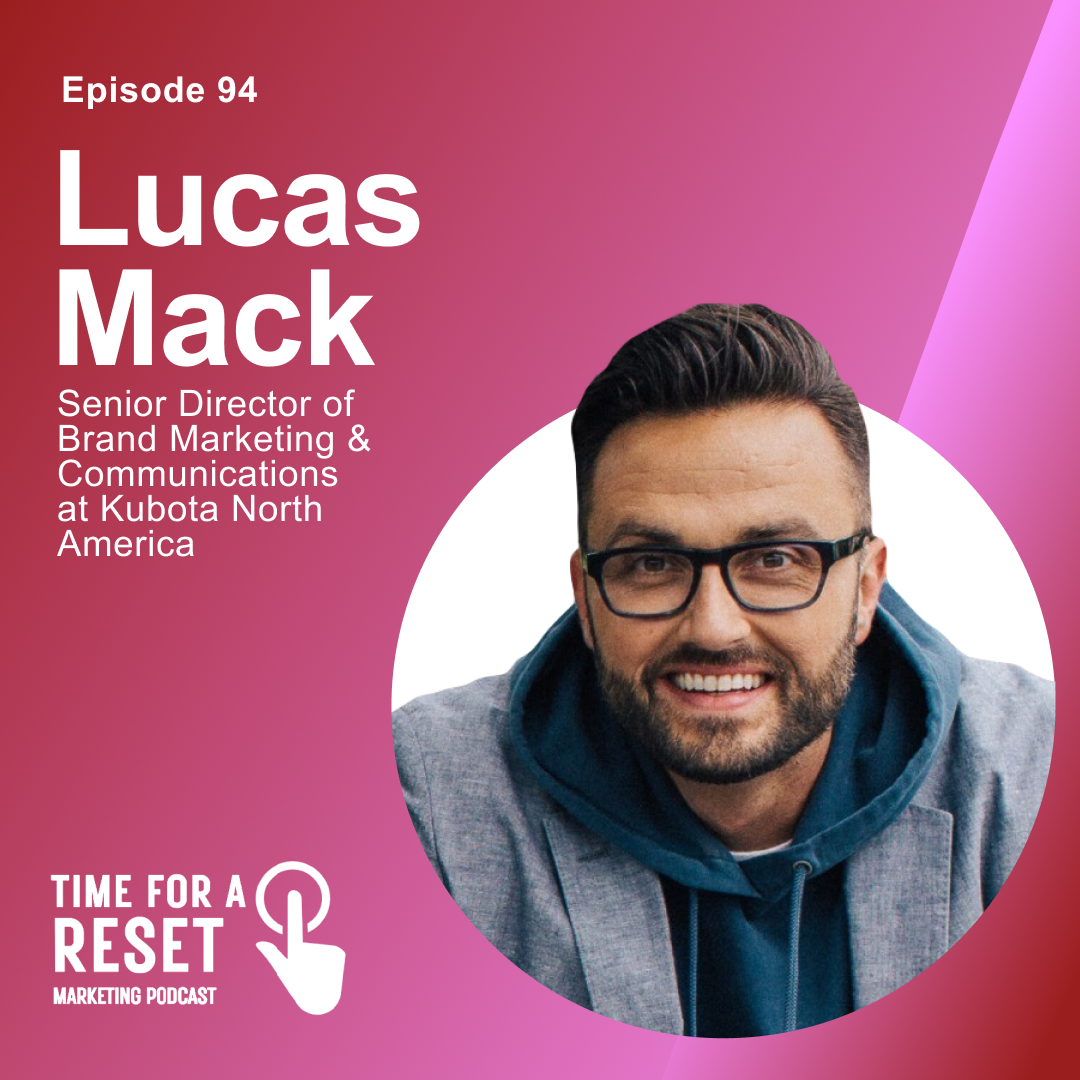
Today, I’m joined by Lucas Mack, Head of Global Brand Strategy. For two decades, Lucas has helped organizations and executives uncover their voice, align culture with vision, and build brands that inspire lasting trust. His journey has included founding and scaling a multi-million-dollar creative agency, consulting with Fortune 100 clients like Microsoft, T-Mobile, and Netflix, and most recently, leading brand strategy and communications at Kubota North America, where he unified employees and dealers under a single human-centered story.
Beyond his corporate work, Lucas is also a TEDx speaker, published author, executive coach, and host of the Lucas Mack Show. His expertise sits at the intersection of brand strategy and leadership transformation, helping leaders embrace storytelling, purpose, and creativity, not just as add-ons, but as drivers of real business growth. Lucas, it’s a pleasure to have you on the podcast. Let’s start with our signature question we ask all our guests. What would you hit reset on?
Lucas Mack – 00:02:40: First of all, thanks for having me on. It’s a pleasure being with you, and this is a really great question. It suddenly gives ultimate power to the person answering, and what it would be for me would be changing executives and leaders within corporations, no matter the size, on the value of storytelling, purpose, and creative as drivers to grow business, customer acquisition, and employee retention, rather than just what I hear all the time: “What does the data show?” And data without story and context is not the answer. I think it triggers a lot of leaders when you ask more emotional questions because that’s just not how the business culture typically is developed, but that’s what humans are craving, and so helping leaders understand that, that’s what I would hit the reset button on.
Tiffany Wilburn – 00:03:35: I love that. I think there’s a lot to be said when you put your consumer in the driver’s seat and remember that your consumer is a human, and they’re complex, and they’re varied, and sometimes they make irrational decisions and then make sense of it afterwards. Can you share an example from your career, perhaps at Kubota or other Fortune 100 clients you’ve worked with, where storytelling shifted how a leader showed up or how storytelling made a measurable difference in aligning culture and driving business outcomes?
Lucas Mack – 00:04:16: There are so many examples, even in the past five years, but there are two that I really like. And one is this manufacturing client of mine when I had my agency. They had six locations and they were regional in the West Coast of the U.S., so they were Washington, Oregon, and California.
The very first day when I was there and I got a tour and my account team was there, my creative team and I were walking with the CEO of the business, and we’re walking through their plant floor. And I’ve always been curious by nature since I was a kid, so let me go into journalism and being a reporter on air for many years. So I’ve kept that curiosity. We’re looking at some of the coolest machines that turned corrugated boxes into full packaging for the Xbox for Microsoft. I didn’t know that the CEO and the rest of my team had wandered off to continue the tour because I was fascinated how the sheets of corrugated box or whatever it was turned into the packaging. So I’m looking at this, and I heard the employees go, “There goes the carpet walkers.” And I go, “Interesting. Like, what’s really going on behind that statement?”
And so as we onboarded them and they onboarded us to be their agency of record, part of what I really understood was that I had to educate executives on even what story means. Everyone has their own definition of story, so they might say story and mean fiction or lie. Like, “The person’s always telling stories. They can never get a straight answer.” Or my perspective of story means truth. So as a journalist, I would show up, ask the questions, get the answers, and objectively tell that story back to the audience.
And so from that framework of story is akin to truth, that’s where I help executives really understand that there are five questions that make a story. This is like elementary stuff, but it’s so powerful and impactful. Who, what, when, where, and why? And Simon Sinek obviously brought ‘why’ to the forefront of the business culture, but it was funny when I started my agency in 2008 and then I think that TEDx came out in 2010, a lot of my friends in TV and all the journalists were like, “Yeah. It’s funny that ‘why’ is all of a sudden this big thing when, as a journalist, you can’t tell a story without answering all five of those questions.”
Why has to be it? So then I started going down this path, and I’ll answer and I’ll give specifics, but just to give context. So why do leaders struggle with ‘why’? Children ask ‘why’ right away; almost ad nauseam they will say, “Why, why, why, why?” And I think because of frustration or time or pressure, parents will just say, “Because I said so,” or kind of shut that curiosity down, but that is a human intrinsic need to have context given to content. And the question ‘why’ is the only question in the story that provides context to content. In addition to it only being the question that provides context to content, it’s the only question that evokes emotion. So who, what, when, where engage the mind. They’re facts, figures, data. It’s what spreadsheets are. “What does the data say?” You can answer who they are. You can get personas, what they did, where they were, when they did it. The thing that data cannot answer is why did they do it.
And ‘why’ is the only question that engages a heart. And in executive meetings when I’ve been at Microsoft, Netflix, all these big companies, when I say the word “heart,” everyone thinks, “This is not a word that’s usually in boardrooms.” You know, you ask, what would I change if I could change anything? It would be having executives understand that every human being, it doesn’t matter where they are. Now sitting at the head of global brand strategy for a company based in Osaka, Japan, Japanese culture feels 100% different than American Western culture. And both have their beauties and strengths and both have obviously weaknesses. But regardless of the culture that we come from and regardless of if someone is left-brain analytical or right-brain creative, every person on this planet has the same psychological buying process. It doesn’t matter if they read a culture that their language goes right to left or left to right. It doesn’t matter if math, data, and science are heralded as more important. Every human buys the same way. We buy emotionally, and we back it up logically.
So my executive colleagues—this is the joke because I say this—how many of you are married? And I have everyone raise their hand who’s married. I said, “Well, what spreadsheet did you have your spouse fill out before you decided to fall in love?” Everyone kinda chuckles. That doesn’t happen. We fall in love, and then we validate, is this the right decision? Which is why labels face the aisles in grocery stores, not ingredients. We’re eating the ingredients. You are what you eat. You become that which is on the back of the packaging, but you’re drawn by the front of the packaging.
So answering the entire story is giving context that all the messaging can go through from leadership all the way down to execution to the market. And I don’t just mean through customers, I mean for employees too. Getting back to an example: with that company, we did an entire campaign before we built up their marketing, which we did and grew revenue significantly over three years for them. We did a huge culture shift in change management and employee engagement inside that company because the first thing we had to tackle was attrition and employee turnover. As Gallup says, it costs a company 20% to 150% of someone’s annual salary when they quit. So top-line revenue, which is usually the first thing we want to drive… well, when employees are dissatisfied, there’s a lot of turnover and attrition’s high, then it’s the profit that gets eroded.
What we did was a campaign called “I Was Caught.” So I told the executives, “If the only time your employees hear from you is when they’re doing something wrong, you’re doing something wrong.” And I said, “We have to reinforce the positive.” And there was a study that I share a lot. I can’t remember the year, but it was in college football. The NCAA partnered with some sociologists and did a study on offensive linemen. And the data, I don’t recall off the top of my head right now, but it was significant. It was like the 20/80 rule. 80% of the time, if you told the offensive line, “Don’t move offsides,” they would move offsides. But if you told them, “Move when the ball moves,” they would move when the ball moves.
So framing that up. And so what we did, we had the silhouette of a body on a T-shirt, and all it said was “I Was Caught,” and we would ambush these employees who were doing the right thing, and we were giving them and honoring them through this entire internal TV show we created. And we cut turnover down, they were able to let go of their temp agency, and employee engagement shot through the roof. So that’s just an example of that is what I call story. It’s not necessarily a beginning, middle, and end story; it’s how do you tell the truth and infuse that into the business and the strategy to drive outcomes that you want?
Tiffany Wilburn – 00:11:35: I love those examples that you offered. I think they’re great examples because they’re illustrative of the outcome. I’m curious if there’s a connection between answering the ‘why’ and purpose because many brands talk about purpose. Some brands have a purpose strategy, but fewer are successfully embedding purpose into their culture and marketing. So what does it take in your opinion for a company to authentically live its purpose? Potentially, it’s ‘why,’ maybe not. I’m curious to hear your thoughts in a way that resonates with employees, customers, and the market beyond simple posters or mission statements.
Lucas Mack – 00:12:19: This is my purpose, which is helping companies understand the power of purpose and not, like you said, nice posters to have on the wall with some landscape imagery. Remember those? I don’t know the brand of who made those back in, like, the eighties and nineties. You would see all those positive sayings, and those black posters were designed…
Tiffany Wilburn – 00:12:38: The break room posters. Yep.
Lucas Mack – 00:12:40: Oh, yeah. That’s right. But I used to give this keynote talk in businesses and different trade shows around the U.S., and it was called “The Why Revolution.” And “The Why Revolution” was about returning to purpose. And this was early on when millennials were entering the marketplace, but I talked about the Greatest Generation and what made them the Greatest Generation. And in my opinion, and what the results show, is the Greatest Generation became the Greatest Generation because they shared a common sense of purpose, and they sacrificed together, they worked together for a clear objective to defeat what they perceived as an evil in the world. And because the objective was so crystal clear, they all locked arms together and moved forward with impact, and the results of that elevated the standard of living in the world.
The generation that follows the Greatest Generation are the Baby Boomers. Now the Baby Boomers in the United States were the largest generation at that time in American history. There were estimated around 70 million Baby Boomers. And the Baby Boomers, they inherited all the wealth. They inherited all the goodness and the greatness that was produced because of the ‘why’ and purpose of the Greatest Generation. So instead of understanding that it was the ‘why’ that created the greatness, they focused on the ‘what,’ and manufacturing grew in the United States, but it was all about production and output. How much more can we output as opposed to why are we producing in the first place?
And eventually in the 60s, we see the results of just focusing on the ‘what.’ There’s discontent arising in society. You have three assassinations within five years of prolific thinkers and minds and political and social movements, and then there becomes a split. You have the hippie movement. You have the anti-war movement. You have the institutionalists, the people that kinda toe the line. There is a split culturally. And the reason that happens, and it will happen in any society anywhere at any time, is when you focus on ‘what’ long enough, discontent will always arise.
And sadly, we are conditioned to answer ‘what’ every single time we meet people for the first time. We exchange names and then the typical question that’s asked is, “What do you do?” And it’s such a reductionary question. People struggle with it. They either feel insecure or their egos are overinflated by what they do, so they’re happy to tell you, but neither of those are the truth of who they are and why they do what they do.
So the Baby Boomers, 70 million of them focused on ‘what,’ discontent arises, and then following them, we have Gen X. And Gen X was the smallest generation in three generations, so 70 million Baby Boomers, and there were only around 50 million Gen Xers in the United States. But Gen X, being brilliant and smart—interestingly enough, the thirteenth American generation—knew that the ‘what’ was insufficient to produce inspiration, but they were so far gone from the ‘why,’ they focused on the ‘how.’ And because they focused on the ‘how’ and broke down process, we had a technological revolution in the world, thanks to Gen X. Apple, Intel, Microsoft, I mean, the list goes on and on. Brilliant minds focus on process and grew to scale technology in this world.
But then this Millennial generation comes along, and the first time they enter the marketplace they were getting a bad rap because everyone was like, “They only care about purpose, what’s your values, what are this, what are that,” and the Boomers were like shutting Millennials down. But I really believe that the Millennial generation, which is in leadership positions but not fully in those driver seats because the Boomers are holding on and Gen X are filling many of the seats the Boomers are vacating, but the Gen X will not hold the entirety of leadership positions that the Boomers were holding, so there is going to be a delta that the Millennials will hold. I’m in one of these seats. The Millennials are a return to ‘why,’ and there were 90 million Millennials in the U.S., and it’s the largest generation of world history, and then you have Gen Z and then the Alpha generation and Beta generation that just is born this year. There is this renewal of understanding that it has to be purpose over profit. Purpose coupled with people makes good business, makes good strategy, makes good culture.
I think Albert Einstein said, “The mind that thought you into the problem cannot be the same mind that thinks you out of the problem.” Said another way, doing the same thing over and over again expecting different results is literally insane.
Tiffany Wilburn – 00:17:15: The definition of insanity. Yeah.
Lucas Mack – 00:17:18: Crazy. Right? And I have a lot of compassion for executives because there’s so much pressure, especially these public companies, to continually increase profits and shareholders. I get it. And the companies that put purpose first are the ones that will last well beyond a trend, well beyond campaigns, and well beyond a generational shift. And so you look at companies like Coca-Cola, a shared experience. It’s not about a beverage, it’s a shared experience, and when you crack that sit down no matter where you are in the world, I mean, that’s what they represent. When you look at Nike, everyone’s an athlete regardless of their abilities—in a wheelchair, Paralympics, and Special Olympics, and the real full Olympics, or you’re just the average person—they believe that everyone’s an athlete. When you have purpose, it drives awareness, it drives a movement, it drives brand affinity, it drives internal engagement, and it drives real vision and clarity. So this is what’s struggling for most companies and this is what I’m on a mission and my purpose is to help companies understand the Greatest Generation and the Millennial generation are four generations removed that are returned back to this purpose.
Tiffany Wilburn – 00:18:29: I love that. When you think about marketing today, even if we say marketing in the last twenty years, it often has these wild swings between a data-driven approach and going after efficiency and creative storytelling and maybe going after effectiveness. So I’m wondering from your perspective, how would you suggest executives balance the two? And realizing there are risks that are inherent, but what risks do you see when creativity is deprioritized that can be mitigated?
Lucas Mack – 00:19:06: I think it’s interesting as I observe myself. I’m very introspective and I constantly am trying to find the most perfect articulation for this message to land with every audience. As I talk about creativity, then the left-brain, analytical executives go, “Oh, this guy’s just…” and then [I] get boxed in. And then if they’re not used to that language, then it gets shelved or put aside.
But what I’m trying to do is bring balance back to the thinking, so it is not only data or only creative and storytelling, it is an ‘and’ approach. But I think the ultimate question that everyone’s trying to make a decision based on is: What is the truth? Data seems like it’s the easiest truth that decisions can be made upon, plans can be made upon, strategies can be made upon, but when I said earlier that I look at the word story as a synonym for truth, without answering all five questions, you don’t have the entire truth.
So, being in the agriculture industry—well, having a machinery business but serving the agriculture space in the world—I ask farmers, I ask customers, and it’s kind of a fun thing to ask is if I cut a seed in half and I plant it in the ground, will anything come from it? They’re like, “Of course not.” Exactly right. If you ask four questions and get four answers, but there was a fifth question that you do not answer, you will not get the results that you hope to get. And that is the truth.
And so what I’m sharing with executives is to have balance, but to understand that the human process of buying in first starts with emotion and then backs it up with logic. So whether someone’s 100% data-driven, streamlining for scale, that’s great. Maybe you start 8% creative, 92% continue, but I’m not saying it has to be fifty-fifty or eighty-twenty or whatever, but I’m saying to introduce the entirety of the story that needs to be told because what I share with executives, every spreadsheet—and I love data, it’s not that I don’t, so I hope the answer doesn’t come across that I don’t use data all the time. However, when I see data, I go, that is a snapshot in time of someone’s engagement to a message in the first place. What was the human psychology that drove them when I took that picture and that frame, not necessarily what is the frame and how do I maximize without the context of how they got to that decision or what that data shows. I think we’re missing that. So in marketing, at the end of the day, to build relationships that sales can be fulfilled upon, that’s how I think of marketing, the simplest form. We have to think of the truth as the holistic story that needs to be told.
Tiffany Wilburn – 00:22:05: I love that. One of the things that you talked about when you were mentioning story and how you see story as truth and it being synonymous with truth, I’m curious if we can talk about the word brand because the word brand often has many misconceptions, especially with leaders. And so I’m curious from your perspective, how do you think the word brand can have a more central role with achieving commercial outcomes? Because brands often pigeonholed into creative, but we know that there’s an outcome implication to your earlier comments. So what are your thoughts?
Lucas Mack – 00:22:47: The first thing when I talk about brand is saying brand is like the word love. Everyone has their own definition and wide usage of it. So let’s say take the word love for instance. I love ice cream. I love my wife. I love basketball. I love my job. Those are not the same. Some are tangible. Some are intangible. Some are personal, and none of them mean the same thing. There’s no way I can love my wife the same as I love ice cream. I break this definition down. In Hebrew, the word love is ‘Ahava,’ A-H-A-V-A, and ‘Ahava’ means to give. So love always gives, so I can’t give to ice cream. I might give my time to the people I play basketball with, but I can give to my wife and my service, my act, my attention, how I treat her. So breaking that down is we use love indiscriminately, but there are specifics of what love actually is.
Same thing goes with brand. Brand is thrown around, from branding an animal and an identity of ownership to creative branding, logos, color palette, fonts, to the purest essence of evoked thought, idea, and emotion when you hear a company. I would say in the top 100 brand trackers in the world, Kantar and… I forget the other one… the two top 100 brands that are in our industry that are on both lists are John Deere and Caterpillar. So what I’m sharing with my company is that it’s not that being brand is seen as just purely consumer, it’s a discipline of how you show up in the world with your employees, with your dealers, with your customers, and for yourselves.
And what is a bit difficult for executives that are more analytical is to understand that brand is the summation of all things. I had our facilities manager come in here today and ask me about our facility signage and what’s the plan. That conversation was just as much about building the brand of this company as the meeting I had yesterday with our president and CEO of North America on strategy to drive business growth. I mean, they’re different levels of implication, but they’re the same thing. We are building a brand, the intangible summation of all things that when you walk in with crystal clarity, everything that is meant to happen from there on.
So when I talk like this, it seems esoteric, your leaders like, “Wow, what’s the guidelines, or what’s the campaign, or what’s the thing?” And I say, “Well, all those things are based off once we answer what is it that we want to be known for in the world and what impact are we actually making in the world?” So my methodology has always been develop the story, which entails answering the five questions, strategy, the internal truth, define the audience, who are all our stakeholders, both internal and external, the personas and all that’s entailed with that, then creative comes as the third step, then distribute that story, and bridge the gap between business and customer, business and employee, and then you drive results. And we measure those results as a result of ensuring that we’ve bridged that relationship well with good creatives.
So branding is the creative part, Brand is the internal truth. At the end of the day, though, the internal truth can be shared through branding, but brand lives in the audience’s perception of everything preceding from that moment. So it’s the consumer, it’s the customer, it’s the audience, it’s the employee, it’s the people observing all the alignment or misalignment. They’re the ones that say what the brand is. What I help executives understand, the company has to tell the truth. And when the company tells the truth, that builds trust, and brand equals trust. That’s why it’s intangible. That’s why it’s the first milliseconds of, do I trust this person or not trust this person? Is this good? It’s the gut instinct versus the logical mind that can usually override the gut instinct, which I’m sure everyone listening has a story about, “God, I should’ve listened to my gut.” So that’s the answer. I say brand equals trust, and trust comes from telling the truth.
Tiffany Wilburn – 00:27:18: Love it. Your work is really at the intersection of brand strategy, which we’ve been talking a lot about the components of brand strategy, but then also leadership transformation. And as a result of your varied past, you’ve worn lots of hats, whether that was founder, corporate leader, TEDx speaker. Where has storytelling made the biggest difference for your career?
Lucas Mack – 00:27:45: Well, I think the biggest impact that it’s made is getting true believers of whatever brand I’m building or company I’m working for or even my own, like, true, passionate, aligned cultures within companies. I wrote this book that kinda chronicles the very early years of my business that I started, and it’s titled Everyone Has a Plan till They Get Punched in the Face, and it’s because I have a lot of challenges starting my business. I quote Mike Tyson, and I write in my book that inspired people inspire people. Conversely, the opposite is true as well. Uninspired people uninspire people.
My perception of many companies, and this is not to indict because some of these companies are so big, it’s the teams or it’s the product teams, but I think we all know teams or companies or leaders that are uninspired and the cascading ripple effect that creates not just within the walls of the company, but you feel it. And you’ve been to our building here. It overlooks all of the city, and I will bring my executives up or I’ll bring my team up, and I’ll say, “Think of how many MBAs are out there. Mhmm. Think of how many business plans are out there. Strategies are out there. Signs are out there. How many millions and millions of dollars are spent. But companies stay small when they don’t understand the core principle of storytelling, brand, and truth.”
And I mean this with love. I don’t mean this to come across as someone that’s indicting because it’s hard. Life is not easy, but hole-in-the-wall restaurants stay hole-in-the-wall restaurants because the food’s incredible, but the environment doesn’t match the experience of the food. And sometimes it’s the opposite of that. Companies will project a phenomenal image, but the customer experience, the product fall short. So that’s what I mean also. That story has to be consistent from message to fulfillment all the way through.
So how stories made an impact on my career is sharing that, seeing the results, driving significant revenue, and really all the things that come from effective strategy and deployment, but more important, I think for me personally, I’m most proud of the leaders that I’ve developed and cultivated or the executives that have started off as very heady, and then I bring them more into the heart, and from that I just watch them thrive. When I had my agency and we served mostly small- to medium-sized businesses, my greatest personal successes from that company that I ran were when my clients got acquired by multinational or national businesses, and I have three off the top of my head that I’m so proud of. And that was from a rebrand, a strategy, alignment, truth that got infused, and helping those leaders who might be an expert at a thing become an expert at communication and scale. So that’s how I’ve seen storytelling really make an impact.
Tiffany Wilburn – 00:30:48: I love that. With the rise of AI and other emerging technologies, a lot of people, and maybe rightfully, are worried that creativity could take a back seat to efficiency and automation. So how do you see these tools influencing the future of storytelling and brand building? And do you think that these tools have the possibility to dilute creativity or maybe open new storytelling possibilities?
Lucas Mack – 00:31:25: I’m in so many conversations about this. I’ve been in two already today. First of all, I love AI. I’m always on the bell curve like the early adopters. And ironically, I left Microsoft and came to Kubota because I was on the team that branded Microsoft’s generative AI from Copilot and all those things, and I thought, “I’ve got to get out.” I’ve got to get out of the AI world. So I think I was too in it to appreciate it, but now that I’m no longer in that space, I love it.
It’s going to bring many benefits, but the benefits, they’re more essential. The questions are going to be existential. So for instance, the concern is, “Well, what about creativity? What about me? Am I even going to be significantly needed?” I think a great benefit to all of humanity will be that AI is going to force the question, “Well, what does it mean to be human?” And that is the very first thing. I mean, at the end of the day, I said this with our executives, our global CEO, you can talk about doing the thing and being the thing, but if you don’t remember that it’s your customers that buy whatever you’re bringing, you’re not going to be that thing, so you have to remember the people.
And when it comes to creativity, I think it’s only sharpening and enhancing, “Well, what is real creativity?” It’s not going to replace creativity. I think it’s putting things in its proper place of human ideas, thoughts, and solutions being sharpened and then utilized of scale solutions of impact with AI. So I see AI as being our greatest leverage to scale the true human ideologies and thoughts and messages. AI is just an open language set and it can think, but it cannot ideate from nothing. It has to pull from some. The question is, “Well, what does it make you human?” A human receives ideas from nothing. You hear Michael Jackson was on Oprah when, I don’t know, the nineties, she said, “Where do these songs come from?” He’s like, “I wake up in the middle of the night, and they just come to me.” It’s like, “Yeah.” We are receivers of something and AI is not to be feared. I was on a call with my art director I’d worked with for eighteen years. She has her own business, but we remained friends, and I caught up, and she’s like, “I’m really concerned about it.” I said, “Don’t you don’t have to be. Use it as leverage of scale, but you are the one that feeds it the idea,” which I think people know, but it’s… we don’t have to be afraid. I guess that’s what I’m ultimately saying. I think the reason we’re afraid, and this is more philosophical, we’re afraid because we’ve been so devalued as humans in the workplace because of data, because of the analytical left-brain particular mindset thinking that the whole universal truth has been absent from many places of business. So when AI comes in, it’s just like, “Whoa, is this going to double down?”
Well, remember, people are not going to buy if they don’t have a job and have income, and UBI is not going to be a solution because you can’t tax and you can’t print money enough… so ultimately what’s going to happen is I think a whole global shift of answering, “Wow, humans are beautiful, and humanity is worth amplifying its beauty and virtue rather than degrading.” And I think AI is a gift that is forcing this existential question, but also help us be more impactful with scale of the solutions we want to bring to the world.
Tiffany Wilburn – 00:34:54: I love that. I think a lot of listeners will resonate with what you said, and hopefully, some of their concerns may be put to rest. Beyond AI, looking ahead, what excites you most about marketing today or maybe even marketing in five years? There’s a lot of young marketers that listen to this podcast. So what advice would you give them about developing their skills that could be used for both storytelling, but also commercial growth drivers?
Lucas Mack – 00:35:28: I think the future is going to reward curiosity. Especially with AI giving default quick answers within seconds, it’s the curiosity of the human. It gets back to that child asking ‘why.’ It gets back to the context needed for the content. And when young marketers can right now use Copilot or ChatGPT or Grok or whatever tool that you want to use and start dumping all the questions that you have and really rethinking, how curious am I about the world and surroundings around me? What is human behavior? Why would people buy? What is a purchasing driver? Why would this look better than that? What is a rebrand? What is that? And when you start looking at all these… it’s going to get to the point where it’s probably just going to read the thought patterns or just the micro-movements on the face of what’s going on regardless of cursor.
And it’s amazing, but I think if we, as marketers, can amplify our curiosity versus always think we have to have the answer in the moment and use AI as some people use it as therapy. It’s really interesting what’s going on with how they’re using therapy, but what it does do is give a lot of great contextual information that we can pull from and then stronger develop our thesis or our plan.
One of the things for me, for instance, I work with a lot of Japanese colleagues, and I go to Japan a couple of times a year. But even if I learn Japanese, I will never understand fully the Japanese culture. And so what I do use AI a lot for my current job right now is explain… so I’ll say, “Here’s the thinking in North America, or here’s the thinking in all the regions we’ve done outside of Japan. Now how did the Japanese see this? How did they translate it? What’s the common values?” And then it will spit out an answer or spit out a whole strategy, and then I’ll go verify with my Japanese colleagues. And I don’t say, “Hey. I put it in the AI.” I had this to what it gave me, but this is thinking that we’re developing. How does this translate? And I had this one colleague, forget what the word was, but he said, “That’s not the word we would say, but the meaning is correct.” And he said, “So I have to think about what word we would say,” and so different things like that, I wouldn’t have known a word that the Japanese use had it not been for AI.
So I think it’s going to sharpen our curiosity. I think it’s going to amplify for young marketers not relying… the default’s going to be easy to rely on AI, but it’s to rely on your own intellect and curiosity and then plug it into AI and get an output. And then sometimes there’s AI hallucinations. I mean, I plugged something in the other day, and it spit back something that was not true, and it felt weird for me. I’m like, “Oh, that’s weird, why would it do that if it’s a language set model and it’s only pulling, why would it fabricate something?” So, like anything, trust but verify, but rely more on intuition, rely more on curiosity, rely more on the organic intelligence over the artificial intelligence. That’s where I think the future of marketing’s going to go because data will be instantaneous and it will be with agents. I mean, data will be running. It won’t be like Power BI dashboards or, “Oh, I’m going to run the report or weekly or monthly or even daily.” It’s going to be instantaneous reactions of the human experience interacting with the message.
Tiffany Wilburn – 00:38:55: So I love what you just said. Is there a single thing that you were working on yourself to be a better marketer today that you’d like to share with the listeners?
Lucas Mack – 00:39:07: It’s funny: I’m slowing down. I love AI. I really do. But it’s causing me to slow down to make sure, is my thinking proper? Am I thinking properly? Because it feels like things are sped up so quickly, and I don’t want to be ever caught in a current. I described to my creative director this morning about sovereignty, and he goes, “I don’t understand. What is sovereignty?” And I said, “How I define sovereignty is when I say yes, it’s yes, and when I say no, it’s no.” And I want to slow down because I think the value that I bring is different than the value you bring, and the beauty is when we all bring the best of ourselves together, the results are way more impactful. So that’s what I’m working on right now is just slowing down and being aware of my thinking.
Tiffany Wilburn – 00:40:00: I love that. And I think especially in an environment where things feel like they’re moving faster than ever, change is constant. Lucas, I know we’re at the end of our time. I really appreciate the chat today. So thank you so much for joining, and see you guys next time.
Lucas Mack – 00:40:19: Thank you.
Outro – 00:40:21: Thanks for listening to Time for a Reset. If you got something out of today’s episode, share it with a colleague or drop us a review. For more sharp thinking and practical tools to help you lead modern marketing, follow us wherever you get your podcasts. Until next time. Hit the reset button and get change over the line.