Victoria Lozano – 00:00:01: I think, Nick, for me, it’s really this conversation and the notion and the debate between brand versus product, and how to invest between the two or how to prioritize between the two. And I just really very passionately believe that that’s not a conversation that we should be having, that you have to do both. I fundamentally believe that consumers care and engage and participate with certain brands only if they actually understand what those brands mean and what they stand for.
Nick King – 00:00:31: Welcome to Time for a Reset, the marketing podcast that gets behind the thinking of the industry’s sharpest leaders shaping the world’s most iconic brands. We ask the big questions. What does it take to drive real change? How do you stay ahead when the rules keep evolving? From shifting consumer expectations to the marketing seat in the boardroom, every episode dives into what’s working, what’s not, and what’s next. Expect smart conversations, real-world insights, and a bold perspective on modern marketing leadership. Let’s hit reset and turn strategy into action. Now, into the conversation.
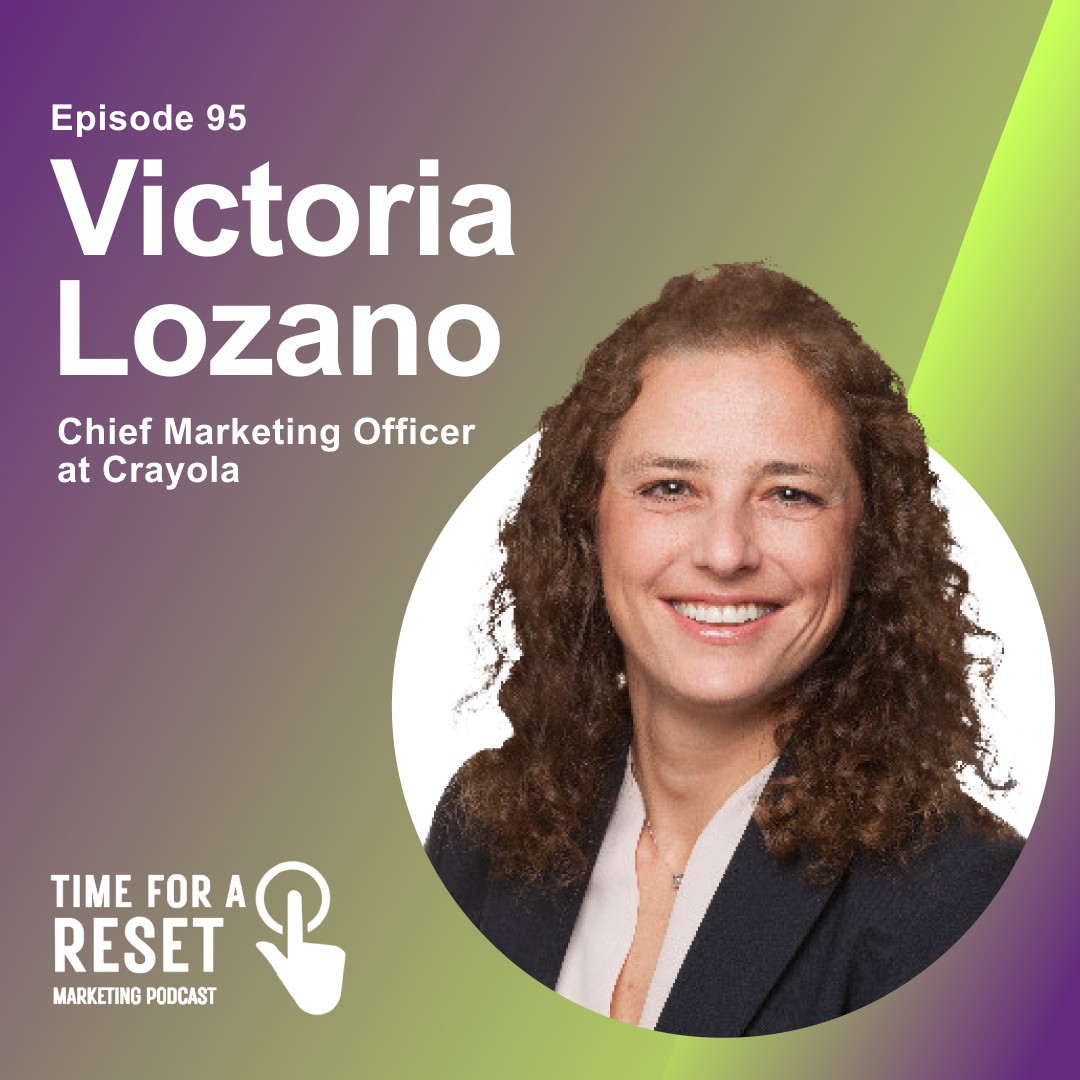
Nick King – 00:01:14: Welcome to Time for a Reset, the podcast where we sit down with marketing leaders from some of the world’s most beloved brands to uncover how they’re driving change in today’s fast-evolving world. Today, we’re joined by Vicky Lozano, CMO of Crayola, where she oversees all aspects of marketing and consumer engagement for one of the world’s most iconic and cherished brands. For over a hundred and twenty years, Crayola has been synonymous with nurturing children’s creativity. Today, it is recognized as one of the most culturally resonant, authentic, and trusted brands globally. In her role, Vicky leads Crayola’s consumer communications, partnership marketing, digital and omnichannel marketing, interactive app portfolio, and education marketing. She also oversees Location-Based Entertainment, which includes a portfolio of branded attraction and retail concepts that bring the Crayola brand to life in experiential ways. The flagship concept, Crayola Experience, has four locations across the U.S., with several more announced both in the U.S. and internationally.
Nick King – 00:02:11: Prior to joining Crayola, Vicky was the Vice President of Marketing at Cadbury North America, where she led the $1.2 billion gum and mints portfolio across the United States and Canada, including brands such as Trident, Dentyne, Stride, Bubblicious, and Certs. Prior to Cadbury, Vicky held various marketing positions with Fortune 500 companies such as the Miller Brewing Company, Warner Lambert Company, and Pfizer Inc. So, welcome to the podcast. Let’s start where we always start, Vicky. What would you hit reset on in the marketing industry?
Victoria Lozano – 00:02:31: I think, Nick, for me, it’s really this conversation and the notion and the debate between brand versus product, and how to invest between the two or how to prioritize between the two. And I just really very passionately believe that that’s not a conversation that we should be having, that you have to do both. The how and the balance might differ by brand and by business, but I fundamentally believe that consumers care and engage and participate with certain brands only if they actually understand what those brands mean and what they stand for. While, of course, every year, there’s innovation, there’s new news to share, there are new specific business targets to hit. I think for me, this reset on it’s one or the other—no. It’s really both. And it’s really around both the understanding and the engagement with the brand as well as supporting the ongoing priorities at any given point in time.
Nick King – 00:03:29: Yeah. I think that really resonates with so many CMOs that we talk to, that the days of just being able to do one are long gone. I guess on that, striking that balance, how do you do that at Crayola? Obviously, a company with such an established brand. Where’s your focus, and how do you strike that in your day-to-day role?
Victoria Lozano – 00:03:48: Well, I think, actually, for us, it’s just really important to be able to be very clear around our overall brand, what we stand for, what we mean, why we exist—not just what we do, which everybody is really familiar with, obviously—but really more is what is the purpose that we serve, and how does that show up in people’s lives? How can we be truly helpful? And a lot of that we do through our Campaign for Creativity, which really looks to drive awareness and establish understanding and really partner with parents and educators around creating simple creative moments that help kids develop creativity as an essential life skill. And it’s really around helping shift some of that societal conversation around what creativity is, why it matters, and what are some of the simple ways that you can actually nurture it as a parent in the day-to-day without creating another to-do list for yourself. And so I think for me, that is, as an example, is a way for us to both elevate the conversation around why we exist, what do we believe in, and something that hopefully connects to people at a much deeper, more meaningful, more personal level while at the same time continuing to support the great innovation that Crayola introduces to market every single year. I think that to us is really the dichotomy and how to integrate those two things and how to do them simultaneously. And we do it under the hashtag #StayCreative part of our messaging and making sure that that shows up across the entire ecosystem of what Crayola does. So whether it be products, whether it be experiences, whether it be content, and really have it be a holistic experience that gives parents, kids, and increasingly so, believe it or not, adults for themselves, a way to engage with the brand and actually find value in both of our messaging and in the products that we offer.
Nick King – 00:05:40: You touched on that #StayCreative hashtag that sort of is the umbrella. Could you give a little bit of a sense of how you brought that to life most recently or however recently is possible to talk about?
Victoria Lozano – 00:05:51: Well, I will say that Crayola has always very much believed in this notion that creativity is really important, and it’s actually essential, and it’s part of our core skills, life skills as people. But I think for many years, we were sort of used as an internal driver and inspiration for ourselves as a brand, as a business. And it was more recently that we’ve actually began to talk about this a lot more specifically out there with the launch of this campaign. We actually worked in partnership with the Ad Council Research Institute, and we really started with looking at understanding what do people actually think. We found some really important insights around the fact that creativity is valued, but a lot of times, parents don’t actually understand how to nurture it in a simple way. And adults who use creativity and hands-on creative experiences as part of their everyday life feel almost guilty because it’s not productive time. They don’t consider themselves good enough, and they don’t have something worthy to show as an output. And, therefore, should I, as an adult who has all these things to do in their life, be actually dedicating time for creative experiences that are just for the enjoyment and the joy that I get out of doing them? So, once we understood that people really care about it at a high level, but they’re really struggling with what we call also where the rubber meets the road on how to incorporate it in everyday activities or how to feel good about the fact that it’s okay to do it just for yourself. It’s okay to do it just because you enjoy it, not because you have to have something productive and show-worthy to come out of it. And when we launched the original Campaign for Creativity, we actually tapped into something that only Crayola could have done. We had this incredible archive of children’s artwork that was going up to 40 years old. And our initial campaign was with the idea was to actually reunite some of these original creators who were kids when they first did it, who are now obviously adults at this point in time, and help reunite them with that original artwork. Help remind them how meaningful creativity was to them when they were kids, how creativity actually is meaningful today, how it shows up in their lives, whether it’s for themselves, whether it’s for their own children, and really use that as a way of starting this broader conversation. That part of our campaign, our initial way, or initial chapter, if I call it that, actually won countless various awards including three Cannes Lions, and it’s a campaign that really started the conversation. In the most recent chapter, we went on to actually talk about the role that color plays in inspiring our creativity, how it connects us to nostalgic memories, to what sort of inspires us, and how it shows up in our everyday life. And we actually are currently working on the next third chapter of our campaign for next year. All of it really is to say, all of that, the message continues to be the same: Let’s remind people of the importance. Let’s help them incorporate it into everyday life through simple creative moments, but do it in a way that engages, that inspires, and helps them really connect with creativity in a way that many of us have not done since we were kids.
Nick King – 00:09:09: Yeah, I can very much empathize with that moment of, I think, some of the only creativity feels like it happens when you’re with your children, but I’m also glad that I don’t see any of my creative work from forty years ago. You’ve had a fascinating career spanning global brands like Cadbury’s, Miller, and now Crayola. How have those experiences shaped your thinking about the relationship between brand storytelling and product innovation?
Victoria Lozano – 00:09:34: I think product innovation is incredibly important. It’s a way to bring new experiences, whatever product category you’re in, and a way to both continue to engage your existing users, but also continue to hopefully bring new users into the category and into your brand. Frankly, I’ve never been on any business across various categories where product innovation was not important. So I think it is absolutely critical. What I’ve sort of seen over my career is the ability to extend the way that the brand plays beyond product innovation. And it’s not instead, it’s a yes, and. It’s continuing to innovate, but it’s also telling not only the bigger message about the brand, which I already talked about, but also having that brand message show up in a lot of different ways. And for Crayola, the way that it shows up is through other experiences like the interactive experiences, because at the end of the day, why should creativity be only on the physical canvas? Or whether it’s Location-Based Entertainment where you can create and curate these really engaging full family experiences that become part of your family memories. Why shouldn’t a brand play a part in your storytelling and how you curate those experiences? Or the kinds of content that we create to take Crayola into classrooms and how you use creativity to teach and learn core subjects like literacy, like math, like social-emotional learning, and actually align with educational standards. So I think what I’ve sort of learned over my career is your ability to bring the brand to life could be so much broader, and can be so much more integrated where you truly do create an ecosystem. And that offers a lot more opportunities to both connect, to engage, and to also bring your brand premise to life where product innovation continues to be at the core, but it’s also a much bigger relationship that you have if you actually leverage all those other levers.
Nick King – 00:11:39: Yeah. And I’m always curious, over your career, the rise of AI, analytics, and data—how has that sort of shifted in your time for you, and how are you approaching that in the world of Crayola?
Victoria Lozano – 00:11:52: Well, there’s no question that AI is here and it’s here to stay, and we have already kind of incorporated it in the way that we actually do the work. What I think is really interesting is on the consumer-facing side, where it’s just an average person interacting with AI, specifically as it relates to inspiring, enabling their creativity, and helping them practice those muscles. I’d like to think that AI does not need to be a replacement. It could actually be something that gives people courage to be able to explore and to create, and the way that you create might look a little bit differently. But at the end of the day, it’s the ability and the design and willingness to step into some of those things where some people may have been hesitant in the past. So I think what we’re sort of working on is how does Crayola show up in that place, but in a way that is also curated. And in the case of specifically for kids, unquestionably safe because no matter who I talk to, anywhere I go, most parents will tell you that they’re not comfortable having their kids have unconstrained use of AI tools. So I think for us, using that in a way that could be inspirational and enabling but also curated in a way that is safe would be the sweet spot for the core of our business.
Nick King – 00:13:10: Yeah. I would also say adults probably shouldn’t have unrestricted access to AI, and certainly some of the people I worked with in my career. Crayola is obviously one of the most culturally loved and trusted brands in the world. In your role, .How are you staying relevant and authentic with regards to the brand in new areas like digital experiences and Location-Based Entertainment?
Victoria Lozano – 00:13:32: First of all, I think we have to show up. Right? We have to be visible. We have to be present, and we have to deliver an experience that people value and they enjoy or, ideally, want to do again. So for us, it’s definitely being able to recognize that those are spaces that absolutely are complimentary for the business, doing it in a way that really brings the brand to life in new and exciting ways, and doing it in a way also that ultimately feeds that back into the ecosystem around, “Well, did you enjoy this experience? Hear, how you can continue to have more creative experiences and more creative moments at home?” So I think for us is really around not being afraid to explore. Some of those, frankly, wasn’t easy. Let’s just go do it, and we nailed it in year one. No, it wasn’t that. It actually there was a learning curve. There was actually a business model and the learning model that allowed us to really figure out how does this business work, how does it work for us, and what’s the—if you can get it down to—like, the formula for us goes forward that really untaps the magic of what delivers, but does it in a way that is consistent with our brand realities, with our economic realities, and there’s a business model that is sustainable. So I think for us, it is really looking at all of those points so that you can create not only the experience that matters, but also becomes a sustainable part of your business that you can continue to build on year over year. And to touch back on your point on your question regarding relevant and authentic, I think the balance for us, the sweet spot, is being able to tap into some of those positive, emotive, nostalgic qualities that the brand brings on. I can’t tell you anywhere I go, if I say I work for Crayola or someone actually sees my phone case, the first reaction I get is, “I love Crayola.” It is that instinctive reaction that we often get because of what the brand is associated with in a positive light of childhood. But at the same time, we want to be really relevant and authentic for where people are today. The nostalgia does not need to be old. Nostalgic can still be fresh and relevant, and it’s the ability to find those ways to create those, to participate in those cultural moments, help create new cultural moments, and hopefully, in the case of Campaign for Creativity, actually, to help change society in some positive way. You know, as you talk about authenticity, I think, to me, that’s an important way of helping the brand break through, but at the same time, do it in a way that resonates to where we’ve been and pushes us to where we’re going into what’s relevant to people today.
Nick King – 00:16:11: Yeah. And you hinted that you sort of learned on some of the iterations. Are you able to expand on that in terms of some of the things that maybe didn’t go quite right in those early days?
Victoria Lozano – 00:16:22: Well, I would say that probably applies to every single business that we’ve gone into. Right? I always say it’s like nobody bats a thousand. Right? And I think the really most important thing is to go in brand right because no matter what you do, you should be proud of what you’re delivering and making sure that it doesn’t just borrow, but it actually builds to your brand and you’re delivering a positive experience. So whether it was Location-Based Entertainment and how we show up in that space, whether it was in our interactive business, or whether it was, again, what we do in education in the classrooms, we have to be proud from a brand perspective of what we’re delivering. Beyond that, it really does come down to understanding what makes either one of those businesses or each of those businesses actually tick. What untaps it? What’s the magic sauce that makes it relevant, that helps make it pervasive, that makes it sticky, that people want to participate or buy or pay the admission fee? And I think it’s really that process that often took iteration.
Victoria Lozano – 00:17:34: Using Location-Based Entertainment as an example, it started with the concept. Do we have the right experiences? Do we have the right design? Are we engaging people? Are they staying long enough? Are they enjoying the kinds of experiences? Is that improving how they feel about the brand and how they want to engage with the brand once they go home? Then it went into how do we operate this, and what are some of the operational best practices and procedures that we need to implement so that we can, A, operate it well, deliver a good experience, but also manage the realities of the cost structure and what it takes to actually do that. And the third bucket was definitely a financial model. What does that actually take? What’s the capital required? What’s the operating cost structure? And for each location that we invest in, how much do we need up front versus what does the financial model look like on an ongoing basis? All of those were sort of overlapping, but nonetheless, their own areas of learnings that we’ve been able to, over the years, really fine-tune that we know what the model is. We know what the experiences are working and how we need to continue to evolve and upgrade them. We know what the financial model needs to look like and what the key levers are. And, really, at that point, it becomes just managing through the model given some realities of specific events that might happen in the course of the year. But I think those are just a few good examples of how we went from “Wouldn’t it be great if we could create this kind of experience that really curates how people experience the brand? And we could make it easy, and we could make it turnkey, and we can ensure a high-quality experience that they want to extend and have more of at home,” down to how does this become a self-sustaining, profitable business that not only makes us proud of the brand and the impact and the experience we deliver, but also becomes a sustainable and financially viable enterprise that actually helps extend our revenue stream into some new categories and new spaces. So, hopefully, that answers your question.
Nick King – 00:19:30: Yeah. No. Very much so. And just wanted to pick up on you talked about the brand heritage that Crayola has. Obviously, it’s so deep and so rich, and parents such as myself have experienced this, and our kids experience it again. How do you inspire your team to sort of innovate and break out whilst also paying homage to the brand that’s been established over so many years?
Victoria Lozano – 00:19:52: Well, I mean, I’ll give you a couple of examples. In fact, one is one I already talked about, but when we launched the campaign to help return find the original artists and return their art, that was really doing that from the marketing perspective. Right? A lot of the comments that we got on social, “I can’t believe you saved this all these years.” “I haven’t seen this art for thirty-five years.” “Oh my god. That was my brother’s. How do you still have it?” So I think kind of connecting to that childhood as we actually have the conversation for what creativity means and the role that it plays or should play in people’s lives and how it should be developed as an essential skill. That’s from an activation perspective as an example. From a product perspective, I’ll give you another one. Earlier this year, we launched a limited edition product, which was the return of some of Crayola’s retired colors. And back to this: how color helps inspire creativity, this was really going back to colors that some people grew up with, many of whom have not been seen for twenty-plus years, and we sort of took them out of our creativity archives and brought them back for a limited amount of time. And I think people were really sparked into this idea: “Oh my god. This was my favorite color when I was growing up,” and all the sort of the emotions and the feelings that that brings back, and the ability to sort of collect and buy something that you can keep as a keepsake of that connection to your childhood. So, again, that’s a product example. I think all of this will sort of vary as you go through. But as you could see from just a couple of those, is we found a way to do an activation. We found a way to do that in product. We have some collaborations, for example, in partnership or in our licensing collabs. So we actually had a partnership with Jones Soda that introduced the limited-time pack of Jones Soda flavors where the box looked like a crayon box and the bottles looked like crayons, and, obviously, they were bottle-shaped. But just a really iconic, but in a surprising category where you don’t normally get to see Crayola. And it’s a product that was actually sold out three times, and they kept trying to add some more inventory, and they kept selling out. So people were really sparking to this idea of seeing Crayola in an unusual way and unusual categories, but making it relevant, and a lot of the social conversations were obviously very much about how it makes them feel and how the product tastes, which was delicious, and really brought Crayola into the consideration set in a completely different way. And, like I said, in a category we don’t normally get to participate in.
Nick King – 00:22:22: Yeah. We touched a little bit on how you’re thinking about AI. But in a world where brands have to stand for something meaningful, what trends are you seeing that marketers like yourself and, I guess, beyond Crayola, how are they adapting to everything that AI is bringing to what they need to do on a day-to-day level?
Victoria Lozano – 00:22:42: I just think it continues to sort of level up the way that you collect data, the way they use data, the way that you can reach your consumers. I think the most obvious example that probably I could give is the use of AI in search. I mean, I think it’s already here. I think there’s a tremendous trend in data around consumer behavior around utilizing AI tools for basic search, which I think changes not only the search behavior, but also the shopping behavior and the way that you need to do new search optimization, the way that you’d need to create your content and your product information, the kind of assets that you create, how you actually disseminate all of that, and ultimately connecting to how you invest in your media so that the lower-funnel conversion actually is enabled. So I think that’s just one example very practically of where the change is pretty fundamental, and I think it’s only going to accelerate going forward because it is a very different experience if you’ve ever done it yourself. Right? It’s a very different experience, and I would argue definitely a smoother experience from a consumer point of view in terms of the amount of information you get and how it’s served up to you and the ease of accessing information you need with a lot less skill, frankly, required in the way that you search and how you search and what you actually review and navigate to get the data that you need.
Nick King – 00:24:07: Yeah. And I guess as we sort of look to the future, where do you see the Crayola brand heading? What’s the big challenge, and where do you see it evolving as we go through the rest of the decade?
Victoria Lozano – 00:24:20: I think continuing to elevate Crayola as a brand and the role that it plays in our lives, so whether it’s a critical life skill for kids, whether it’s just the sense of joy and wellness that it helps deliver for adults, I think continue to level that up in the way that we show up across products, experiences, and content. I think continuing our global expansion, because I think Crayola continues to have incredible opportunities in many, many places around the world despite already being present. I think there’s substantial growth opportunities. And then to continue to diversify our revenue stream when we look at new opportunities. I already talked about Location-Based Entertainment or interactive business. The work that we’re doing with Crayola Studios and what that team is looking at as opportunities to embed the brand in culture while at the same time opening up new revenue streams. I think all of those are examples of the way that Crayola is and will continue to show up in people’s lives that becomes really synonymous and part of the culture today. It’s not just the brand that I grew up with. It’s a brand that is relevant, that is really vibrant, and a brand that really shows up in meaningful ways across many of those levers, and it really is part of a bigger ecosystem. I think what people often are surprised by is to learn that our brand is actually bigger than our business. And I think the aspiration for Crayola is to grow into those shoes. We think there’s definitely an opportunity for this business to be as big as this incredible, majestic brand. And all the things that I’ve mentioned are these things that we have folks across the business who are bringing their passionate energy, their expertise of really being able to level it up and have Crayola play an even more meaningful role going forward.
Nick King – 00:26:18: That sounds like one of those things that is a nice problem to have when you’re on the outside. I can imagine that’s quite challenging on the inside having a brand that’s bigger than the business. We always finish up with just a couple of questions really about you as a marketer and as a leader. I feel like everything has changed so dramatically over the last five years, but certainly over the last twenty-five years. What are the most important attributes for a senior marketer that you’re looking for and what you’re aspiring to sort of move into as you continue your career?
Victoria Lozano – 00:26:50: I think some of the skills around critical creative thinking, and I think very closely tied to it is problem solving. I think having, you know, what you call it vision or whether you call it what I just called them. But it’s the ability to really say, “Where can we go? What can this business be?” regardless of what business that you’re actually on. And really reframing or framing it up in a way that creates not only an inspiration for people around you, but creates a viable business expansion and growth opportunity. And I think it’s the people who are often able to brave that kind of thinking that help redefining where the businesses go, how the brands grow, and kind of help reset the conversation and do some really brilliant things in the marketplace. So I think that’s one. And the second one to me that ties really closely into it is one of judgment. And I would say that’s one that’s not just for senior marketers. I would say that’s one of the skills that I value most pretty much regardless of the level that you are in the organization. If you have someone with really sound judgment, whatever that they’re working on, to me, it’s one of the skills that I value most in the folks that I work with to be able to say, “You know what? As long as we are really aligned as to what that big idea is, what we want to be able to accomplish, and what really matters if we’re aligned on that, and I trust your judgment to navigate that course,” there’s no greater gift as a leader, as a manager of being able to do that. So I think that’s a skill that I really value most, and I think I found that especially as I’ve personally gotten more senior and moved up the organizational titles, that is a skill that I’ve seen repeatedly over and over in myself, being able to trust myself and seeing where that actually plays well and plays as a strength.
Nick King – 00:28:48: Yeah. And then I guess always the hard one to answer, so being vulnerable for a moment, where are you looking to improve and be a better marketer?
Victoria Lozano – 00:28:58: Well, I think for me, it’s less about a one specific skill and more around at any given time, whatever is that I’m working on, is really one about being aware of your blind spots. And what I found through my career is that usually when something goes wrong, when it’s a launch that didn’t get the results that you had hoped or a campaign that just didn’t resonate, it’s usually not the things that you really sweat at the details on. It’s the things that you took for granted, where you said, “Hey. That’s the part I’m not worried about, and that’s the part that will be good.” Those are usually the things that come and bite you. And so I think for me, it’s always on anything that I’m working on is to do better, to improve myself, is to be aware of the things of what is it that I’m not paying enough attention to, what it is that I’m taking for granted that might end up being the linchpin? What is the orthodoxy, or what’s the assumption perhaps that I’m making that might not be right where everything else that you sort of worked on and built on falls apart because that one underlying assumption was actually not right? So I think that’s the one that, honestly, I always pause and push myself to think about because I have repeatedly found when I didn’t do it. That’s the thing that ultimately when I reflect, you know, in the past and you say, “Hey. What could I have done better? Why didn’t it work the way that I had expected it to work?” That is usually part of the core problem that may have been the case.
Nick King – 00:30:31: Thank you so much for sharing that. It’s been fascinating talking to you. I really appreciate your time. Thank you for joining us on Time for a Reset.
Victoria Lozano – 00:30:38: Thank you.
Nick King – 00:30:40: Thanks for listening to Time for a Reset. If you got something out of today’s episode, share it with a colleague or drop us a review. For more sharp thinking and practical tools to help you lead modern marketing, follow us wherever you get your podcasts. Until next time. Hit the reset button and get change over the line.