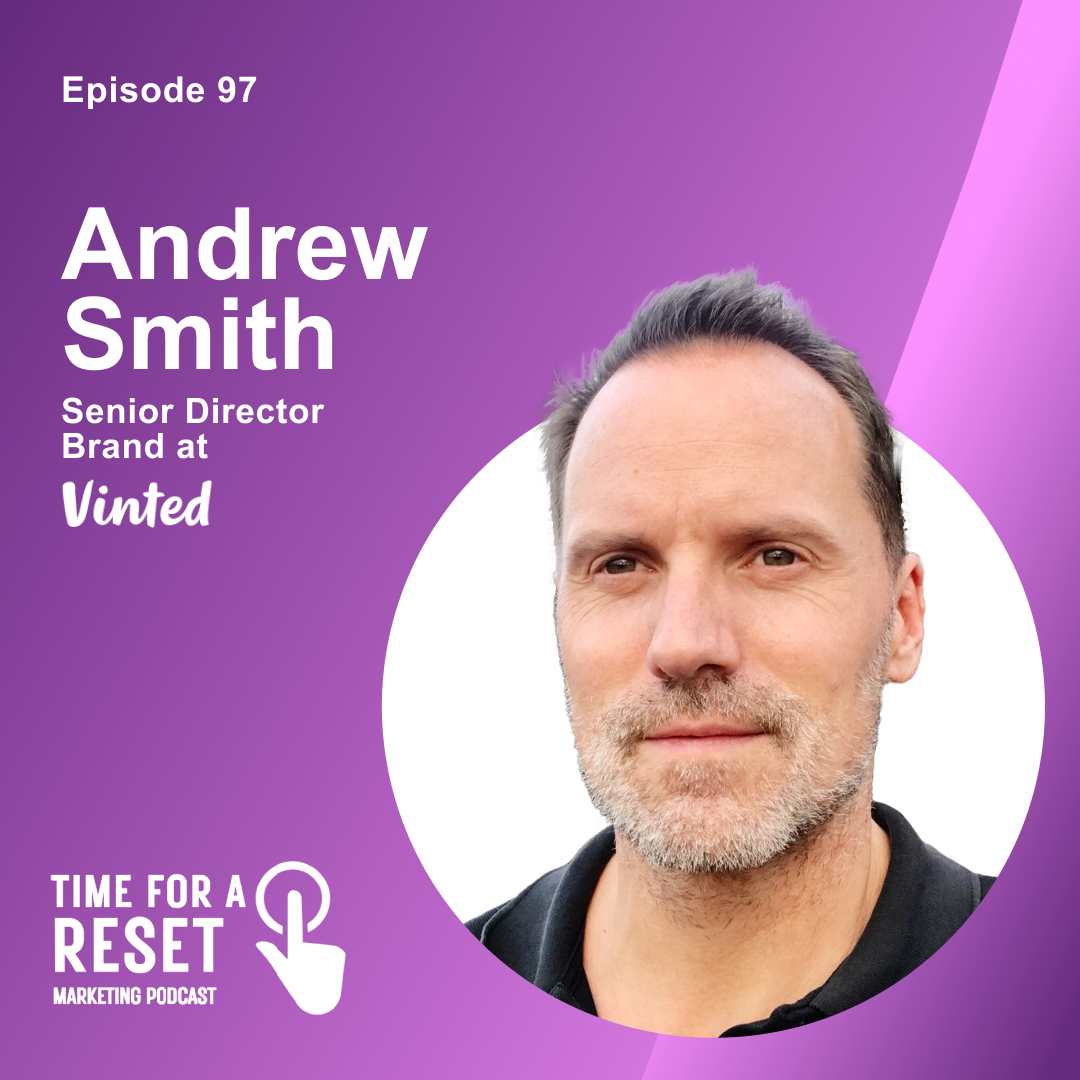
Andrew Smith – 00:00:01 Brand purpose is really, really important, and I think having a clear mission and vision for the company is absolutely critical. But at the same time, I think a lot of brands have spent years polishing big lofty statements. And I don’t believe that purpose has to be this aspirational theater. I find that when brands stop posing and they start being more radically honest, everything can get a lot better—whether it’s the work, the culture, the creativity, or the trust that you build.
Intro – 00:00:34 Welcome to Time for Reset, the marketing podcast that gets behind the thinking of the industry’s sharpest leaders shaping the world’s most iconic brands. We ask the big questions: What does it take to drive real change? How do you stay ahead when the rules keep evolving? From shifting consumer expectations to marketing’s seat in the boardroom, every episode dives into what’s working, what’s not, and what’s next. Expect smart conversations, real-world insights, and a bold perspective on modern marketing leadership. Let’s hit reset and turn strategy into action. Now, into the conversation.
Fiona – 00:01:09 Hi. Welcome to Time for a Reset. I’m Fiona, your host for today, and I’ve got the wonderful Andrew Smith with me from Vinted. Welcome, Andrew. Lovely to have you on the podcast.
Andrew Smith – 00:01:17 Lovely to be here.
Fiona – 00:01:19 Just by way of background, guys, Andrew is a brand marketer. He’s got quite an interesting background, actually, which will come out on this call because we’ve got some questions to ask about various parts of his career. Andrew has had a long time in the industry. He’s currently working at Vinted as Senior Director of Brand but has worked across scale-up companies, global organizations, and creative agencies, all the way back to his career as a consultant at the start.
Fiona – 00:01:43 He worked at Booking.com for quite a few years, leading a team there around Booking.com’s global and regional ad campaigns. He’s got a really interesting mix of tech, data, brand, and purpose as part of his background and has had some really interesting roles recently. I know, Andrew, you were CMO for VanMoof, the electric bike company. You’ve been an advisor for a mobility company and, obviously, now at Vinted. Do you want to maybe start by giving the folks on the podcast—the listeners—some of your background on your current job, what you’re doing at Vinted, and a little bit about the company?
Andrew Smith – 00:02:18 Absolutely. Well, Vinted is a marketplace platform for buying and selling secondhand goods. It started way back in 2008 in Lithuania. It is still headquartered there and grew into very much Europe’s leader in secondhand fashion—re-commerce—and has more recently expanded out into new categories and has recently also connected itself with the United States. So it’s been on a really interesting growth trajectory throughout its history, but especially since 2020 during the COVID period when closet cleaning, decluttering, and resale really witnessed a huge boom.
Andrew Smith – 00:02:57 Vinted also took that opportunity to build out its own shipping network. So completing not just the transaction on the marketplace, but then delivering the goods is also a core part of our business, which is really exciting because it helps us control more of the end-to-end experience for the customer and really helps us deliver better as an organization.
Fiona – 00:03:18 Yeah. It’s really interesting. Frequently, it’s taken off, Andrew. Like, I only started using the platform probably about a year ago myself. Same thing—cleaning up closets type of stuff.
Fiona – 00:03:26 And the number of people that talk about it now in the market is incredible. And an entire generation of people are starting to buy a lot more secondhand stuff rather than buying new things; it’s really changed the marketplace, I think.
Andrew Smith – 00:03:39 Absolutely. I became a user of the platform myself during the COVID period when I, like many other people, was cleaning things out and trying to look for a good way to get rid of the things that I didn’t want without simply throwing them away or casting them off into a landfill. This is when I was leaving Booking.com. I thought to myself, “I would love to find a job where I was still in brand marketing, and I was working for a tech company, but then really was trying to contribute to a sustainable solution to the world.” And I thought, “Oh, maybe Vinted would be a nice place to work someday.”
Andrew Smith – 00:04:11 And at the time, they didn’t have any appropriate jobs for me, but a couple of years later—I think it was two and a half years later—I was there in the company. So I’ve been with Vinted now for about two and a half years, since mid-2023. And my job as the Senior Director of Brand is to manage a wonderful team of people that look after everything from our brand positioning strategy as well as our messaging strategy that cascades into all of the campaigns that we decide to build and activate. There’s a product marketing team, which does a wonderful job of figuring out how we’re going to take new features to market and how we’re going to communicate with our community about how to best use the platform. We have an internal creative studio that looks like an agency, quite frankly.
Andrew Smith – 00:04:53 We’ve got concept teams. We’ve got designers. We have copywriters who focus a lot on CRM as well as product-level copywriting, and producers. And then, in addition to that, we have an operations and project management team, which has really helped us operate efficiently. So that’s a very strong and talented team, and I’m really proud to be leading them.
Fiona – 00:05:14 Awesome. Okay. So I wanted to start today just asking you about the question we ask all brand marketers coming onto the podcast, which is: What would you hit the reset button on in the marketing industry today?
Andrew Smith – 00:05:26 Yeah. Great question. And if anybody’s seen any of the speaking that I’ve done at some recent events, you probably won’t be surprised to hear me say that I would love to see a reset on how brands talk about purpose. Brand purpose is really, really important, and I think having a clear mission and vision for the company is absolutely critical. But at the same time, I think a lot of brands have spent years polishing big lofty statements that sometimes don’t always reflect the truth of what a company actually does, or perhaps it feels like a little bit of a stretch from the reality in which the company operates.
Andrew Smith – 00:06:00 And I don’t believe that purpose has to be this aspirational theater. It can really be important and lofty, but still rooted in reality. And I find that when brands stop posing and they start being more radically honest, everything can get a lot better—whether it’s the work, the culture, creativity, or the trust that you build. And I think the ultimate goal is that if customers cannot see a gap between what you say and what you do, then you can be congratulated because you probably have a really clear purpose that’s grounded in reality and something that people can really trust.
Fiona – 00:06:35 And you’ve led marketing across some pretty dynamic organizations. So you’ve got Booking.com, VanMoof, and now Vinted. How have those experiences shaped your view on radical honesty and what it really looks like in marketing?
Andrew Smith – 00:06:46 Yeah. I have had some very different experiences with this. And to be honest, I’ve learned a lot about radical honesty sometimes in the hard way, but also in a really rewarding way. I remember many years ago at Booking.com when we were working on a positioning strategy, which was quite a challenging project with a number of stakeholders and different people who were involved in thinking about how we wanted to position our brand. And there was this instinct, like a logical one and a well-intended one, that because of our size and our scale, we should be this big inspirational travel brand.
Andrew Smith – 00:07:18 But it took a while to lean into the truth and just sort of accept that Booking.com is a very large and influential company, but ultimately, it’s a very effective utility. And ease and value were the real story. Once we embraced what customers actually loved about us—like the speed, the reliability, the value—that’s when the brand strategy could really start to click. And then our work got sharper, and I think our effectiveness really accelerated. And I came to realize that there’s nothing unsexy about being brilliantly useful.
Andrew Smith – 00:07:51 You can position functional strengths and use creativity to find inspirational and entertaining ways in. So the whole idea of “Booking.Yeah”—if you are familiar with any of those campaigns—that whole sign-off was fun and memorable, but it was also actually built on the foundation that our message was that we get things right for the traveler. And so it really was a creative and energetic expression, but it was rooted in this realness that Booking was this really powerful utility as an application and as a marketplace. I think with VanMoof, this was an interesting example.
Andrew Smith – 00:08:25 So we had an enormous amount of brand love. It’s a beautiful product. The brand was crafted really well, and we were sort of “riding”—pun intended—this incredible infatuation that people were having with electric bikes and living better in your city. And I think this kind of brand love buys you a lot of forgiveness for a long time, but eventually, every brand gets held to account. And so I think if I could look back on things—and I’m not even exactly sure how we could have done it better—but to have owned up to some of the issues that we were facing in terms of quality and delivery would have been really beneficial because while transparency can create risks, honesty always costs less in the end than letting things fester in the shadows.
Andrew Smith – 00:09:09 And I think at Vinted was really an opportunity where I tried to reflect a lot at this point in my career on what I had learned. And I walked into a company and a brand that already had this incredibly bold mission to make secondhand the first choice worldwide. That was our mission. And it represents in and of itself a huge purpose. It’s about tackling waste, rethinking consumption, and making better use of what already exists.
Andrew Smith – 00:09:35 But even with that ambition, our positioning needed to stay anchored in the truth of what makes us genuinely valuable to people. And that actually was really quite simple. Vinted is, at its core, a functionally superior utility, and it’s this utility that generates a lot of love. Everything just works, and people love to go onto the platform to unlock value in things that they already own. That’s like our practical magic.
Andrew Smith – 00:10:03 We solve a real problem like waste and underutilization, but we don’t do this by preaching sustainability. We do this by making it easy and rewarding to give things a second life. And the byproduct of that has quite a nice impact on the utilization of resources and re-commerce.
Fiona – 00:10:20 It’s interesting you say that as well, particularly in e-commerce—that singular kind of focus on getting the utility right, and then people will come back. They’re bought into what the brand stands for, but functionally, if it’s not working, then people are still not going to stick around no matter how lofty your ideals are. And history shows that works in e-commerce in particular. Whatever you think about Amazon in this day and age, they certainly get the utility component of it right, which is why they were so successful, I think. And you see the really successful e-commerce brands doing the same types of things.
Fiona – 00:10:51 You are someone that’s worked in a role where you’re bridging creativity, data, and technology. How has your approach to marketing evolved over the years as the industry has evolved? Because, obviously, you’ve been in marketing a long time. It has changed so much, especially in the last five years, I think, with the speed of the technology changes. How’s that changed your approach?
Andrew Smith – 00:11:09 Absolutely. And I can’t even imagine how much it’s going to change in just a few years or a few months’ time even when we see the rapid evolutions of artificial intelligence. But I will tell you that my relationship with data has evolved a lot over the years. And I think back some years ago when I had far more of a creatively focused role and maybe prior to being in a technology and marketplace environment, I used to really feel like creativity needed silence from data or it needed some separation. It needed to be thought of on its own.
Andrew Smith – 00:11:41 And now it’s really obvious to me how much creativity needs data, but also the right data. The kind that reveals human behavior, maybe beyond just the dashboards that we see. Data can often tell us what’s happening, but we need to look also into it to find out why that something is happening. And getting at insights, whether they’re fully data-driven or combined between data and human observation, helps us get at the “why” that sits behind behavior. And I think once we understand that, creativity can really bring that to life in ways that feel new, which is really important.
Andrew Smith – 00:12:16 Creativity needs to bring something that is surprising and refreshing and captures your attention, but it also needs to feel familiar at the same time. You need to be able to look at yourself and see yourself in that idea or in that narrative. That’s when something resonates. But creativity needs to give it a fresh look and a fresh interpretation so that it captures your attention. I really think it’s data’s job to help us measure impact and maybe guide us towards a direction, but it’s not there to dictate imagination.
Andrew Smith – 00:12:42 And I think creativity is what gives us imagination.
Fiona – 00:12:45 That was my next question to you—especially asking people with creative backgrounds—about how you get that balance right between ensuring that the data and AI tools that are now available, which give you incredible flexibility, support authenticity rather than dilute it. In a world where there’s a lot of AI “slop” online now that is not great, and there are some great examples of where it has been great. So how do you get that balance right?
Andrew Smith – 00:13:11 I would say we’re still on our own journey to figure out what we can do with AI, how to harness it for our organization. I think it’s really natural that you look at AI and you see the opportunities that you have to generate efficiency, increase your speed, create things that are highly personalizable at a massive scale. But I think you have to make sure that you guide yourself with the right set of ambitions. Like, there’s no doubt that AI can introduce aspects that make you highly efficient, but there’s no sense in pursuing AI-generated content if your content doesn’t perform at least as well as your previous content, if not better.
Andrew Smith – 00:13:58 And so you need to also look and make sure that things work that you’re creating, and that’s partly about whether or not people are clicking or achieving the metrics that you’re looking for. It’s also understanding how people are perceiving this content. And I think that’s something that you can only research on your own. You really have to understand how your communities and your customers perceive this. We’ve seen signals where some customers say that they think it’s brilliant and innovative, and it’s a sign that a company is truly advanced if they’re embracing AI. And other people voice ideas that this is just a shortcut for brands who are looking to save money.
Andrew Smith – 00:14:22 So I think perceptions are still evolving. We have yet to even become a population that is truly accustomed to AI-generated content. And I think like many things, it’s going to have its role, and we just need to find what the right role is for your brand and your community. Another thing that’s on my mind a lot about AI is what does it do to your long-term distinctiveness? I think, of course, the tools, when embraced, can create new formats and new ways of expressing your brand that didn’t exist before.
Andrew Smith – 00:14:52 So we have the opportunity to make our brands even more distinctive than they were before. But as you mentioned, there is quite a lot of focus on volume with AI, and things can dangerously converge to the middle. And the middle is where mediocrity and a lack of distinction sit. So we have to be quite vigilant about how we’re using this, how we’re telling ourselves whether or not it’s successful, and then just making sure that we don’t lose sight of the long-term needs of the brand, which is very much staying true to purpose, truthful, and also distinct.
Fiona – 00:15:26 Many marketers talk about purpose and personalization, but it can often sound quite automated or overly polished. How do you guard against that?
Andrew Smith – 00:15:34 Yeah. So I think Vinted is a really fascinating example because we sit at the intersection of purpose and commerce. So we’re a marketplace, but what people are doing on our platform is culturally meaningful. They’re giving things a second life. And just as you mentioned in the introduction, younger generations are fundamentally shopping in different ways.
Andrew Smith – 00:15:56 I remember when I was younger, there were stores that you would go to to buy your new clothes, and then you would occasionally go to a thrift store. Or what was emerging at the time in terms of vintage shops, which sounded always really sort of exotic—things that you would just really look for certain occasions or if you had a particular style, you would look for things in these shops. And today, when I speak with my nieces and nephews, it’s like the two—firsthand shopping and secondhand shopping—just blur together in terms of this general idea of shopping. And in fact, many of them are just only shopping secondhand. They don’t even call it secondhand.
Andrew Smith – 00:16:31 It’s just the way they shop. They buy things secondhand online. They wear it for a while, and then they resell it. And so there’s just this different perception of what shopping and consumption and buying clothing or other goods even means. But for Vinted, we’ve tried to build this positioning on truth and aspiration.
Andrew Smith – 00:16:49 So our mission is to make secondhand first choice worldwide by making it easy for the world to make the most out of what we already have. And I think the way we really try to keep that real is maybe best exhibited in the brand idea that we’ve been building our campaigns on. And the idea that sits on top of or behind—or builds upon—our mission is this brand idea of “New Again.” And it’s more than language. It’s an idea that we try to get across in a lot of our communications.
Andrew Smith – 00:17:18 And on the very most basic level, it helps us communicate what Vinted does at its core. Like, “New Again” means we give things a second life. But you know, the idea can stretch itself to more of a human feeling of a renewal and resourcefulness. So slightly more ambitious, but then at the same time, still feels very real because we know that this taps into what people say to us about how they feel when they shop secondhand. And then if we were to look at its biggest possible definition, “New Again” itself challenges what the definition of new is altogether and asks us: Do we need things new, that have labels and sit on a rack?
Andrew Smith – 00:17:59 Or does “New Again” just mean that it’s new to us? And is it a new way of thinking about consumption?
Fiona – 00:18:05 You touched on just then operating at that intersection of purpose and commerce with the type of sustainable fashion you’re doing. And this is an interesting use, I think, of AI, and it’s particularly one of the best uses of AI: being able to produce assets in multiple versions of language with different images that are resonant for the different markets. And so I wanted to ask you a little bit about that. How do you ensure that your brand stays emotionally resonant as it scales across diverse markets and cultures? Because that is a big challenge for a lot of global brands like yourselves—trying to make sure that the message that you’re trying to get across stays consistent but is also localized enough that it resonates with the local culture.
Andrew Smith – 00:18:45 Yeah. That’s a really interesting question and an interesting challenge at Vinted. And we’re a very, I guess you would say, centralized organization—both quite literally in terms of how we’re organized, but then also how we look at campaign development. Like, we really try to create core ideas that we feel can travel really well and be leveraged across multiple markets. And I think we benefit from knowing that at the core, what motivates people to use Vinted is very common across a lot of places.
Andrew Smith – 00:19:16 So that can go back to talking about how our value as a utility and our usefulness is really what resonates across markets. And so being able to sell things and find really good deals—that’s kind of a fundamentally strong economic motivator no matter what market you’re in. And so our job is to really harness those fundamental insights, but then tell our story in an increasingly refreshed and innovative and creative manner. So I think it is quite possible for us to stay very core to our messaging and our identity and scale that across markets. But indeed, you’re right.
Andrew Smith – 00:19:50 Every market is different. And so while maybe there’s some variation in the perceptions of secondhand shopping, what’s more relevant is just the general maturity of that market for Vinted. In some places, we are already a very mature brand where we’ve been communicating for a long time, be that France or the UK. And there are newer markets that we’ve just gone into where we are needing to talk to people about who we are and then also what it is that we do. So we do have to kind of stretch the communications to calibrate them so that they’re appropriate for the market, and we do that across different channels.
Andrew Smith – 00:20:25 While our core TV assets might be largely consistent, within the online channels, we’ll start to vary things a little bit more or run campaigns that are appropriate for a market that’s just getting to know Vinted. But I think one of the things that we also really do is that we just lean into different formats to do some of the cultural resonating work that we have, and we’re quite active in influencer marketing. And a lot of those campaigns, we can tap into creators and talented influencers who are really strong in a particular market and really resonating with the local culture. And likewise, we are fans of doing TV partnerships where we can collaborate on the creation of a show with a TV channel. And some of these things are very culturally resonant within the market.
Andrew Smith – 00:21:11 I mean, we partnered with Big Brother, for example, last year in the UK, and this was a TV moment when the program came back. And we had the opportunity to partner with that asset to make ourselves really relevant in the context of the show, but at the same time, be really relevant in the context of a cultural moment for the UK.
Fiona – 00:21:30 You just touched on something there about the strength of influencers now in this space and particularly in the e-commerce space. In a world dominated by the influencers’ AI and those polished brand narratives, where do you see marketing going next? Like, how do you see it developing over the next couple of years?
Andrew Smith – 00:21:46 That’s a really good question. I mean, I think that especially when it comes to AI, I think there’s no doubt that we’re seeing AI prove its power. I mean, we might not really know where it’s going to go exactly, but the debate over whether or not it’s here and it’s going to impact us is really not a question anymore. I think that one of the bigger questions, and I was just mentioning this before, is how people are going to feel about AI-driven creativity over time. Like, as I mentioned, some people in research see it as wildly innovative and quite a strength for a brand to be embracing it.
Andrew Smith – 00:22:21 And then other people see it as a shortcut to what they perceive as just sort of average content. And I think if your personalization strategy makes everyone sound like they graduated from the same marketing boot camp, then you’ve lost your way a little bit. You need to find a way to enjoy the benefits of this efficiency but use the technology to strengthen your brand. We need to look at it, not just through that lens of efficiency, but we have to look at what it does to performance, the perception of our brand, and distinctiveness.
Andrew Smith – 00:22:54 And using the same tools as everyone else, we do really risk sounding like the same brand, and the onus is on the brand to really monitor that over time. I think it would be foolish to pretend that I or anybody knew exactly where this was going to end up. I mean, it’s all moving so quickly. There are new content types and channels and interactions. All of these things are emerging so quickly that predicting the future is guesswork, to be honest.
Andrew Smith – 00:23:18 I just truly try to be sensible, embrace and explore and create with a really open mind, and stay super adaptive.
Fiona – 00:23:27 To me, it’s like any new technology where you’re still figuring out how it’s going to play, how it’s going to work well for you, and how it’s not going to work well, and learning the lessons. And like any tech, well used, it’ll produce fantastic results. Badly used, you can see it already in some creative that’s been produced that’s clearly AI-generated that doesn’t have that human connection to it, and then others that are simply hilariously funny—like excellent use of AI to create some crazy campaigns that you’ve seen already that are grounded in humor. And, obviously, AI leaned into the fact that it’s AI. It has given it a bit more resonance for people.
Andrew Smith – 00:24:04 Yeah. As we’ve run some experiments, I think one of the things that has stood out to me—I mean, obviously, there is some efficiency to be gained—but it also shifts quite a lot of time internally when you’re going to generate this content. Like, things that you used to have done externally are now done internally, and, of course, everybody will get better at it over time. It is quite a big adjustment, and it is a steep learning curve. But in some of the things that we’ve experimented with over the summer—and I think some of these assets are running right now in the UK and a few other markets—you’re probably seeing them.
Andrew Smith – 00:24:35 But it’s opened up a new creative format for us. Doing animation was previously out of bounds for us because we didn’t have the time or the money to invest in it as a form of craft for the brand. And AI was actually really very friendly to this. I mean, of course, it took a lot of time to generate the images and get it right and get it all moving in a way that we could cut together a film that we thought was really working. But in the end, it actually is enabling us to embrace an executional method that we just didn’t have much of an opportunity to use before.
Andrew Smith – 00:25:08 I find that really exciting. So if used to replace what you already do really well and efficiently, I don’t know if that’s the best application. If used in a way to do things that were previously off-limits because they were too resource-intensive—or just simply the technology makes it quite friendly to do these kinds of things—I think that’s where some really exciting things lie ahead.
Fiona – 00:25:31 You’ve led creative teams across global giants and agile startups. How do you foster that culture of creativity and honesty in your team? Especially when we always ask our brand clients—in a world where commercial pressures are high, particularly when you’re in the e-commerce world where it is so easy to measure the results of the work that you’re doing—how do you balance that staying creative and honest while also serving those commercial pressures for performance?
Andrew Smith – 00:25:57 Yeah. Indeed. I mean, commercial pressure is a constant, especially when you’re in a marketplace business, but how we respond to it is a leadership choice. And for me, data and KPIs keep us really honest about our impact, but I really try not to let them suffocate any level of ambition. So data can help us measure what we’re able to achieve, but they don’t at all dictate our imagination.
Andrew Smith – 00:26:20 And I think, actually, one of the biggest evolutions we’ve made at Vinted is embracing the constraints as creative catalysts. So we study our creative extensively. We test our content, research, and do post-campaign analyses. And we’ve really come to a great understanding of what our strategic brand assets are and the kinds of things we need to do consistently in our work that are building memory structures and driving our distinctions. And these things then become mandatories in briefs.
Andrew Smith – 00:26:50 And then, of course, every brief has a commercial goal attached to it. So on one hand, this might sound really restrictive, but I think one of the beautiful things is that when you simplify a brief down into a few non-negotiables, it actually opens up the creative playground immensely because it removes a lot of the guesswork. It focuses the thinking. And while you might say that there’s a handful of things that must get done, how we do this is an open creative playing field. And I think one of the examples that we’ve done while I’ve been at Vinted is the “Too Many” campaign.
Andrew Smith – 00:27:26 And if you’ve seen it, you’d probably recognize it. It’s a campaign where we’ve got a number of ads where people are literally wearing all of the things they own, whether it’s 15 hats or seven pairs of sunglasses or whatever it is, just visualizing humorously this insight that we all have a few too many things. And the beauty of this campaign is that it’s incredibly performance-oriented. So whether it comes down to when the brand needs to be introduced in order to drive memorability or how we’re doing the sequence at the end that demonstrates how you utilize the application—there are some really functional, mandatory elements that have been included in that brief.
Andrew Smith – 00:28:04 But basically, it was completely open to coming up with this fresh and sort of culturally sharp way of reflecting to people an honest truth that we all feel, which is like, “My goodness. I have overconsumed to the point where I couldn’t possibly wear everything that I have.” And I think it sort of landed the message, and that was just pure creative imagination from the team.
Fiona – 00:28:28 How brilliant. I actually do know the campaign. It was quite funny. Do you find it harder to maintain that authenticity in your campaigns working at a larger, more structured organization compared to a scale-up, or does it not really make a difference to you?
Andrew Smith – 00:28:43 I think, honestly, the creative challenge is the same whether you’re at a big company or a scale-up. You want to make something meaningful that moves the business. Probably what changes with the size of an organization is the number of stakeholders, and that can really complicate things for sure. But that’s where leadership comes in, whether it’s the team or coming down to the person who’s in charge of the team. It really comes down to how strongly you can lead through those complexities.
Andrew Smith – 00:29:10 But I think one of the biggest things is honestly having a really clear decision-making framework within the organization. And that can exist in a small organization and a large one, and it can also be lacking in a small organization and a large one. And I’ve certainly been through every permutation of that environment. And, thankfully, we have a culture that’s really committed to clear decision-making at Vinted. So we have the benefit of working in that structure and really keeping the team focused on their work and what’s going to make a meaningful outcome.
Andrew Smith – 00:29:43 And then thankfully, we can navigate fairly efficiently through decision-making.
Fiona – 00:29:47 You’ve worked at lots of different brands with very different DNAs. So what have been your biggest lessons about connecting brand truths to business growth? Was there, like, ever a moment where the “radical real” didn’t go to plan? And what lessons did you take away from that?
Andrew Smith – 00:30:03 I think one of the consistent things in my career has been that anytime I’ve tried to impose a narrative on a brand, it seems to have slowed things down. Like, either because it didn’t end up leading to an execution that was really impactful or it just, for some reason, was contrary to who the company really was, and therefore, it struggled to gain internal traction. And then as I’ve started to accept what the brand truly is and build from there—so, for example, coming to terms with the fact that while there are many inspirational, aspirational aspects of what Booking.com does, its strength lies in its utility, and let’s use that as a start point and build from there.
Andrew Smith – 00:30:47 And I think I took the shortcut and leaned into that aspect at Vinted and started there to begin with. And I think that always just has really helped the business accept the positioning, and then that’s just let the work move along a lot faster. So I think you really need to leverage the brand and its DNA to build long-term relevance and distinction. We often talk about strategic moats in our business, and so we talk about cost advantages and technological superiority—things that ensure you build these moats and these protective barriers so that it’s really hard for the competition to come in and disrupt you or take over.
Andrew Smith – 00:31:26 And I would love to think that brand distinction can also really serve as a moat in this kind of race to build competitive advantages, but it’s this distinction that needs to be based on something truly meaningful and real to your customers and your community. I believe that we’re on our way to do that at Vinted, and I think a DNA that is very performance and technology-oriented really helps us achieve this because they love to see us measuring our brand preference, and they love to see us measuring our brand distinction. And as we can see ourselves grow that over time, that’s something that’s very native to an organization with a DNA like Vinted and, ultimately, really healthy for the brand.
Fiona – 00:32:08 For marketers listening, you’ve been through it. Right? So you’ve experienced it yourself. But how would you advise them to start stripping back that polish and lead with honesty in their own organization? So what sort of obstacles would they have to overcome to get to that level that you’re operating at at Vinted?
Andrew Smith – 00:32:23 I think if you want to strip back the polish and lead with honesty, try saying in one sentence what your brand actually does for people. So strip out the jargon, forget the slides, really think about your product, your marketing, and the culture, and whether they all line up together. I think it’s that test: if you can just really quickly say something to your colleague, your friend, your mom, your dad, whomever, in one sentence, that they’ll sort of nod and really get what you’re about. And it doesn’t have to be a sexy idea or concept. It can be something really straightforward.
Andrew Smith – 00:32:59 And that’s your start point. That doesn’t mean that’s where you have to end up. I mean, when somebody asked me at the very beginning, “What do you think it is that Vinted really does? Like, no BS, strip it all back,” the first words out of my mouth was not “New Again.”
Andrew Smith – 00:33:12 That’s not where we started with saying. We started with saying, “No, we really make it easy for people to get the most out of what the world already has.” Like, that was just a sentence that we landed on. And from that, we could build ideas that were rich with emotion and rich with character and felt really culturally resonant. But it really started by just being really quite simple and honest about what we felt our true strengths were and what people really valued in us.
Fiona – 00:33:35 And looking ahead, Andrew, what excites you most about where marketing is heading now? We’ve talked a lot today about authenticity, purpose, and AI-driven creativity. What are you excited about?
Andrew Smith – 00:33:46 Yeah. I need just to stay consistent with the theme. I think that there’s an era of a bit of honesty—proof over polish, I guess we could say—that we might start seeing in more and more brands. I think after this wave of well-intended but sometimes self-important moves to be really rich on purpose, maybe the world is ready for a little bit of a reset, if you will. They really want to understand more honestly what brands are delivering and see less posturing, less promising. I mean, promises are important, but maybe less overpromising, and really get a sense of truth-based purpose that feels important to them.
Andrew Smith – 00:34:22 Purpose will also mature. It’s not just about having beautiful statements. You’ve got to show your receipts. You’ve got to show your proof. We do a societal impact report every year where we really try to share our science-based objectives that we have around what we’re measuring as being the impacts that Vinted has on consumption and ultimately sustainability.
Andrew Smith – 00:34:45 And these are studies that we commission, and these are data points that we come up with. We really want to show our receipts, and whatever it is that they tell us, we want to share with the world what it is. And I think that’s also a part of being accountable and being honest.
Fiona – 00:34:59 Yeah. Especially in that purpose-driven space, you want to come across as functional. You’re actually providing something that’s useful to people and doing something good without preaching. At the same time, it’s quite a balance to get right, isn’t it? Earning that trust from people without constantly banging on about how fabulous you are.
Andrew Smith – 00:35:17 Absolutely. And that’s the interesting thing at Vinted. Like, when we do our campaigns and we do our messaging, we really lead with what value it gives to our community. So you’ll see that most of our work is about creating value for sellers, creating value for buyers, and what it’s like to be part of the Vinted community. We know that there’s ultimately an effect that all of this has on consumption, and therefore the effect that it has on waste, and therefore the effect that it has on other societal indicators.
Andrew Smith – 00:35:46 But they’re usually not the messaging that we lead with because what we’re literally doing for people is providing value on an individual basis. Like, we are a platform that helps solve problems that people have with having just too many things, or things that they’re not using enough, or things that they want to find another use for. That’s the immediate value that we provide. And then there’s a cumulative effect, and that’s something that we will talk about, but usually as part of a study or a part of another effort that’s not necessarily our leading communications.
Fiona – 00:36:17 Well, we always like to ask this question on the podcast, Andrew. For the future marketers, what do you think the most important attributes are for a senior marketer of tomorrow?
Andrew Smith – 00:36:26 I think a senior marketer of tomorrow has to be a genuine hybrid. And “hybrid,” I think, implies that it’s like a couple of things mixed together when, in fact, it’s probably a mixture of about 18 different things these days. I think somebody who’s really comfortable in creative reviews and discussions, but then as well comfortable sitting in front of a room of board members and discussing the health of the brand, the health of the marketing department overall, and the value that marketing is delivering. So someone who can think in terms of quantitative aspects of performance, but also very narrative and qualitative aspects of creative. Someone who can think of systems, not just campaigns. And, of course, I’d be remiss not to say that you need to be really engaged with finding the truth, being culturally aware.
Andrew Smith – 00:37:13 And then, of course, let’s not forget somebody who can find humanity in this world of AI.
Fiona – 00:37:19 Absolutely. My follow-up question was: marketing is changing all the time. What are some of the things you’re working on yourself to continuously improve and learn new skills, new tools to be a better marketer?
Andrew Smith – 00:37:30 Yeah. Well, at this point, after my twenty-plus years in the industry, I’ve sort of become an old dog in a world of a lot of new tricks. So I think one of my own biggest challenges, quite frankly, is I need to find time to slow down and think deeply in a world obsessed with speed. There’s a lot coming at me. There’s a lot coming at my team.
Andrew Smith – 00:37:49 I need to keep up with a lot of things, but I also need to make space to really digest information and what’s important. And so I think a lot of that has come down to time management. Interestingly, I do find that AI has helped me create a lot of time that I didn’t used to have. Like, it is true—the things that it can help you accelerate doing that used to be quite time-consuming make a material advantage in the day. And I actively try to reinvest that time into journaling and reflecting, taking time to meet some new people who have ideas that I would like to know more about, working on my network, and investing in my team to lead them better and to give them more time, to offer them more of my time and mentorship.
Andrew Smith – 00:38:41 I think another thing I have to work on—or we’ve all had to work on—is sometimes letting go of perfectionism because, of course, we want things to be high quality and be as perfect as they can. We also know that time is something that is very difficult to slow down. And so sometimes, in order to move along at pace, we do also need to remind ourselves that getting something out as best as we possibly can get it is also more effective than not getting it out at all. And so really trying to keep all of these things in balance is a constant challenge.
Fiona – 00:39:00 Well, sometimes that speed is the marketing moment, and hitting it at the right time is actually more important. Sometimes for the cultural moment, trying to get something out the door is sometimes more important than having it perfect. So I love that. I’m glad to hear another marketer say that because I find the same: the biggest benefit for me from AI is creating the space to think more creatively. So automating the things that you can so that you’ve got more time and space to think about what the next thing is you want to work on rather than just speeding up and doing more and more and more—just giving yourself the space to think and ideate with your team. It’s a bit of a gift, isn’t it?
Andrew Smith – 00:39:33 Yeah. And I think one of the things to be really careful about is that with AI, like any technology—but especially with AI—it gives you the ability to generate so much more. And whether that’s, like, of course, in advertising content or communications content, but then also just within your own life and world. If you’re curious about a topic or something like that, you can have a chat with AI and then suddenly you’ve got just pages and pages of ideas and stuff. And so even though it can really help you accelerate and it can help you generate more work, we always just have to constantly remind ourselves about what is really important to focus on. And do I need to do so much, or do I need to do more of the more meaningful work? And I think that’s something that’s quite hard for technology to tell you exactly what that is. That’s ultimately up to you and what you believe is a valuable investment of your time. And I think that’s the constant tension that I have to live with. Like, just because I can do a lot more, should I be doing a lot more, or should I be creating space to really think about an idea or to really work with somebody on my team who I feel can benefit from more of my time?
Fiona – 00:40:38 Yeah. Sometimes more is not better. It’s just more.
Andrew Smith – 00:40:41 Precisely.
Fiona – 00:40:44 Well, thank you so much. It has been fantastic talking to you about a couple of other topics. It’s been great chatting with you, and thanks for joining us on the podcast.
Andrew Smith – 00:40:51 You’re very welcome.
Outro – 00:40:53 Thanks for listening to Time for a Reset. If you got something out of today’s episode, share it with a colleague or drop us a review. For more sharp thinking and practical tools to help you lead modern marketing, follow us wherever you get your podcasts. Until next time. Hit the reset button and get change over the line.