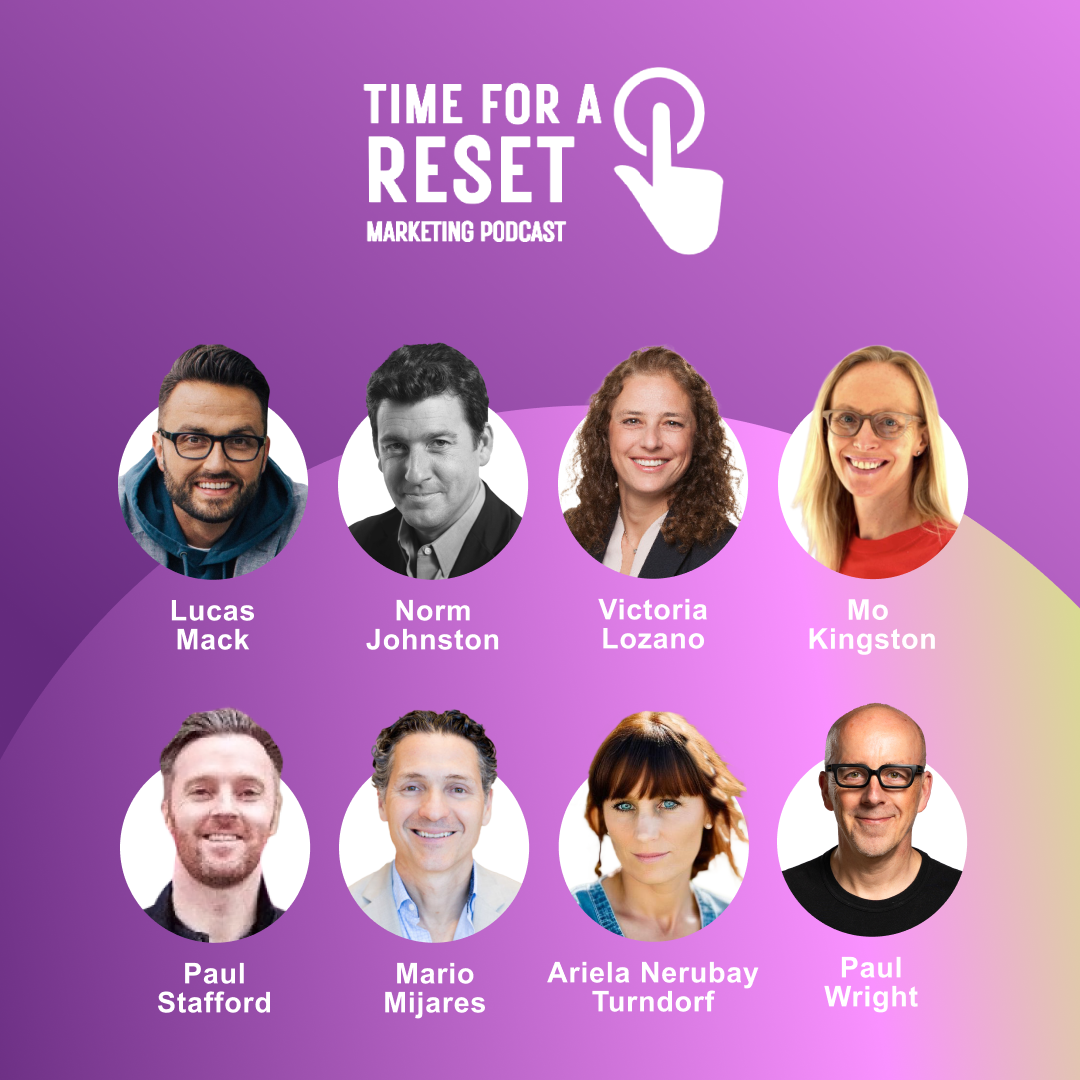
Intro – 00:00:02: Welcome to this special “Greatest Hits” episode of Time for a Reset brought to you by Overline, where we look back at some of our key conversations with senior marketers about the big challenges reshaping our industry and how they’re navigating an increasingly complex landscape.
Today, we’re bringing together some of the most compelling moments from conversations we’ve had throughout 2025. These episodes were hosted by the leadership team at Overline, including Nick King, Paul Frampton-Calero, Fiona Davis, and Tiffany Wilburn.
Each highlight explores what it truly means to reset marketing for growth, relevance, and impact. You’ll hear perspectives from global brand leaders spanning CPG, retail, financial services, and media about balancing brand and performance, simplifying complexity, and unlocking the power of data and cultural relevance. These conversations reflect the thinking that defined the year and will shape what comes next.
Let’s get into the moments that mattered most. We start with Tiffany Wilburn in conversation with Lucas Mack, Senior Director of Brand Marketing and Communications at Kubota North America. Lucas challenges the industry’s overreliance on data in isolation. He argues that while data provides the what, it is storytelling and purpose that provide the why, the essential context needed to drive true business growth and customer acquisition. He urges leaders to reset their mindset and view creativity, not as a soft skill, but as a commercial necessity.
Tiffany Wilburn – 00:01:27: What would you hit reset on?
Lucas Mack – 00:01:29: This is a really great question. It gives, all of a sudden, ultimate power to the person answering. What it would be for me would be changing executives and leaders within corporations—no matter the size—on the value of storytelling, purpose, and creative as drivers to grow business, customer acquisition, and retention for employees, rather than just what I hear all the time: “What does the data show?”
Data without story and context is not the answer. I think it triggers a lot of leaders when you ask more emotional questions because that’s just not how the business culture typically is developed, but that’s what humans are craving. And so, helping leaders understand that—that’s what I would hit the reset button on.
Intro – 00:02:21: Building on that theme of trust and truth, we move to the publisher’s perspective with Norm Johnston, Senior Vice President of Global Advertising Strategy at News Corp. Speaking with Fiona Davis, Norm highlights the industry’s approach to brand safety. He reveals how outdated keyword blocking is demonetizing quality journalism by flagging safe content as risky based on clumsy algorithms, sharing a staggering example of how this technology gets it wrong.
Norm Johnston – 00:02:52: The brand safety thing is particularly annoying, and we are doing quite a bit of work around that. I’m not sure, in most cases, people are educated enough on what’s happening in that world.
I’ll give you one example. We’ve just done a test in the UK with a company called Illuma, which is, again, AI. So this is an opportunity to use AI and have a better contextual understanding of the semantics in an article.
We did an A/B test of Illuma versus one of the main solutions in the market right now—one of the big scale ones. I won’t get into the name. And the results were staggering. I mean, just unbelievable. I’d say about 54% of the articles got blocked. And once an article gets blocked, the value goes down significantly, CPM-wise.
Over 50% of what was being blocked was unequivocally brand safe. It was an article in The Times newspaper around winemaking in the days of Troy, about 1,500 BC, I think. And it got blocked for “drugs.” Which is not good for us because it was a very good piece of journalism. It’s not good for readers who are interested—you know, there are probably some big wine-drinking history fans—and not good for advertisers who would probably want to target some of those people.
So the solutions that are in the marketplace right now do not work. We have the statistical data to suggest that. And I don’t think they’re bad people, but they’re sitting on technology that is not doing any favors to advertisers, consumers, or journalists.
Intro – 00:04:34: Next, we shift our focus to brand strategy with Nick King speaking to Victoria Lozano, Chief Marketing Officer at Crayola. Victoria challenges the false choice often presented to marketers between investing in brand versus investing in product. She argues that long-term growth depends on doing both well, explaining that brands only earn engagement when consumers clearly understand what they stand for.
Nick King – 00:04:56: What would you hit reset on in the marketing industry?
Victoria Lozano – 00:04:59: I think, Nick, for me, it’s really this conversation and the notion and the debate between brand versus product, and how to invest between the two or how to prioritize. I really, very passionately believe that that’s not a conversation that we should be having—that you have to do both.
The how and the balance might differ depending on the brand and on the business, but I fundamentally believe that consumers care, engage, and participate with certain brands only if they actually understand what those brands mean and what they stand for. While, of course, every year there’s a very practical side—there’s innovation, there’s new news to share, there are new specific business targets to hit—I think for me, this reset on “it’s one or the other” needs to happen. No, it’s really both. And it’s really around both the understanding and the engagement with the brand, as well as supporting the ongoing priorities at any given point in time.
Intro – 00:05:57: Next, we have Paul Frampton-Calero in conversation with Mo Kingston, Global Marketing Strategies Lead at Nestlé. Mo reflects on the need to reset marketing’s obsession with activity over impact, urging leaders to simplify, focus on growth, and ensure marketing is seen as a value driver rather than a cost center.
Paul Frampton-Calero – 00:06:15: If you had a big orange button on the table that you could hit reset on, what would you change in the marketing industry? You’ve worked at many different big brands and probably seen many different models for marketing. So what would you change?
Mo Kingston – 00:06:29: If I had a reset button, there’s probably many things I could hit reset on in my life. But in work, it would be confusing busyness for progress.
And I guess behind that is, unquestionably, marketing has “complexified,” and that can be seductive because we spend lots of time doing lots of stuff. I think that’s actually driving progress, but we are the drivers of growth. And if we’re not doing that in the company, we become a cost, and it’s an environment which can’t tolerate cost. But if we do do it, we are the kings and queens because I am yet to see a business model which doesn’t have growth at the core.
Intro – 00:07:06: We continue with Paul Frampton-Calero talking to Paul Stafford, previously Head of Retail Media at Superdrug, now Head of The Very Media Group, about how retail media has evolved beyond lower-funnel conversion to become a powerful brand-building channel using first-party data to support awareness, innovation launches, and audience development.
Paul Frampton-Calero – 00:07:25: If you had a big orange button on your desk in front of you, what would you reset in the industry?
Paul Stafford – 00:07:33: Would you reset media specifically? So we’re three years into this journey—just over three years in—and what has become really, really clear now is that it’s not just a conversion, sort of bottom-funnel opportunity. Absolutely, what I see now is that retail media can really build brands. It doesn’t have to be mass-reach TVC, but it can fit into that.
But I have to see, even through the course of the briefs that I’m getting, that we’re being asked to help solve brand challenges. Right? You have brands on the conversion end. But how can I build NPD awareness? How can I build audiences, which is the absolute accelerator for that mid and upper-funnel piece? How can I bring my audience opportunity of that huge amount of first-party data to help build brands?
Intro – 00:08:19: Fiona interviewed Mario Mijares, Vice President of Marketing, Loyalty, and Monetization Platforms at 7-Eleven to explore how observational data is transforming research, audience targeting, and product development, enabling marketers to move beyond declared behavior and optimize the entire innovation life cycle.
Mario Mijares – 00:08:38: The reason why I’m saying this is very exciting is, in the same way thinking about audiences, targeting, and messaging is very different than the way it was five years ago because now they have access to all those insights for retail. I think a new version of that is going to be: “Hey, maybe the way I’ve been doing all my research is not as optimal as it could be because I’ve been relying on declared behaviors.” And now I can do observed behaviors and have a direct tie to the insight that I’m seeing, the research on that group of people, testing it in the store, testing the message, and optimizing the whole product development chain.
Intro – 00:09:21: Continuing with the theme of product evolution, we turn to Tiffany Wilburn in conversation with Ariela Nerubay Turndorf, Chief Marketing Officer at Grupo Jumex. Ariela discusses the challenge of evolving a legacy brand for a new generation. She shares how Jumex modernized product formats and positioning to stay culturally relevant while preserving the emotional heritage that defined the brand for decades.
Ariela Nerubay Turndorf – 00:09:44: So to give you a little story, as I was mentioning before, there are so many segments out there, and the Latino population evolved from being core, Spanish-dependent, to now being second-generation English mainstream. So when you have a legacy brand like Jumex that people grew up with and consider their childhood drink, how do you evolve the brand from being a childhood drink that my Mexico-born parent brought to the table every morning while I was having breakfast, to “this is the brand that I now carry in a 12-pack into a party now as an adult”?
Right? So the way to evolve that really required some product innovation. We actually evolved the development of our traditional blue can, which is on a much larger 16-ounce format. And we developed this smaller, thin can format, which is actually trending. As you know, all of the energy drinks and the cool coffees are all in this slim can.
Intro – 00:10:55: Finally, we close with a perspective on digital strategy from Paul Wright, Head of EMEA at Uber Advertising. Speaking with Fiona Davis, Paul argues that the industry has lost its way by obsessing over IDs and devices rather than actual humans. His reset is a call to stop optimizing for algorithms and vanity metrics, which often leads to ad fraud, and get back to the fundamentals of engaging real people in the right context.
Fiona Davis – 00:11:20: You’ve been in the advertising business for quite a while. What would you hit the reset button on if you had a giant red button today to change what’s happening in brand advertising?
Paul Wright – 00:11:29: Well, I think it’s a historical problem. We built a whole advertising digital ecosystem based on targeting devices rather than people. And I think we’ve got to get a reset back to people because I think advertising needs to engage with people in the right way.
20% of advertising goes to fraudulent activations, and those activations are only going to get worse with AI slop and all the other stuff that’s going on. And that doesn’t help anyone in the ecosystem. But if we actually focused on people, targeting people, and engaging with those people, I think we might be in a much better place.
Outro – 00:12:01: That brings us to the end of this greatest hits episode of Time for a Reset brought to you by Overline. These conversations remind us that meaningful progress often comes from stepping back, questioning assumptions, and refocusing on what truly drives growth. Thank you to our guests, hosts, and listeners for being part of the journey this year. We’ll be back with more insights, perspectives, and honest conversations soon. Until then, thanks for listening.